#2301: InterruptEar

Several members of my family are subject to earworms…fragments of music which they not only hear playing repeatedly inside their heads -but with which they tend to sing along.

Even though the singing is well done, listening to the same line of a gallic ballad 50 times in succession can be somewhat trying.

Antonio_Jiménez_Alonso_singer_

Today’s invention is a system to reduce the domestic noise pollution.

A microphone attached to a computer detects any snatches of sound which are repeated more than a few times.

When this has happened, a program is triggered which plays a random, fresh piece of music through speakers.

The best substitute is usually a piece which contrasts sharply in style with the last earworm.

A more sophisticated version of this idea would therefore identify the song being sung and choose a new tune which has a very different musical tone and tempo.

A related approach would be used for family members singing along tunelessly whilst listening to music through headphones. An external mic would listen for singing outside the headphones or earbuds and in the event of any unfortunate tendency to karaoke, it would cut off the music for, say, five minutes.


#2300: Passhared

What word do you think of when you scroll down this page?

The ability to detect some feature common to a number of complex, natural scenes is something which only people can do*.

Valakee_password

Today’s invention is therefore a captcha-type security tool which distinguishes between people and bots by asking registrants to type in the word which links a collection of such images.

This would be inherently much more difficult than asking eg how many giraffes are in the picture…which is clearly guessable.

It might be possible to simply send people to a page on Pinterest, with any captions removed. Certainly, Google image search doesn’t work in this context because some of the images which appear in response to a general search term ‘arch’ are explicit diagrams or may actually contain the word itself).

(* Although this kind of software could detect ‘arch’ es, it would have no ability to discern that this was what linked all the images on a page).

#2298: Oasisub

Now that much of the world is running short of fresh water, desalination technology is greatly in demand.

Salt concentration in the ocean varies from about 3.2 to 3.8% so the job can be made 16% easier just by using water from the right spot. This unfortunately turns out to be at a depth of about 500m.

Michel_Meynsbrughen_underwater

So today’s invention is to use a militarily-redundant nuclear submarine to desalinate water whilst moored at this depth.

Such machines already make their own fresh water but I imagine fitting out the interior with eg large-scale osmotic filters and flash evaporators, in place of the usual weaponry and crew accommodation.

The engines, which have already been heavily invested in, could provide many more years of useful service running the plant and pumping fresh water ashore.

#2297: Elevautor

When you watch some unfortunate’s car being lifted onto the back of a lorry, to be ransomed by the traffic aurthorities, it’s a thought-provoking experience.

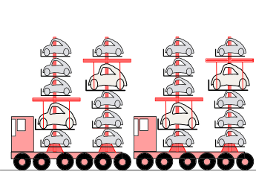
The thought it has most recently provoked is today’s invention: a mobile multistorey carpark.

elevautor

Trucks would be parked in urban locations, more or less permanently.

These have a number of vertical masts which can be folded down during transit. Each mast has a set of platforms which lock securely to it. It also has a hoist (like that used by traffic wardens, shown as a thicker horizontal bar).

When a car wants to park, it drives onto an empty platform which is left in the roadway (and which can be easily driven over by passing traffic).

This is quickly hoisted upwards and inwards (automatically, after the occupants have exited and texted the truck’s mobile number with their parking code) so that the platform and car are locked onto a mast.

On return to the truck later, the driver once again texts his code to have his car brought to the road (after a proximity detector tests that no cars are just about to drive past).

#2293: LightLane

More motor racing. I’m intrigued by this branch of engineering, partly because it exists solely due its use as a marketing tool.

If it didn’t sell a shedload of soft drinks or financial services, people would find themselves back racing their daily rides across muddy fields.

Zach_Luke_racecar

Today’s invention adds to the marketing circus.

Cars, especially in F1, already carry a number of cameras. They would now have to carry a high-powered projector.

A sensor in each vehicle would detect whether there was a car within one length behind it.

If there was none, the projector would display an image of their main sponsor’s logo -on the track surface (Logos have already been greatly simplified, for a variety of reasons).

As well as increasing the total advertisement real estate, this would give added incentive for tailing cars to try to catch others, to extinguish the projections of rival sponsors.

On wet days, the projection could be switched to forward-facing, out of the spray.

#2290: Raciators

Racing car design is faced with the problem of how to optimise the balances between eg drag, downforce and heat transfer.

F1 radiators in particular have to achieve enormous through-flow whilst also dealing with all sorts of refuse which finds its way onto the track. Pit crews extract huge amounts of litter, but that can only happen after many laps during which it will have greatly impaired engine efficiency.

radiators

The F1 rules on radiator design seem to be pretty non-specific. Today’s invention attempts to exploit that.

Radiator panels would be mounted on rotary seals, allowing them to be rotated during a race.

At locations where engine loading was decreasing, they could be flicked from forward-facing into inline configuration. This would shed a large proportion of the refuse and briefly reduce drag as well.

Waggling the radiators on the starting grid could be used to lower the engine temperature -especially at tropical grand-prix.

#2286: LapMap

Racing drivers already have a lot of information to cope with. Learning the many circuits adds to the burden, especially for neophytes to the business.

Today’s invention is an attempt to make the process of anticipation easier for rookie drivers.

lapmap

During testing on a particular circuit, some laps would be driven with the normal wheel replaced by a wheel-sized map of the track created as a 2D steel shape.

This would have a simple linear display inset into its front surface.

Lights would indicate the current position of the driver’s car, as well as the nearest few others -both behind and in front.

This would allow a driver as he turned the wheel to physically learn the circuit and anticipate which curves were coming up next more effectively.

It would also allow the occurrence of any accident to be indicated, thus improving track safety.

#2282: SpinWings

It seems that DARPA have identified a requirement to fly high-payload UAV missions from ships too small to accommodate normal takeoffs.

Today’s invention attempts to address that requirement (but without having to fill in their million pages of paperwork).

changewing

A cylindrical UAV fuselage has wings attached with variable pitch.

This machine is loaded into a mast (grey) which is then hoisted into a vertical position on the deck somewhere.

A cable around the cylinder is withdrawn, by a deck motor, very fast so that the entire drone spins out of the mast and into the sky. (Sensitive equipment would be located along the cylinder axis to minimise rotational acceleration effects).

At this point, one of the wings rotates about its axis into the same aerofoil configuration as the other and the red tailfins extend from the fuselage.

The internal jet engine fires up, the cylinder aligns itself horizontally, like a plane, and the system then does whatever democracy requires.

On return to the ship, the UAV reverts to helicopter mode and undertakes a remotely controlled descent into the conical mast collector.

#2281: PullPortal

People being able to push open doors is often just a bad idea. Collisions can occur if the door is solid and some doors are better left without any apertures (eg public lavatories).

Today’s invention is a door which can only be opened by pulling (irrespective of your direction of travel).

pulldoor

There are two parts to the image.

Each part is a plan view of the edge of a door and the direction controller mechanism.

In the lower part, the door is locked by the interference between the two prongs on the cylinder joining the handles and the two triangular blocks attached to the wall. The cylinder and prongs are sprung so as to naturally return to this position when the handle is released.

To open the door from the right hand side (upper diagram), rotate the handle clockwise so that the left prong points downwards and can then be pulled past the left triangular block (which is lower on the wall than the right block). This handle is attached to the cylinder via a ratchet which can only drive the cylinder when the handle turns clockwise.

Releasing the handle allows the cylinder to rotate back to its normal orientation. The door then moves back to its central position, driven by a normal door closer spring.

As it moves back, the left prong bypasses the right (upper) triangle and hits the left (lower) triangle, so that its face acts as a ramp and allows the left prong to slip over and into the equilibrium position.

Similar logic applies to opening the door from the left side.

#2280: Social Ties

Manufacturers are always attempting to engage buyers with their products via social networking.

Today’s invention deals with that issue in the style-conscious world of sneaker design.

sneakersignals

Sneakers would come with a box of flat, coloured tubes (like heat shrink material).

These would be slotted onto laces to form a colourful pattern (after being allocated a unique one from the manufacturer’s website).

People with their own pattern could then use their smartphone to image the ‘barcodes’ formed by the laces to get access to the online profiles of other wearers of this design.

This would allow people to make friends, get dates etc. Bad behaviour would be limited by the identifiability of all wearers of this design.

A six-lace, five-colour arrangement would allow about 240 million different codes.