#2276: PackAging

It’s one thing to put unhealthy products like cigarettes in ugly packaging, but today’s invention seeks to get the message across in a more personal way.

When someone buys a pack of cigarettes from a vending machine, a photograph would be taken of them, by the machine.

Davide_Guglielmo_cigarette

This would then be processed in realtime to simulate the aging effects of tobacco usage and the resulting image printed onto the package.

A more positive marketing message might be used on healthy products, except that the image there would show some automatic wrinkle removal, eye whitening etc.

#2270: PuppetPlane

I always liked to suspend my model planes from clear threads hanging from the ceiling.

Technology has moved forward a lot since I was a boy modelmaker, though.

Július_Fábián_glider

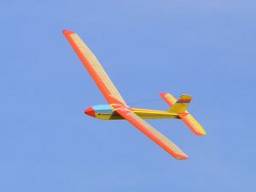
Today’s invention is a quadrocopter which can support a model aircraft (say 1/72nd scale) via a few fishing lines.

This can be programmed to skim the ceiling in a preset flight pattern, bringing to life such models in a way that no static stand or display case can…especially if the model has a motor-driven propeller.

A more advanced version would involve two such ‘copters whose aircraft would chase each other overhead.

#2269: Avalauncher

Skiers and mountaineers are often at the mercy of avalanches.

Today’s invention provides wthem with a NASA-specification escape technology.

savalanche

In the same way that space vehicles usually carry an escape rocket on the nose, people in the mountains could take poles each of which contain a small hybrid rocket motor.

In the moments that they sense an avalanche has begun, each user would plant one pole in the ground and stand on the disk at the base, holding the handgrip which houses the rocket start button.

The motor could be fired when an acoustic sensor detected the onrush of snow from above, but manual firing would probably be preferred.

This would lift the user say 10 metres into the air so that they could avoid the vast majority of the wall of snow and ice. They would land on softer material and be less likely to be submerged.

The rocket motor could then be used as both a lance with which to melt any surrounding snow and a signal when they emerged from the drifts.

#2265: SweepSeat

In office environments, people often end up eating at their desks…at least it’s usually whilst sitting down that I generate most crumbs, dust, pencil sharpenings etc.

Today’s invention offers a way to cut the costs of office cleaning by having the messy occupants do the work themselves (in an ambient way).

Dave_DiBiase_chair

I’ve noticed that office chairs on wheels get dragged all over the place from desk to desk when people are setting up impromptu meetings or staring over shoulders at screens.

This set me thinking that some of the castors on these chairs could operate in the way that old fashioned rotary carpet sweepers did.

As a chair moves about the carpet tiles or wooden floors it automatically picks up crud and stores it in a small receptacle on the top of each castor which can be periodically emptied into a waste bin.

#2264: FlowShow

Imagine travelling inside a ship or submarine. Many crew members spend a lot of time actually submerged.

Today’s invention attempts to give them a greater sense of their position and speed.

00040_harrier

A number of laser pointers would be set up in each compartment. Each would be capable of projecting onto the wall an arrow shape with varying orientation and length.

In this way, the external flow of air (or water) could be represented on the inside of the vessel as a (very crude) field of moving vectors.

This would probably reduce any tendency to motion sickness and help keep a crew more aware of their current operating status.

#2252: Subooster

Many navies are engaged in building a new generation of electrically powered ships. These have many advantages such as numerous, dispersed drive units.

Today’s invention is a new form of drive unit for large ships.

Subooster

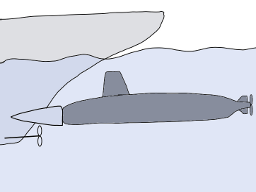
Such vessels, eg aircraft carriers, would be fitted with a special underwater docking mechanism to which a nuclear submarine (or two) could attach themselves.

This would happen only if the carrier needed to get somewhere at twice its normal speed, since it renders the submarine more vulnerable than normal.

Since these subs have enormous potential power outputs, they could add their propulsive force to that of a carrier, without a correspondingly large increase in combined drag.

#2249: Y-knot

Tangled earbud cords are a pain and I’ve suggested several remedies before.

Today’s invention is another. It takes the form of a very thin, Y-shaped balloon to which the cables would be bonded.

blowbuds

When you extract your tangled cables from your pocket, to greatly lessen the untangling problem, simply blow in the open end of the Y balloon and the internal pressure will fix everything except tight knots.

#2245: Streamstile

The dynamics of crowds always fascinate me. I’m particularly keen on smoothing people flows, as you might streamline or laminarise the movement of a fluid.

Today’s invention attempts to provide a solution to one of the main problems of ticket barriers.

barrierspeed

People walk up to existing barriers, stop, insert ticket, wait, receive ticket and plunge through the open gate.

If the barrier dislikes their ticket, the process is further complicated by the need for the person to collect it and reverse into the face of the oncoming masses.

Instead, imagine a barrier of the type shown. A person (dark blue) puts the edge of their ticket in an open slot (with the gate in the closed, turquoise position).

They must walk smoothly forwards as the machine reads their ticket, never letting it go.

Reaching the red location, the barrier decides to move the gate to the open (pink) position or to keep it closed.

In this event, the person still clutching their ticket is directed around a U-turn into a space between queueing passengers (rather than bumping into them). They can then seek assistance from an attendant in the usual way.

This eliminates all the stopping and reversals associated with normal barriers.

Although there would be fewer outlets, the increased speed of egress would more than compensate for this, and thus boost net flowrates of passengers.

#2243: SledHeads

Athletes in the various bobsled events go to enormous lengths to achieve greater speed.

Today’s invention is a new form of helmet attachment.

sledheads

The pilot would have a (yellow) biconcave spacer attached to his helmet.

Similar fitments would be applied to the pushers in eg a four-man bob.

The brakeman would have a tapering helmet attachment as shown (blue).

This would allow a crew to press their heads together during a run and thus greatly smooth their combined aerodynamic profile.

#2240: Canalamaran

The Panama canal has been a massive boon to world trade.

Ships are now becoming so large, however, that they are starting to exceed the Panamax standard (the size of the largest vessels which can pass through).

canalamaran

This limitation is caused mostly by the dimensions of the canal locks. Today’s invention is a way for huge vessels still to make use of this canal and others around the world (without enormously costly increases to canal dimensions).

Imagine a ship like the one on the left which has an enormous draft and is supported and stabilised by two large outriggers whilst at sea.

Just before it arrives at a canal lock, the outriggers engage with tractor units (orange), running on rollers, which can move along the two-metre wide concrete towpath on each side.

These can be hydraulically jacked up to take a sizeable fraction of the weight, so that the ship’s hull need not be fully accommodated by the depth of the canal, allowing it to carry its cargo between oceans.