#2236: FallSpring

Climbing rope has to be pretty springy stuff to be able to withstand the sudden loading caused when a mountaineer loses his/her footing.

Too elastic, though, and no-one will use it because of a perceived lack of security.

springknot

Today’s invention allows climbing rope to be less elastic (ie perceived as stronger) and yet also helps avoid jarring injuries to anyone who slips while climbing.

It consists of a simple, helical, spring-steel sleeve through which the rope is threaded.

This would remain above a climber (held by internal friction) so that in the event of a fall, the rope’s straightening would be resisted by the spring so as to to smooth out the shock loading, reducing injuries.
#2234: Keyscreen

Today’s invention is a new way to foil would-be pickpockets (see this for an illustration of how insecure your portable possessions actually are).

Many of the nefarious techniques employed to steal stuff involve distracting the owner, so that he or she fails to notice the theft.

safegrip

Now that we have ubiquitous touchscreens, why not use these to protect our valuables?

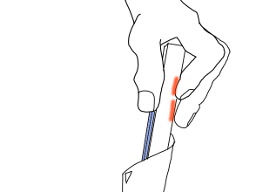
Imagine a smartphone with a slim case in which other items such a credit card and some notes could be carried on the back (blue).

The phone would require that it be held in a particular finger configuration (red) as it was being extracted by the owner from his pocket (one of say 100 such patterns).

If the device detected the acceleration associated with such extraction, whilst the screen was gripped in the wrong way, it would automatically ring and issue audible alerts.

It might also tweet and message your friends in order to alert any travelling companions.

#2230: Harnessteer

I get concerned by people squinting at mobile phones as they drive. The last time I was in San Francisco, the minibus driver who picked me up was using two mobiles, a walkie talkie, a GPS navigation device and a speed trap warning alert…pretty much simultaneously.

In order to lessen the cognitive load of people trying to travel using a GPS system, today’s invention is a new form of seatbelt.

Antonio_J_Sanchez_belt

Instead of having to look away from the road to see some tiny screen or listen to a hectoring electronic voice, the lapstrap would be driven leftwards in advance of a next-left turn, and vice versa.

This communication method would soon become second nature, so that the feeling of the strap’s motion would form an integral part of the motor memories of normal driving -without any decrease in safety (since it provides an important extra incentive to buckle in).

This approach might require a larger inertia reel of belt material, but the average journey would have equal amounts of left and right turning, leading to no large-scale imbalance between storage cannisters.

It might start to feel as if one knew where one was going, even on totally unfamiliar streets.

#2228: Spinnersteer

Today’s invention is a way to simplify the controls on model aircraft.

Rather than mimic the complexity of ailerons and other flaps, it would be possible to have a twin-engined model turn using only gyroscopic forces.

gyroturn

In the diagram, two counter-rotating propellors are shown.

To make the plane turn to starboard, a metal rod would be pushed outwards along the drive shaft from inside (gravity acts on the extended rod, creating a clockwise torque about an axis into the plane of the diagram).

The effect would be to make the engine rotate to the right. When the course had been changed, the rod would be withdrawn again.

Turns in the opposite direction would be achieved by extending a rod in the other propellor.

#2226: BracedRacer

Today’s invention is yet another bicycle frame.

It consists of a simple cross arrangement with pulleys at the extremities.

beltbike

A fibre-reinforced drive belt passes around the frame as shown (red) and its tension helps to reinforce the frame itself -which could be substantially shorter and lighter than a conventional layout.

#2224: FoosBoost

Foosball (table football) is far from the beautiful game.

Today’s invention aims to introduce a bit more skill and less brute force into all those tables located at cool web companies and their imitators.

foosball

Each team figure would have a hexagonal base so that the usual frantic lateral motion could be used to drive the ball forwards or backwards at a more controllable angle.

The figures would also have an internal channel formed from heel to chest.

This would allow the player to scoop a ball from behind and twist the handle to eject it from the chest or to carry it overhead in a kind of bicycle kick.

#2207: Festivalve

Apparently lots of eye injuries occur when people remove corks from champagne.

Today’s invention aims to limit this threat to festivities.

corkvent

Each cork would have a small number of vent holes drilled through it prior to insertion in a bottle.

As the cork is extracted, these holes would gradually release the internal pressure, greatly reducing that available to cause injury.

#2199: MagniBuyer

Many people who use supermarket trolleys suffer from poor eyesight.

At the same time, packaging is increasingly covered with information at high density…some of it small-print essential to the purchase decision.

magnifier

Today’s invention is a magnifying glass in the handle of a supermarket trolley (shown in pink). In fact the whole of the handle could be a cylindrical, perspex lens.

This would allow any package (orange) to be passed behind the handle so that minute text could be scrutinised effectively (via the red virtual image indicated).

#2185: CarCall

I’m fascinated by the use of lifts in big buildings. According to this article, people get impatient if they have to wait longer than 20 seconds.

I get impatient a lot faster than that.

Today’s invention is therefore an app which the user clicks on, probably whilst sitting at their desk, to specify that they want to go to floor X.

This is effectively a remote lift call which alerts the system to calls all over the building and does its best to schedule their arrival.

Since mobile devices can be allowed to detect where people are, one’s smartphone or tablet knows the time required to walk to a lift lobby.

With this information, the app can beep you when it’s time to start moving, so that you arrive just as the lift appears and step on.

Any waiting therefore happens somewhere you choose.

#2126: Autower

Car parking is often hard to find.

Today’s invention is to change car design to help alleviate this problem.

Cars would be made in a semicircular shape with a ‘bite’ taken out as shown.

The bite would have funicular type drive wheels embedded which would engage with a rack on the back of another vehicle.

This would allow cars to form a tower which could then bend over (under computer control) to pick up others in the same way.

The effect would be to greatly reduce the amount of parking space needed.

The cars could also be constructed so that they allowed movement from one to the other when a tower had formed. In this way, instant, flexible office space could be made from commuter transport.