#2344: ScissorShields

I was shocked to hear, from some primary school teachers, that about 70% of 10-year olds can’t use scissors; having been denied access to them for ‘safety reasons’.

Today’s invention aims to fix that silliness.

scissorshields

The scissor blades each have a sheath fitted which is free to slide along the blade (and with an internal spring so that the sheaths want to shoot off the blades).

A wire loop joins the sheaths, via a pair of pegs on the handles.

When the scissors are open, the sheaths move close to the handles, leaving only a very small length of blade exposed for cutting.

As the cutting progresses, the handles move closer to each other and more of the blades are unshielded.

This allows scissors to be used by the inexperienced but prevents even a child’s finger from making contact with any significant length of bare blade.
#2341: Bombrella

When nation A’s crazy leaders decide to carpet bomb the people of nation B, today’s invention is a defensive use of unmanned aerial vehicles.

Nation B would have squadrons of small robot aircraft, perhaps launched from a patrolling cargo plane when an air raid was threatened.

Bombrella

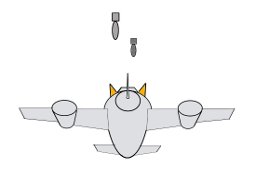
Since dumb bombs fall quite predictably in clumps and strings within the atmosphere, the UAVs would be able to locate them descending from altitude, fly underneath, at zero relative speed and catch the bombs before they could hit their targets in B-land.

The drones would automatically fly their dangerous cargo somewhere else (perhaps back to A’s territory) before inverting and dropping them to detonate safely.

Although some targets would still be hit, the effectiveness of such bombing, always questionable, would be further reduced.

#2339: BulletBrake

Since it seems gun control is hard to legislate for in some countries, today’s invention is a way to allow people to own guns for home defence which have severely limited range.

A conventional semi-automatic has a number of extra ports created in its slide. Its barrel too would have perforations around its circumference, corresponding to these ports.

recoil

When the trigger is pulled, the gunpowder ignites and the slide moves backwards as normal. Much of the energy in the cartridge is however lost as the ignited gas vents through the barrel and ports.

This greatly reduces the muzzle velocity, allowing a homeowner still to apply lethal force but with greatly reduced danger to bystanders from stray, long range shots and ricochets.

The ports and vents could be positioned circumferentially and sized so as to react accurately against the up-kick and torque which firing such a weapon generates.

The effect would therefore be to improve accuracy significantly at close range.

#2334: FanLander

Flying fixed-wing aircraft from ships is fraught with difficulties.

The pressure is on to create aircraft carriers which do not require a huge runway (since it makes them costly and vulnerable).

fanlander

VTOL aircraft are hyper expensive (especially if you’ve decided to ditch, rather than upgrade, the superb Harrier), so how to equip one’s comparatively bog-standard fast jets with seagoing abilities?

Today’s invention is a new concept in aircraft carrier.

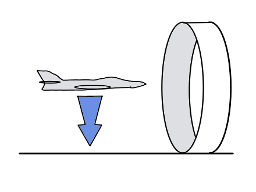
This is based on having a small ship, packed with planes and with several enormous Dyson-esque ring fans on deck.

These would be capable of creating such an airflow that an aircraft placed in front would rise vertically and fly through the hoop to take off.

To land, approach the hoop with a high airspeed but zero deckspeed and, by reducing the fan airflow, touch down gently.

#2331: Portiles

Imagine if you could make, say, the hull of a spacecraft or an architectural design or a rocket motor with ports or doors which could be easily repositioned in its surface.

Today’s invention is to adapt the children’s 15-tile puzzle to allow this.

tilecraft

A cylindrical skin would be made using curved tiles.

These would be free to slide axially or circumferentially, one at a time.

This would cause the open port(s) to change position.

When its new location had been arrived at, a window, an exhaust nozzle, an open frame or a hinged hatch could be inserted in a given aperture to ensure that the pattern was maintained until the next reconfiguration was needed.

#2327: StreetSeen

I designed this advertisement for the HTC One competition recently.

In so doing, I thought up today’s invention.

blinkfeed

Given the effort involved in all of that pasting up adverts on hoardings, why not instead project the ads, using existing streetlights?

Advertisers could pay for each light in front of a hoarding to be equipped with a computer-controlled mini projector, powered from the light’s own electricity supply.

This would allow each hoarding to show a variety of different ads at different times, eg school run or afternoon drive-time. These projected ads could be films.

The films could even be made silent, but with a soundtrack that people could hear via the radio as they drove or walked by.

#2326: Swarmeteor

It seems that penguins in a huddle move around so that each one has to face the Antarctic wind for only a fraction of the time.

We now have cubesats theoretically capable of exhibiting such swarm-like behaviour in space.

swarmeteor

Today’s invention is a way for a large number of such small satellites to safely re-enter the Earth’s atmosphere, together, rather than burning up individually.

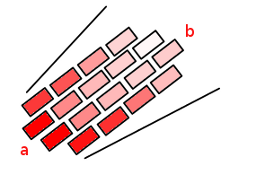
These mini spaceships would fly in close formation so that those at the front would be friction-heated by the atmosphere.

They would then fire retro rockets differentially and thus flow from front to back of the swarm, being continuously replaced at the front (a) by cooler ones from the rear (b).

Those devices with the most precious samples or data could be allowed more time at the back or even inside the swarm, in order to minimise the thermal damage to them.

These systems could then be recovered and reused.

#2320: Incognauto

If you have a valuable vehicle, parking it on the street is a risk that you may wish to reduce.

Today’s invention might help with that.

incognauto

It takes the form of a car cover…shaped to look like a larger and much less desirable vehicle than your own.

A driver could enter his or her car design onto a website and be offered a number of different unstealable car profiles guaranteed to fit over the vehicle of value.

The car cover would be inflatable using a remote controlled tyre compressor. This would grip the inner car tightly, retain the correct shape and also keep any unauthorised access to a minimum.

#2315: DuoNote

I like postit notes very much but I’m sometimes in need of a way to make an exact copy of the contents of one note.

In the old days, a piece of carbon paper might have sufficed, but it’s pretty messy stuff and the resulting copy quality can be poor.

copypen

Today’s invention offers an alternative.

A (ferrous-nibbed) pen is equipped with a thin magnetic disc.

As the pen writes on the top note, so this disc is moved on top of the next one.

A small roller ball (attached to the underside of the disc and impregnated with ink) follows the pen nib and creates a duplicate image on the second note.

#2306: Symmetrotor

If a helicopter sustains damage to its rotor blades, then it is normally time to attempt some kind of forced landing.

Today’s invention offers an alternative.

SONY DSC

If your chopper starts with blades at 90 degrees apart and one is eg partly shot away, then the damaged one would be jettisoned and the remaining blades would automatically reconfigure so as to space themselves out circumferentially at 120 degree intervals.

If an original five blades were suddenly reduced to two (at 180 degrees), there would probably also have to be some increase in engine speed, so that, in the worst case, a gentle landing could be effected.

In this way, your blades need only be controlled by a very simple swarming algorithm that says “maintain equal distance from your two neighbours.”

A similar approach might work for windfarms, since their blades are always breaking off.