#2264: FlowShow

Imagine travelling inside a ship or submarine. Many crew members spend a lot of time actually submerged.

Today’s invention attempts to give them a greater sense of their position and speed.

00040_harrier

A number of laser pointers would be set up in each compartment. Each would be capable of projecting onto the wall an arrow shape with varying orientation and length.

In this way, the external flow of air (or water) could be represented on the inside of the vessel as a (very crude) field of moving vectors.

This would probably reduce any tendency to motion sickness and help keep a crew more aware of their current operating status.

#2263: Stressearch

When I’m trying to recall a name or fill in a crossword clue, I often find myself knowing the correct stress pattern without being able to remember the exact word(s).

For example, I spent a week last year trying to recall the name of the actor who played ‘The Joker’ most recently. His name was ‘blah blah-blah’, with his first name beginning with H…maybe.

marcin_krawczyk_invention

Today’s invention is a dictionary plug-in which helps with this kind of tip of the tongue memory recall.

Since online dictionaries usually contain both phoneme and stress pattern information (eg ‘Definition’ ?def-?-?nish-?n ), a user would be able to narrow his search for a word or phrase by specifying the pattern of stresses in such a nebulous memory trace eg blah-blah, blah-blah-blah.

This would be particularly useful to poets who often search for a particular sound pattern with an appropriate meaning, I’m told. It would also have helped when I was trying recently to remember the names of the early North American explorers, blah-blah and Clark.

I find it interesting that we seem to store such a rhythmic representation, but that the link to the specific sounds is harder to make.

#2262: Twintank

I’ve tried many times to suggest solutions to the problem of damaged tracks on armoured vehicles.

Today’s invention is another approach to this issue.

twintank

The tank consists of twin hulls supported on three tracks and joined by tunnels (top diagram). Each hull would have its own motor unit and some independent weapons.

In the event that the central track is destroyed, the vehicle can continue to progress, albeit with reduced manoeuvrability.

If one of the side tracks gets broken, the crew on that side escape through one of the tunnels into the other hull, seal the hatches and jettison the entire damaged hull half before driving on (bottom diagram).

With tunnels set in the front and rear (rather than top and bottom) multiple vehicles could be joined in other configurations, such as one resembling a brick wall when viewed from above.

This would allow an entire division to travel across country as a kind of armoured mat (with personnel and other resources able to move around inside whilst in transit).

#2261: Poutrageous

Today’s invention is a double-ended lipstick.

Each end would have a different shade, so that wearers could experiment with various combinations of colour on the top and bottom lips.

Jenny_Rollo_lips

Not only would this be visually striking, but for a more subtle effect, you could wear a lighter version of the lower-lip colour on the upper lip (to compensate for the natural shading there).

#2260: Wastepanes

Public spaces contain fewer rubbish bins than ever before (partly because of the perceived need to deny terrorists receptacles in which to hide bombs).

This has led to a phenomenon called Litterplugs, in which people without access to bins find a convenient crevice and shove their litter there.

trashslice

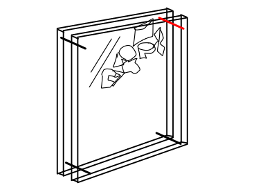
Today’s invention exploits this tendency by providing locations into which people can cram their refuse legitimately. They would shove eg crisp packets, crushed drinks cans, etc into the top of a gap between two plexiglass screens mounted on a wall.

This would allow inspection of the contents and when full, could be easily cleaned out by allowing one sheet to rotate about one corner fixing (red), dumping the contents into a larger, mobile waste bin.

#2259: Globeglass

It’s cool that Google have mapped the night sky.

This set me thinking that it might be really nice to create a cellphone app which allows the user to point his mobile device at the ground and see a simulation of whatever part of the world is beneath him (In the same way that fighter pilots can see through the floor of their planes, when wearing the latest helmets).

Evan_Earwicker_paperweight

Scanning this backwards and forwards would show a number of spatially-arrayed labels, located on the outer, transparent surface of a simulated sphere (The onboard cellphone gyro could be used to calculate the required angles).

The labels could be set to show famous landmarks or the hometowns of emigrant relatives etc.

#2258: TapTat

I fell off my motorcucle once, mercifully at low speed, and developed a bruise on my hip that strongly resembled the stars and stripes.

Today’s invention is a temporary alternative to the tattoo.

closeup-of-a-bruise-thumb7442533 www.freeimages.co.uk

A small template in the desired shape would be snapped against the skin, probably using a spring mechanism something like a mousetrap. This would create a bruise and with no more pain than the conventional process induces.

It should also be possible to vary the local colour in such a bruise by applying a sequence of differently sprung templates to different parts of the body area involved.

Although this would not give the high definition of a conventional tattoo, this approach has the advantage that, when the love of your life changes, you need not be burdened by his/her initials forever.

#2257: Serialabel

I’m told that ‘bingewatching’ of eg an entire TV series over a single weekend is a growing social phenomenon.

For those of us who are slightly less media obsessive, viewing an episode every now and then, via the now ancient DVD technology, can be deeply frustrating.

episodes

Consider, for example, the infamous boxed set. Although most players will have a ‘last time played’ memory function, this isn’t much help if you can’t remember which disc you are on.

Today’s invention is a simple labelling for discs which allows anyone to record where they stopped last time.

Discs would have episode numbers printed on them in the form of a clock face. When you put the disc away, simply leave it rotated to the ‘last episode watched’ marker, inscribed on the case.

If you live in a household with several independent viewers, one way to avoid who-watched-what-last? warfare would be to have cases come with a number of thin, disc-shaped sheets. These could be made in different diameters, centred on the hub, so that several people could record their separate histories (which might require a notch in the disc itself to ensure that it was always replaced at the same rotational position, relative to the box).

(Who am I kidding? I really want a boxed set which loads directly into a reader, box and all, and which gives no acccess to any of the disks, so that they can’t be lost, scratched etc.)

#2256: VaneTail

Even small helicopters are fiendishly complex, which makes them to expensive to buy and maintain.

Today’s invention is one way to simplify light helicopters.

fantail

When you open the throttle on the engine it exerts a torque on the main rotor and, with any luck, you gain altitude.

The downside is that the airframe has a reactive torque act on it, so that it will tend to try to spin about the main rotor axis in the opposite direction. To counteract this and allow engine acceleration in forwards flight, helicopters are fitted with a tail rotor.

Such a system is heavy and complicated. Imagine, by contrast today’s invention.

It is modeled on an old-fashioned lady’s fan. This would be made of aerospace quality mylar and held between two thin plates, hinged so as to naturally spring apart.

This assembly would be inserted into a light, box-section rear spar, as shown.

During engine acceleration, the fan would be partly ejected from the spar(eg by a push-rod). It would spring open and limit rotation of the airframe by introducing an appropriate level of rotational drag (without introducing any extra drag in the forwards direction).

Coordination of the inwards and outwards movement of the fan with throttle use would also facilitate changes of direction.

An even simpler version would use the rotational flick of the airframe, on throttle opening, to slide the fan outwards automatically, in the manner of the original steam governor.

#2255: ShiftShed

I heard a while ago about a scheme in which US schoolkids pay a small amount each day to leave their mobile phones in a truck outside school.

Today’s invention applies this logic to bicycles, in an attempt to limit the profusion of ugly bikesheds/stands and eliminate theft.

biketruck

As illustrated in plan-view, a large-capacity electric wagon would park each day between a couple of walls with a bike-sized slot.

The slot would have a keypad which would shuttle the vehicle backwards and forwards automatically to allow a user to deposit his machine -through the open vehicle side (orange). This would display a code necessary to later retrieve one’s bicycle.

Each wagon would have return times listed on its side, so that a bike owner would be aware of when collection could occur.

The wagons could then be parked against a wall or against each other on some nearby, low-value site, until their return journey.

This would also allow bike owners to avoid using personal bike locks.