#2244: TailTurner

I was inspired today by this little robot’s ability to change direction very rapidly.

This works by conservation of angular momentum of the whole system (car+tail). As the tail whips around in one direction, the body spins in the opposite direction to meet it.

scissorcar

Having low friction feet means that the robot can make these turns with very small frictional losses.

All this set me thinking about today’s invention: a car with a tail.

Such a vehicle would carry some mass at the end of a hinged cantilever tail (this might be where the fuel was stored).

The hinge would be powered by a fast-response electric motor.

Using four fat conventional tyres would result in significant damage to them on every tight turn, so it might be necesssary to equip the vehicle with more, computer-steerable wheels (including perhaps under the tail itself).

The accelerations induced would still of course need to be less than would cause damage to the occupants, but in principle such a vehicle could make very rapid changes of direction (perhaps useful for a military vehicle attempting to evade incoming missiles).

This form of transport could be made more comfortable by having seats which rotated in coordination with changes in direction, but more gradually, keeping the occupants’ backs against the seatbacks.

#2243: SledHeads

Athletes in the various bobsled events go to enormous lengths to achieve greater speed.

Today’s invention is a new form of helmet attachment.

sledheads

The pilot would have a (yellow) biconcave spacer attached to his helmet.

Similar fitments would be applied to the pushers in eg a four-man bob.

The brakeman would have a tapering helmet attachment as shown (blue).

This would allow a crew to press their heads together during a run and thus greatly smooth their combined aerodynamic profile.

#2242: SparClean

My parents told me stories of people in the Middle East doing their laundry in rivers by bashing their soaped clothes against flat rocks.

Perhaps they still do this dhobi work, since apparently it’s a cheap and very effective way to get even grimy shirts immaculate.

Jean_Scheijen_gloves

Today’s invention is related to dhobi laundry and was inspired by this punchbag used as a dirty clothes basket.

Imagine a heavy punchbag into which you put your laundry items and a squirt of detergent.

A hose is used to pour warm water in at the top and effluent runs into a drain or water butt on the ground below.

The user would punch the loaded bag, which would be a significant training exercise.

This would force water through the fabric, cleaning it effectively and with less electricity being used.

#2241: Locompass

A Yale lock works by having a key drive pins radially outwards until they no longer stop an inner core (orange) from rotating inside its housing (yellow).

This design can be compromised by anyone with a wire (insert wire, drive one pin upwards out of the way, put circumferential pressure on the barrel to keep it there -and repeat until all pins are raised).

locompass

Today’s invention makes picking such a lock significantly harder.

Instead of one set of pins there would be say eight sets arrayed circumferentially.

The required key would be star-shaped in section and could not easily be substituted for by any collection of wires or skeleton keys, due to the limited space and level of dexterity required.

The key would carry a red dot at the 12 o’clock position, to enable correct insertion into the lock.

#2240: Canalamaran

The Panama canal has been a massive boon to world trade.

Ships are now becoming so large, however, that they are starting to exceed the Panamax standard (the size of the largest vessels which can pass through).

canalamaran

This limitation is caused mostly by the dimensions of the canal locks. Today’s invention is a way for huge vessels still to make use of this canal and others around the world (without enormously costly increases to canal dimensions).

Imagine a ship like the one on the left which has an enormous draft and is supported and stabilised by two large outriggers whilst at sea.

Just before it arrives at a canal lock, the outriggers engage with tractor units (orange), running on rollers, which can move along the two-metre wide concrete towpath on each side.

These can be hydraulically jacked up to take a sizeable fraction of the weight, so that the ship’s hull need not be fully accommodated by the depth of the canal, allowing it to carry its cargo between oceans.

#2239: SkyStrings

Today’s invention is a massive musical instrument, based on a construction crane.

This would have several cables suspended from trolleys on the main boom.

harp

The cables would have different weights attached, each of which would also incorporate a loudspeaker chamber (red, yellow and blue).

Using a computer to control trolley movements, these could be made to bump into each other, creating some loud chords across the building site.

It would be a challenge to write some popular music for such an instrument.

Failing which, this might be used, when not actually building, as a modern equivalent of a clock tower’s bells, striking the hour.

#2238: BlastBrush

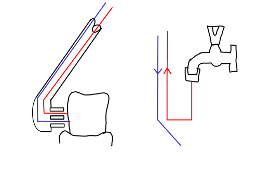
Today’s invention is a toothbrush which fires water (red) at one’s teeth whilst brushing, but which also then sucks the debris (blue) out of the mouth and down the sink.

The suction would operate just as the tube they force into your mouth at the dentist’s does -except that this would be much less invasive and uncomfortable.

BlastBrush

The supply pressure at the tap would be used to drive water through a nozzle in the brush head, greatly accelerating the flow.

The dirty water extraction could be powered by the normal vibration motor in the handle, which would also drive a small peristaltic pump.

#2237: Remotoroll

I was caught in deep snow, on a hill, this evening. My 2-wheel drive vehicle went so far up and no further. I wanted to push it to the kerb but was scared that any momentum would cause it to career backwards into various parked cars/ lamposts/ trees.

Today’s invention is an attempt to help people push their vehicles with more control than can be achieved when standing with the driver’s door open, ankle deep in flakes.

Emanuela_snow

It takes the form of a remote control for the vehicle’s brakes.

Ideally this would operate the main brakes in a gradual way (rather than the binary states offered by the handbrake).

This could be incorporated into one’s key fob and activated only when the engine was off.

As you rock the car back and forth to nudge it backwards, the brakes could be eased off and on from outside, allowing the car to make small, controllable progress.

This system might also come with a adjustable lock for the steering which could be set before moving the car a little and then reset, iterating slowly towards a target position.

#2236: FallSpring

Climbing rope has to be pretty springy stuff to be able to withstand the sudden loading caused when a mountaineer loses his/her footing.

Too elastic, though, and no-one will use it because of a perceived lack of security.

springknot

Today’s invention allows climbing rope to be less elastic (ie perceived as stronger) and yet also helps avoid jarring injuries to anyone who slips while climbing.

It consists of a simple, helical, spring-steel sleeve through which the rope is threaded.

This would remain above a climber (held by internal friction) so that in the event of a fall, the rope’s straightening would be resisted by the spring so as to to smooth out the shock loading, reducing injuries.

#2235: Symmetricharge

Ball bearings have always fascinated me, since manufacturing them still has an element of artistry about it. Roll a large number of them about long enough between parallel grinding plates and they come out statistically spherical and smooth within controllable tolerances.

If however you want to know how far from perfect a given ball is (perhaps for a very high performance application), today’s invention may help.

Jakub_Sobecki_balls

When a perfect conducting sphere is subject to a very high voltage it will, theoretically, distribute charge uniformly across its surface. Regions with locally sharper radius will concentrate charge.

Imagine a machine, therefore, in which each candidate sphere is charged up on a non-conducting plate in a dry-air enclosure, using a very high-voltage source.

Approach the sphere with a micrometer-driven conducting wand. Record the proximity at which discharge by air breakdown occurs. Sharper regions will discharge at greater distances from the wand.

This can be repeated for a large number of different rotational positions to ensure that each ball is spherical to within ultra-fine limits.

(The wand might contain a tiny reservoir of ink, so that the sharpest point on each ball might be highlighted by attracting a dot of oppositely-charged pigment).