#2234: Keyscreen

Today’s invention is a new way to foil would-be pickpockets (see this for an illustration of how insecure your portable possessions actually are).

Many of the nefarious techniques employed to steal stuff involve distracting the owner, so that he or she fails to notice the theft.
safegrip

Now that we have ubiquitous touchscreens, why not use these to protect our valuables?

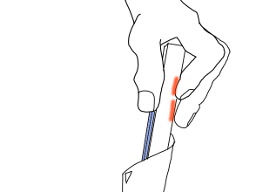
Imagine a smartphone with a slim case in which other items such a credit card and some notes could be carried on the back (blue).

The phone would require that it be held in a particular finger configuration (red) as it was being extracted by the owner from his pocket (one of say 100 such patterns).

If the device detected the acceleration associated with such extraction, whilst the screen was gripped in the wrong way, it would automatically ring and issue audible alerts.

It might also tweet and message your friends in order to alert any travelling companions.

#2233: RollingToll

There is some evidence that setting up priority lanes was one measure that seemed to smooth traffic flow during the London Olympics. People didn’t like it, but it appeared to work.

Now think about motorways. Traffic jams are often created because drivers believe that they gain some advantage by swapping lanes.

Ivan_Prole_line

In so doing, however, they may have a disruptive effect on the flow -a kind of vehicle turbulence occurs which causes extra braking waves.

Today’s invention is a new form of onboard tolling device. This would detect when a vehicle changed to an outer lane (by eg a combination of steering and the vibration of driving over cats’-eyes) and record what the effect on its speed was following each change.

If a lane change was followed by a decrease in speed over the next time period (or sudden braking) it would be classified as impatience or a failure to anticipate and the driver could be automatically charged eg a few extra pence.

This would inhibit drivers from constantly seeking some short-term speed advantage and make rush hour less frenetic.

#2232: TreeWheeler

In a conventional spoked wheel, most of the stress is concentrated where spokes meet rim.

One solution is to beef-up the outer ends of the spokes, but this boosts the moment of inertia enormously, overcoming any benefit from the use of lightweight alloy, for example.

KCayleyTrees

Today’s invention is therefore to manufacture wheels which have a strong but lightweight, triangular mesh of spokes near the outer edge.

The form that these wheels might take is indicated above and is based on a Wolfram Demonstrations Project.

This kind of fractal-based design allows for a more effective distribution of stress and might be made relatively easily by additive manufacture using a 3D sintering machine (if they can do gearwheels then roadwheels should also be feasible).

#2231: Aeroofoil

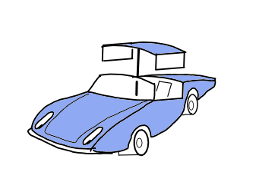
As an alternative to the gullwing-type doors beloved of supercar fans, today’s invention is a single roof panel, raised by a central hydraulic ram.

The ram would have an aerodynamic profile so that the roof could be lifted even at speed for some convertible motoring.

rooflift

One advantage of this approach is that the opening of the vehicle can be done in a narrow parking space, without endangering anyone’s paintwork.

Secondly, the roof panel might have its angle of attack altered when open to act as an extra spoiler and generate drag-reducing turbulence or, in the case of true hooning behaviour, to provide extra downforce, when cornering.

Finally, once again the roof panel could be automatically triggered to limit the likelihood of a rollover accident.

#2230: Harnessteer

I get concerned by people squinting at mobile phones as they drive. The last time I was in San Francisco, the minibus driver who picked me up was using two mobiles, a walkie talkie, a GPS navigation device and a speed trap warning alert…pretty much simultaneously.

In order to lessen the cognitive load of people trying to travel using a GPS system, today’s invention is a new form of seatbelt.

Antonio_J_Sanchez_belt

Instead of having to look away from the road to see some tiny screen or listen to a hectoring electronic voice, the lapstrap would be driven leftwards in advance of a next-left turn, and vice versa.

This communication method would soon become second nature, so that the feeling of the strap’s motion would form an integral part of the motor memories of normal driving -without any decrease in safety (since it provides an important extra incentive to buckle in).

This approach might require a larger inertia reel of belt material, but the average journey would have equal amounts of left and right turning, leading to no large-scale imbalance between storage cannisters.

It might start to feel as if one knew where one was going, even on totally unfamiliar streets.

#2229: HideRide

What can one possibly say about Nesta? They really aren’t very effective.

This is exemplified by their well-meaning but ineptly handled competition Hands Off My Bike which aims to decrease bicycle theft. Today’s invention is the contribution I’d have made towards this worthy objective -if I could have ever regained access to my draft entry.

HideRide

Parking lots are choked by enormous 4 wheel drive vehicles with huge ground clearance. Owners wanting to make some money could sign up to a scheme whereby they could register their planned parking time and location.

A cyclist in a carpark could determine if a given vehicle was in the scheme and if so, use the 4*4 as a horizontal, secure bike shed.

Imagine a cylindrical metal cake tin with closed ends. This would be clamped to one’s bike as shown. The upper end of the tin would have a circular aperture, through which a tough rubber bladder could protrude a little. This would be inflated by a small air pump in the tin, activated by a phonecall.

To park your bike, you would text the licence number to a central site and pay a little cash. Then you would turn the handlebars and lay the bike on the closed end of the tin. Push the bike under the vehicle and inflate the bladder.

This makes the bike and even the bike wheels potentially inaccessible -and largely invisible. Certainly there would be no way to bounce the vehicle hard enough to release the bike or to puncture the bladder, wedged in a recess beneath the floorpan.

#2228: Spinnersteer

Today’s invention is a way to simplify the controls on model aircraft.

Rather than mimic the complexity of ailerons and other flaps, it would be possible to have a twin-engined model turn using only gyroscopic forces.

gyroturn

In the diagram, two counter-rotating propellors are shown.

To make the plane turn to starboard, a metal rod would be pushed outwards along the drive shaft from inside (gravity acts on the extended rod, creating a clockwise torque about an axis into the plane of the diagram).

The effect would be to make the engine rotate to the right. When the course had been changed, the rod would be withdrawn again.

Turns in the opposite direction would be achieved by extending a rod in the other propellor.

#2227: PhysiogNamy

Names and faces always get me confused. My problem is that I automatically assign each face a name I think is appropriate…even if that isn’t the individual’s actual name.

This becomes particularly difficult when trying to follow a story.

Andrea_Brancaccio_helmets

Game of Thrones is an example of a “sprawling ensemble cast“. Each episode contains a new stream of characters with names that are complex and don’t map onto faces very easily, at least for me.

It’s particularly bad when characters refer to others who aren’t present.

Today’s invention is therefore a bonus feature built in to DVDs (or which could be driven by a smartphone app).

Every time a name is used in dialogue, a small portrait of that character would flash up in say the bottom right hand corner of the screen. Ideally, I’d like this to be a zoomed window onto a family tree so that the relationships between people could be made clearer.

Those that don’t have my mental difficulties could have this feature switched off, of course.

I just noticed that the DVD packaging contains a number of family trees but no portraits -there is a real opportunity to add on-screen value here.

#2226: BracedRacer

Today’s invention is yet another bicycle frame.

It consists of a simple cross arrangement with pulleys at the extremities.

beltbike

A fibre-reinforced drive belt passes around the frame as shown (red) and its tension helps to reinforce the frame itself -which could be substantially shorter and lighter than a conventional layout.

#2225: Furrowflight

I’m ploughing my way through Walter Lewin’s 8.01 Physics course online. He recently covered orbital mechanics, on which today’s invention is based.

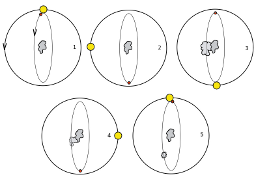
It’s a way to sample the surface of an asteroid without having to create and deploy a costly lander.

spacesampler

A body in space with no atmosphere, such as an asteroid, would allow a small spacecraft (yellow) to enter into orbit around it (1->2->3->4->5).

From this would be ejected backwards a tiny (red) satellite (eg a cubesat).

This could be given an intial speed just great enough to allow it to return to the mothership, without significant additional fuel cost or active control, following the kind of orbit shown.

As the cubesat passed close to the asteroid’s surface, it would drop a small mass which would create a plume of dust through which the craft could fly on a second orbit before returning to the main satellite.

I’m tempted to suggest that repeated applications of this technique could be used to erode and thus deflect a dangerous, earthbound rock.