#1040: Lottoslot

For someone who regards secrets as, in general, not healthy, I seem to spend a lot of time thinking about shredders.

Today’s invention is intended to add an extra measure of security to paper shredding by making the required orientation of the paper on insertion, non-obvious.

shred

Thus, rather than just entering beautifully-aligned A4 sheets (which are measurably easier to reconstruct) this gives an added element of angular randomness to the direction of cut each time.

#1039: MetricMedic

Using biometrics for access to computers is now common and works, sort of, for many low-security applications.

Today’s invention is to equip a computer mouse with a clear window in the upper curved surface where one’s hand normally rests. A small, high resolution camera shoots through the hole, together with an outgoing beam of light.

Chris_Chidsey_eye

To start the machine, hold the specially curved surface of the mouse against one’s eye orbit. The light and camera are activated, taking pictures of both iris and retina.

These are automatically fed to the computer which confirms one’s identity to a very high level of precision.

The images are also stored so that, over time, these can be examined (perhaps automatically) for any telltale signs of incipient illness.

#1038: CarRack

Today’s invention is an electric car sharing scheme. In the early morning, cars are driven to multiple locations around town on the back of a transporter and dropped off in modules like the one shown.

This allows hugely increased packing density, since each vehicle has its front wheels rolled up on a track using a small hand-cranked winch (once roof is stowed and doors closed).

cars

Customers arrive, insert their credit card and driver’s licenses into a slot in the module. This allows removal of one car from the front, leaving the rest locked together like shopping trolleys. The card number is retained until the vehicle is returned to any one of the (networked) modules.

Cars added to the back of the queue have time to be recharged (and may even have the facility to swap in a new battery) whilst waiting.

#1037: Cargoflow

There is a pattern of ocean currents which is largely stable over very long time periods.

Although the speed of these currents at depth is slow (only around 1m/s) it is predictable.

mirko_delcaldo_fish

Today’s invention is a flotilla of linked, submarine-like containers designed to transport goods around the globe using only these deep currents as a power source.

These could be made fairly cheaply of reinforced concrete and capable of carrying a large volume of commodities such as fuel or foodstuffs. The speed of transport would be slow and might give rise to futures-like trading in the value of materials in transit for eg 60 days between continents. Huge sections of these journeys would be effectively naturally refrigerated.

It might be possible to reuse some of the world’s surplus military subs for this purpose, or at least to head each flotilla with one so that its navigation systems could be used to direct the goods to the correct destination(s).

#1036: Noncontacts

If you wear contact lenses which don’t get discarded every night, you probably carry a small case around, just in case they need to be stored temporarily.

If your eyes have become dry or sore, it’s a real pain to have to cart about spectacles to change into as well.

pince-nez

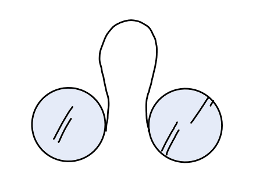
Today’s invention is a contact lens case the containers of which are held together by a springy band. Each container has a clear base which is actually a screw-in lens, matching your prescription.

If you need to remove your contacts at any time, pop them in the cases with some fluid at the bottom, reseal and then apply the pince-nez case to one’s nose for more relaxed vision.

#1035: MeScope

Today’s invention is a microscope without any of those confusing and time-consuming focus knobs.

Instead, a fingerprint swipe device identifies the user (take the rubber gloves off first) and then sets the focus of the system accurately for the current level of magnification -based on one’s personal spectacle prescription (if any).

Marcelo_Terraza_microscope

It might also alter the colour and intensity of illumination, based on pre-stated preferences -particularly useful for shared microscopes in busy labs.

#1034: CeleBrands

I was standing behind Clive James in a supermarket food queue once and, rather than engage him in discourse on Piero della Francesca, I merely scrutinised his basket. I was surprised to find him buying sausage rolls with tomato.

It made me seriously think about how I could live a small part of his life for a mere £2.49 (plus loyalty points). Today’s invention is a website which can be used by celebrities to publicise what they consume (whether food or books or whatever).

Brian_Nunnery_celebrity

They upload their receipts (in return for extra discount and publicity). The rest of us get some kind of vicarious post-twitter contact with the media pantheon -and their shopping.

#1033: BeatBots

I tend to think that hunt sabotage has more to do with fighting the class war than saving creatures from suffering.

Today’s invention is weapon on behalf of the ‘game’ animals and the human beaters who find themselves economically dependent on this form of feudalism.

Lorenzo_González_partridge

It is a swarm of small robots which can be used to pre-beat an area of moorlands so that hiding grouse or pheasant are driven away before the chinless hoorays range rover onto the scene.

These would be capable of maintaining a coordinated line across the terrain, moving quietly beneath the foliage so as to remain concealed. The failure or destruction of one would be automatically adjusted to by the others and they could be programmed to rendez-vous later in the back of a waiting truck (using eg GPS units built into each).

Most significantly, no human beaters would find themselves walking towards a line of shotguns held by merchant bankers.

#1032: SpaceShop

As ever, when I hear of some problem, I’m usually thinking of a way to turn it to advantage.

There is now so much junk up there in space that the shuttle is having to jink out of the way occasionally to avoid the odd bag of tools or gas oven that they jettisoned on a previous orbit. Even colliding with a fleck of paint, at the kinds of relative velocity available in orbit, can cause toughened glass to perforate.

Andy_Barrass_machining

Today’s invention is to make use of this space junk. When building giant machines in orbit, as I believe is planned for eg forthcoming space stations, it would surely be useful to have a serious drilling facility. Instead of injecting a huge machine into space, align the workpiece in the back of a shuttle or equivalent and steer towards a piece of junk of the right size and velocity.

Presto, guaranteed holes in whatever you want. This technique might also be used to erode the surface of workpieces, providing a form of milling machine.

There would need to be a ‘swarf shield’ following this workshop, to catch the resulting debris, but at least much of its kinetic energy would have been dissipated as heat in the machining process. This heat might also be used to form materials in eg casting and forging processes.

#1031: SkiSlots

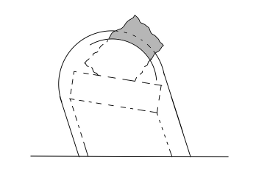
I’m slightly surprised to see giant 4x4s driving around with ski racks on the roof.

A much less ugly approach, given their massive ground clearance, is to mount a shallow, tough box on the underside of the vehicle. Today’s invention would thus allow skis to be slotted in from behind the vehicle, making them much less likely to fly off in transit and also providing better aerodynamic performance (mostly by smoothing off the car’s neglected underside).

Daniel_Nedelcu_skis

This discreet, tray-shaped box would also be potentially much more secure for expensive skis than leaving them roofside. The box itself might be used as a sledge.