#2299: SpinSkin

I’ve been reading about the conflicting evidence which exists about whether bicycle helmets increase road safety. It seems that there is serious doubt about something I’d assumed true.

One major cause of injuries is that, on impact, a rider’s head rapidly rotates, resulting in brain and spinal damage by twisting.
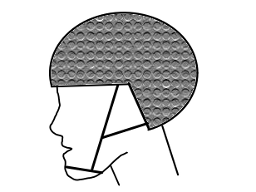
rollerhelmet

Today’s invention is a bicycle helmet design which consists of a padded inner and a hard outer shell with many, marble-sized perforations. The outer shell is made to have as small a diameter as possible.

Each perforation accommodates a tough plastic sphere, in such a way that it is retained within the hole, but able to spin in any direction.

When a rider comes off and hits his or her head, the spheres absorb some of the energy but also rotate within their recesses so that the head itself is not wrenched around by the impact.

#2298: Oasisub

Now that much of the world is running short of fresh water, desalination technology is greatly in demand.

Salt concentration in the ocean varies from about 3.2 to 3.8% so the job can be made 16% easier just by using water from the right spot. This unfortunately turns out to be at a depth of about 500m.

Michel_Meynsbrughen_underwater

So today’s invention is to use a militarily-redundant nuclear submarine to desalinate water whilst moored at this depth.

Such machines already make their own fresh water but I imagine fitting out the interior with eg large-scale osmotic filters and flash evaporators, in place of the usual weaponry and crew accommodation.

The engines, which have already been heavily invested in, could provide many more years of useful service running the plant and pumping fresh water ashore.

#2297: Elevautor

When you watch some unfortunate’s car being lifted onto the back of a lorry, to be ransomed by the traffic aurthorities, it’s a thought-provoking experience.

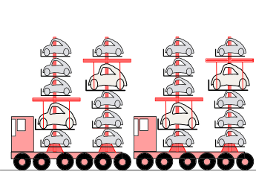
The thought it has most recently provoked is today’s invention: a mobile multistorey carpark.

elevautor

Trucks would be parked in urban locations, more or less permanently.

These have a number of vertical masts which can be folded down during transit. Each mast has a set of platforms which lock securely to it. It also has a hoist (like that used by traffic wardens, shown as a thicker horizontal bar).

When a car wants to park, it drives onto an empty platform which is left in the roadway (and which can be easily driven over by passing traffic).

This is quickly hoisted upwards and inwards (automatically, after the occupants have exited and texted the truck’s mobile number with their parking code) so that the platform and car are locked onto a mast.

On return to the truck later, the driver once again texts his code to have his car brought to the road (after a proximity detector tests that no cars are just about to drive past).

#2295: PatienText

Today’s invention is a relatively simple interface design idea that seems to have eluded the world of software.

Everyone in that world is no doubt a flawless typist and password prodigy.

Joshua_Davis_login

It drives me crazy, however, when eg logging into some program that the OS or browser or whatever launches another dialog box which then becomes the centre of events and soaks up the previous few characters I’ve just painfully generated.

The result is that I have to deal with the new box first by deleting my inappropriate part-entry and then remembering a wholly different password.

Instead, imagine that any new text entry boxes popping up do so without occluding the one you are working on.

If there is a problem, such as having forgotten one’s password for the window being typed in, rather than locking up the entire machine by refusing to move to the next dialogue box, such windows would all have equal status -so that you could type one letter at a time into each, if you fancied the idea.

#2293: LightLane

More motor racing. I’m intrigued by this branch of engineering, partly because it exists solely due its use as a marketing tool.

If it didn’t sell a shedload of soft drinks or financial services, people would find themselves back racing their daily rides across muddy fields.

Zach_Luke_racecar

Today’s invention adds to the marketing circus.

Cars, especially in F1, already carry a number of cameras. They would now have to carry a high-powered projector.

A sensor in each vehicle would detect whether there was a car within one length behind it.

If there was none, the projector would display an image of their main sponsor’s logo -on the track surface (Logos have already been greatly simplified, for a variety of reasons).

As well as increasing the total advertisement real estate, this would give added incentive for tailing cars to try to catch others, to extinguish the projections of rival sponsors.

On wet days, the projection could be switched to forward-facing, out of the spray.

#2292: Concushion

Concussion is no joke. Repeated concussions are believed to cause cumulative damage, leading to mental problems for a range of different athletes.

Among those at risk are American Football players.

diane_gibbs_football_game

Many attempts are being made to lessen the problem by redesigning helmets.

Today’s invention approaches the issue from a different direction.

Players would have a uniform limit set on their momentum. This would be achieved by fitting boots with studs in the shape of overgrown ballpoint pen nibs.

Accelerometers in the boots would detect someone’s change in speed during a play. Once their momentum reached the limit, the balls in their studs would be forced outwards, allowing the balls to roll against the astroturf and causing them to lose some traction.

The heaviest linemen and linebackers would thus have a speed limit imposed on them that was much lower than the lighter, faster players.

This would stop them from colliding with players with momentum sufficient to cause even small-scale brain damage.

#2290: Raciators

Racing car design is faced with the problem of how to optimise the balances between eg drag, downforce and heat transfer.

F1 radiators in particular have to achieve enormous through-flow whilst also dealing with all sorts of refuse which finds its way onto the track. Pit crews extract huge amounts of litter, but that can only happen after many laps during which it will have greatly impaired engine efficiency.

radiators

The F1 rules on radiator design seem to be pretty non-specific. Today’s invention attempts to exploit that.

Radiator panels would be mounted on rotary seals, allowing them to be rotated during a race.

At locations where engine loading was decreasing, they could be flicked from forward-facing into inline configuration. This would shed a large proportion of the refuse and briefly reduce drag as well.

Waggling the radiators on the starting grid could be used to lower the engine temperature -especially at tropical grand-prix.

#2289: GlidEjection

Fighter planes have had ejectable crew modules before.

Today’s invention is variant on that theme. A plane with a very low-weight front end, including canard wings (orange), is shown in the lower image.

glideject

Should the crew need to leave in a hurry, a secondary wing, which is stowed under the long axis of the fuselage, is rotated about its central axis.

This allows the pilot to pull the nose up a little and detach the crew module in the form of a small glider (upper image). This uses only aerodynamic forces, keeps the crew together and maintains pilot control.

Not only does this cause less injury to crew members than normal ejection but it also gives them some hope of gliding back home -or at least to a safer location.

#2288: Stillwater

When I’m running longish distances I like to carry water.

There are several problems associated with lugging a bladder-type system…mostly to do with the perpetual taste of plastic and the difficulty of cleaning the damn thing out.

Stillwater

I prefer bottles, but these thrash about asymmetrically and get in the way, even if I run economically (which I usually don’t).

Today’s invention is a belt which has a set of bottles attached. Each ‘bottle’ is effectively a wide hip flask which has notches in which other flasks can slide up and down.

Each flask rests on a spring so that as liquid is drunk from any one it maintains the position of its centre of mass. The centre of mass of the whole system therefore stays nearly in the same position throughout a distance event.

There are only two flasks shown in the figure, one with red liquid and one with blue. The multiflask approach allows a runner to carry several different types of liquid for different stages of a marathon for example. It also lessens the tendency to generate large wave motion inside a single vessel.

#2287: StoreFloor

Shopping in bricks-and-mortar supermarkets sometimes drives me crazy.

The layout of produce is determined by some central office guru, with degrees in marketing psychology, who wants you to see beer after you just bought peanuts…so these unrelated products will be placed adjacent to one another.

ilker_store_map

Today’s invention is therefore a new way to lay out products in a store, which will educate consumers and remain static over time.

The floor would have a scale map of the world painted on it.

Products’ shelves would be placed at the locations of their country of origin.

If you want an authentic Mexican meal or to dine as a locavore, this approach would help you out.

It would also allow people some sense of exploration and to ask questions about how produce from country X is cheaper than from their own local farms.