#2268: Containair

According to the BBC, At any given moment about 20% of all containers on the world’s seas are empty.

If this is correct, then this extreme economic imbalance offers some opportunities for rationalisation.

John_Nyberg_containers

Today’s invention represents one of the simplest possible approaches.

Containers are stowed on deck and contribute significantly to the drag on ships and thus their running costs -even when empty. A small saving on fuel would be enormously valuable.

The smallest possible modification would be to equip containers with ends which both open.

This would allow containers to be on deck with their doors folded back and the airflow passing through the resulting corridors.

Although the drag would be cut by much less than 20%, it could still represent a very big saving.

Of course this design of container would also work well if being driven, empty, on the back of a truck.

#2267: Gestalteration

I’ve always been fascinated by the idea of consciousness and its inconsistencies (which we call illusions).

One of these is the Ebbinghaus illusion in which the apparent size of an object is influenced by the size of objects around it.

wikipedia.org_Harvest_moon

It seems that this effect plays a role in causing the Moon Illusion (in which the Moon sometimes looks enormous when viewed near the horizon). Take a picture of this though and the effect is much diminished.

Today’s invention is a camera app which detects an isolated circle and, if it is near other objects, distorts the image so as to make the circle actually larger within it.

This idea could be extended to a suite of other geometry-based illusions, so that impressive perceptual phenomena could be captured photographically.

#2265: SweepSeat

In office environments, people often end up eating at their desks…at least it’s usually whilst sitting down that I generate most crumbs, dust, pencil sharpenings etc.

Today’s invention offers a way to cut the costs of office cleaning by having the messy occupants do the work themselves (in an ambient way).

Dave_DiBiase_chair

I’ve noticed that office chairs on wheels get dragged all over the place from desk to desk when people are setting up impromptu meetings or staring over shoulders at screens.

This set me thinking that some of the castors on these chairs could operate in the way that old fashioned rotary carpet sweepers did.

As a chair moves about the carpet tiles or wooden floors it automatically picks up crud and stores it in a small receptacle on the top of each castor which can be periodically emptied into a waste bin.

#2264: FlowShow

Imagine travelling inside a ship or submarine. Many crew members spend a lot of time actually submerged.

Today’s invention attempts to give them a greater sense of their position and speed.

00040_harrier

A number of laser pointers would be set up in each compartment. Each would be capable of projecting onto the wall an arrow shape with varying orientation and length.

In this way, the external flow of air (or water) could be represented on the inside of the vessel as a (very crude) field of moving vectors.

This would probably reduce any tendency to motion sickness and help keep a crew more aware of their current operating status.

#2262: Twintank

I’ve tried many times to suggest solutions to the problem of damaged tracks on armoured vehicles.

Today’s invention is another approach to this issue.

twintank

The tank consists of twin hulls supported on three tracks and joined by tunnels (top diagram). Each hull would have its own motor unit and some independent weapons.

In the event that the central track is destroyed, the vehicle can continue to progress, albeit with reduced manoeuvrability.

If one of the side tracks gets broken, the crew on that side escape through one of the tunnels into the other hull, seal the hatches and jettison the entire damaged hull half before driving on (bottom diagram).

With tunnels set in the front and rear (rather than top and bottom) multiple vehicles could be joined in other configurations, such as one resembling a brick wall when viewed from above.

This would allow an entire division to travel across country as a kind of armoured mat (with personnel and other resources able to move around inside whilst in transit).

#2256: VaneTail

Even small helicopters are fiendishly complex, which makes them to expensive to buy and maintain.

Today’s invention is one way to simplify light helicopters.

fantail

When you open the throttle on the engine it exerts a torque on the main rotor and, with any luck, you gain altitude.

The downside is that the airframe has a reactive torque act on it, so that it will tend to try to spin about the main rotor axis in the opposite direction. To counteract this and allow engine acceleration in forwards flight, helicopters are fitted with a tail rotor.

Such a system is heavy and complicated. Imagine, by contrast today’s invention.

It is modeled on an old-fashioned lady’s fan. This would be made of aerospace quality mylar and held between two thin plates, hinged so as to naturally spring apart.

This assembly would be inserted into a light, box-section rear spar, as shown.

During engine acceleration, the fan would be partly ejected from the spar(eg by a push-rod). It would spring open and limit rotation of the airframe by introducing an appropriate level of rotational drag (without introducing any extra drag in the forwards direction).

Coordination of the inwards and outwards movement of the fan with throttle use would also facilitate changes of direction.

An even simpler version would use the rotational flick of the airframe, on throttle opening, to slide the fan outwards automatically, in the manner of the original steam governor.

#2255: ShiftShed

I heard a while ago about a scheme in which US schoolkids pay a small amount each day to leave their mobile phones in a truck outside school.

Today’s invention applies this logic to bicycles, in an attempt to limit the profusion of ugly bikesheds/stands and eliminate theft.

biketruck

As illustrated in plan-view, a large-capacity electric wagon would park each day between a couple of walls with a bike-sized slot.

The slot would have a keypad which would shuttle the vehicle backwards and forwards automatically to allow a user to deposit his machine -through the open vehicle side (orange). This would display a code necessary to later retrieve one’s bicycle.

Each wagon would have return times listed on its side, so that a bike owner would be aware of when collection could occur.

The wagons could then be parked against a wall or against each other on some nearby, low-value site, until their return journey.

This would also allow bike owners to avoid using personal bike locks.

#2254: TapeTracks

Tracked vehicles which suffer damage to their undercarriages can be left stranded in perilous situations.

Today’s invention is a backup mechanism for such scenarios.

trackfeed

The vehicle would be fitted with armoured roadwheels, each of which would accommodate perhaps a dozen snail-shell ‘magazines’ holding a rolled up, spring-steel tape.

These snailshells would be fitted inside the roadwheel radially, so that when crossing soft ground, the strip inside each could be driven outwards by a small internal motor.

This would provide continuously-variable ground pressure to allow fast movement on roads (tapes withdrawn) or steady progress over bogs (strips fully extended).

In the event of damage by eg mines to some of the strips, they could simply be extended to offer restored traction.

#2252: Subooster

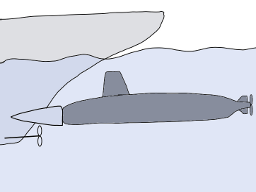
Many navies are engaged in building a new generation of electrically powered ships. These have many advantages such as numerous, dispersed drive units.

Today’s invention is a new form of drive unit for large ships.

Subooster

Such vessels, eg aircraft carriers, would be fitted with a special underwater docking mechanism to which a nuclear submarine (or two) could attach themselves.

This would happen only if the carrier needed to get somewhere at twice its normal speed, since it renders the submarine more vulnerable than normal.

Since these subs have enormous potential power outputs, they could add their propulsive force to that of a carrier, without a correspondingly large increase in combined drag.

#2251: WingSpam

Aerial robots (uavs, drones) are appearing everywhere.

These range in size from the insectoid to those bigger than a light aircraft. Today’s invention is an underwing module for one of these huge automata.

mandrone

This consists of a pod which could comfortably contain a person, enabling someone with special skills, but no flying knowledge, to be taken to or collected from a remote location.

The uav would be flown by a distant, ground-based pilot, as usual, but they could minimise any risk by limiting the number of airborne people to one.

Such a module could also be used to accommodate a human observer when tv imagery is insufficiently clear or smooth. It might even have room for a parachute so that the occupant could make a quiet descent, if engaged in some covert operation.