#2247: ParkPump

I’ve been watching the construction of a major new building in Glasgow over recent weeks.

One of the crazy aspects of this process is that they use an enormous and costly pump to raise concrete to the upper floors.

cementlift

Today’s invention is a simple alternative for low flowrates of concrete.

A simple calculation shows that it would be possible to raise liquid concrete to about 100m, using only the weight of the mixer lorry itself.

This would have to be driven onto a hinged ramp under which would be a piston with cross-sectional area of about 100cm^2.

Valves would be needed of course to coordinate the inflow at the bottom and the small bursts of outflow to the upper storeys.

#2245: Streamstile

The dynamics of crowds always fascinate me. I’m particularly keen on smoothing people flows, as you might streamline or laminarise the movement of a fluid.

Today’s invention attempts to provide a solution to one of the main problems of ticket barriers.

barrierspeed

People walk up to existing barriers, stop, insert ticket, wait, receive ticket and plunge through the open gate.

If the barrier dislikes their ticket, the process is further complicated by the need for the person to collect it and reverse into the face of the oncoming masses.

Instead, imagine a barrier of the type shown. A person (dark blue) puts the edge of their ticket in an open slot (with the gate in the closed, turquoise position).

They must walk smoothly forwards as the machine reads their ticket, never letting it go.

Reaching the red location, the barrier decides to move the gate to the open (pink) position or to keep it closed.

In this event, the person still clutching their ticket is directed around a U-turn into a space between queueing passengers (rather than bumping into them). They can then seek assistance from an attendant in the usual way.

This eliminates all the stopping and reversals associated with normal barriers.

Although there would be fewer outlets, the increased speed of egress would more than compensate for this, and thus boost net flowrates of passengers.

#2244: TailTurner

I was inspired today by this little robot’s ability to change direction very rapidly.

This works by conservation of angular momentum of the whole system (car+tail). As the tail whips around in one direction, the body spins in the opposite direction to meet it.

scissorcar

Having low friction feet means that the robot can make these turns with very small frictional losses.

All this set me thinking about today’s invention: a car with a tail.

Such a vehicle would carry some mass at the end of a hinged cantilever tail (this might be where the fuel was stored).

The hinge would be powered by a fast-response electric motor.

Using four fat conventional tyres would result in significant damage to them on every tight turn, so it might be necesssary to equip the vehicle with more, computer-steerable wheels (including perhaps under the tail itself).

The accelerations induced would still of course need to be less than would cause damage to the occupants, but in principle such a vehicle could make very rapid changes of direction (perhaps useful for a military vehicle attempting to evade incoming missiles).

This form of transport could be made more comfortable by having seats which rotated in coordination with changes in direction, but more gradually, keeping the occupants’ backs against the seatbacks.

#2240: Canalamaran

The Panama canal has been a massive boon to world trade.

Ships are now becoming so large, however, that they are starting to exceed the Panamax standard (the size of the largest vessels which can pass through).

canalamaran

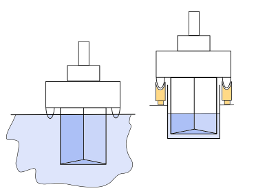
This limitation is caused mostly by the dimensions of the canal locks. Today’s invention is a way for huge vessels still to make use of this canal and others around the world (without enormously costly increases to canal dimensions).

Imagine a ship like the one on the left which has an enormous draft and is supported and stabilised by two large outriggers whilst at sea.

Just before it arrives at a canal lock, the outriggers engage with tractor units (orange), running on rollers, which can move along the two-metre wide concrete towpath on each side.

These can be hydraulically jacked up to take a sizeable fraction of the weight, so that the ship’s hull need not be fully accommodated by the depth of the canal, allowing it to carry its cargo between oceans.

#2238: BlastBrush

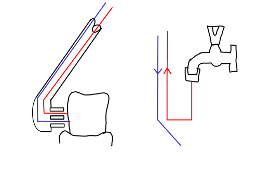
Today’s invention is a toothbrush which fires water (red) at one’s teeth whilst brushing, but which also then sucks the debris (blue) out of the mouth and down the sink.

The suction would operate just as the tube they force into your mouth at the dentist’s does -except that this would be much less invasive and uncomfortable.

BlastBrush

The supply pressure at the tap would be used to drive water through a nozzle in the brush head, greatly accelerating the flow.

The dirty water extraction could be powered by the normal vibration motor in the handle, which would also drive a small peristaltic pump.

#2237: Remotoroll

I was caught in deep snow, on a hill, this evening. My 2-wheel drive vehicle went so far up and no further. I wanted to push it to the kerb but was scared that any momentum would cause it to career backwards into various parked cars/ lamposts/ trees.

Today’s invention is an attempt to help people push their vehicles with more control than can be achieved when standing with the driver’s door open, ankle deep in flakes.

Emanuela_snow

It takes the form of a remote control for the vehicle’s brakes.

Ideally this would operate the main brakes in a gradual way (rather than the binary states offered by the handbrake).

This could be incorporated into one’s key fob and activated only when the engine was off.

As you rock the car back and forth to nudge it backwards, the brakes could be eased off and on from outside, allowing the car to make small, controllable progress.

This system might also come with a adjustable lock for the steering which could be set before moving the car a little and then reset, iterating slowly towards a target position.

#2235: Symmetricharge

Ball bearings have always fascinated me, since manufacturing them still has an element of artistry about it. Roll a large number of them about long enough between parallel grinding plates and they come out statistically spherical and smooth within controllable tolerances.

If however you want to know how far from perfect a given ball is (perhaps for a very high performance application), today’s invention may help.

Jakub_Sobecki_balls

When a perfect conducting sphere is subject to a very high voltage it will, theoretically, distribute charge uniformly across its surface. Regions with locally sharper radius will concentrate charge.

Imagine a machine, therefore, in which each candidate sphere is charged up on a non-conducting plate in a dry-air enclosure, using a very high-voltage source.

Approach the sphere with a micrometer-driven conducting wand. Record the proximity at which discharge by air breakdown occurs. Sharper regions will discharge at greater distances from the wand.

This can be repeated for a large number of different rotational positions to ensure that each ball is spherical to within ultra-fine limits.

(The wand might contain a tiny reservoir of ink, so that the sharpest point on each ball might be highlighted by attracting a dot of oppositely-charged pigment).

#2234: Keyscreen

Today’s invention is a new way to foil would-be pickpockets (see this for an illustration of how insecure your portable possessions actually are).

Many of the nefarious techniques employed to steal stuff involve distracting the owner, so that he or she fails to notice the theft.

safegrip

Now that we have ubiquitous touchscreens, why not use these to protect our valuables?

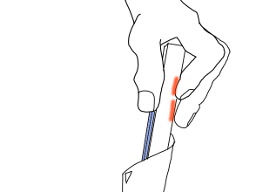
Imagine a smartphone with a slim case in which other items such a credit card and some notes could be carried on the back (blue).

The phone would require that it be held in a particular finger configuration (red) as it was being extracted by the owner from his pocket (one of say 100 such patterns).

If the device detected the acceleration associated with such extraction, whilst the screen was gripped in the wrong way, it would automatically ring and issue audible alerts.

It might also tweet and message your friends in order to alert any travelling companions.

#2233: RollingToll

There is some evidence that setting up priority lanes was one measure that seemed to smooth traffic flow during the London Olympics. People didn’t like it, but it appeared to work.

Now think about motorways. Traffic jams are often created because drivers believe that they gain some advantage by swapping lanes.

Ivan_Prole_line

In so doing, however, they may have a disruptive effect on the flow -a kind of vehicle turbulence occurs which causes extra braking waves.

Today’s invention is a new form of onboard tolling device. This would detect when a vehicle changed to an outer lane (by eg a combination of steering and the vibration of driving over cats’-eyes) and record what the effect on its speed was following each change.

If a lane change was followed by a decrease in speed over the next time period (or sudden braking) it would be classified as impatience or a failure to anticipate and the driver could be automatically charged eg a few extra pence.

This would inhibit drivers from constantly seeking some short-term speed advantage and make rush hour less frenetic.

#2232: TreeWheeler

In a conventional spoked wheel, most of the stress is concentrated where spokes meet rim.

One solution is to beef-up the outer ends of the spokes, but this boosts the moment of inertia enormously, overcoming any benefit from the use of lightweight alloy, for example.

KCayleyTrees

Today’s invention is therefore to manufacture wheels which have a strong but lightweight, triangular mesh of spokes near the outer edge.

The form that these wheels might take is indicated above and is based on a Wolfram Demonstrations Project.

This kind of fractal-based design allows for a more effective distribution of stress and might be made relatively easily by additive manufacture using a 3D sintering machine (if they can do gearwheels then roadwheels should also be feasible).