#2230: Harnessteer

I get concerned by people squinting at mobile phones as they drive. The last time I was in San Francisco, the minibus driver who picked me up was using two mobiles, a walkie talkie, a GPS navigation device and a speed trap warning alert…pretty much simultaneously.

In order to lessen the cognitive load of people trying to travel using a GPS system, today’s invention is a new form of seatbelt.

Antonio_J_Sanchez_belt

Instead of having to look away from the road to see some tiny screen or listen to a hectoring electronic voice, the lapstrap would be driven leftwards in advance of a next-left turn, and vice versa.

This communication method would soon become second nature, so that the feeling of the strap’s motion would form an integral part of the motor memories of normal driving -without any decrease in safety (since it provides an important extra incentive to buckle in).

This approach might require a larger inertia reel of belt material, but the average journey would have equal amounts of left and right turning, leading to no large-scale imbalance between storage cannisters.

It might start to feel as if one knew where one was going, even on totally unfamiliar streets.

#2229: HideRide

What can one possibly say about Nesta? They really aren’t very effective.

This is exemplified by their well-meaning but ineptly handled competition Hands Off My Bike which aims to decrease bicycle theft. Today’s invention is the contribution I’d have made towards this worthy objective -if I could have ever regained access to my draft entry.

HideRide

Parking lots are choked by enormous 4 wheel drive vehicles with huge ground clearance. Owners wanting to make some money could sign up to a scheme whereby they could register their planned parking time and location.

A cyclist in a carpark could determine if a given vehicle was in the scheme and if so, use the 4*4 as a horizontal, secure bike shed.

Imagine a cylindrical metal cake tin with closed ends. This would be clamped to one’s bike as shown. The upper end of the tin would have a circular aperture, through which a tough rubber bladder could protrude a little. This would be inflated by a small air pump in the tin, activated by a phonecall.

To park your bike, you would text the licence number to a central site and pay a little cash. Then you would turn the handlebars and lay the bike on the closed end of the tin. Push the bike under the vehicle and inflate the bladder.

This makes the bike and even the bike wheels potentially inaccessible -and largely invisible. Certainly there would be no way to bounce the vehicle hard enough to release the bike or to puncture the bladder, wedged in a recess beneath the floorpan.

#2228: Spinnersteer

Today’s invention is a way to simplify the controls on model aircraft.

Rather than mimic the complexity of ailerons and other flaps, it would be possible to have a twin-engined model turn using only gyroscopic forces.

gyroturn

In the diagram, two counter-rotating propellors are shown.

To make the plane turn to starboard, a metal rod would be pushed outwards along the drive shaft from inside (gravity acts on the extended rod, creating a clockwise torque about an axis into the plane of the diagram).

The effect would be to make the engine rotate to the right. When the course had been changed, the rod would be withdrawn again.

Turns in the opposite direction would be achieved by extending a rod in the other propellor.

#2226: BracedRacer

Today’s invention is yet another bicycle frame.

It consists of a simple cross arrangement with pulleys at the extremities.

beltbike

A fibre-reinforced drive belt passes around the frame as shown (red) and its tension helps to reinforce the frame itself -which could be substantially shorter and lighter than a conventional layout.

#2225: Furrowflight

I’m ploughing my way through Walter Lewin’s 8.01 Physics course online. He recently covered orbital mechanics, on which today’s invention is based.

It’s a way to sample the surface of an asteroid without having to create and deploy a costly lander.

spacesampler

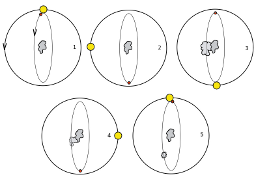
A body in space with no atmosphere, such as an asteroid, would allow a small spacecraft (yellow) to enter into orbit around it (1->2->3->4->5).

From this would be ejected backwards a tiny (red) satellite (eg a cubesat).

This could be given an intial speed just great enough to allow it to return to the mothership, without significant additional fuel cost or active control, following the kind of orbit shown.

As the cubesat passed close to the asteroid’s surface, it would drop a small mass which would create a plume of dust through which the craft could fly on a second orbit before returning to the main satellite.

I’m tempted to suggest that repeated applications of this technique could be used to erode and thus deflect a dangerous, earthbound rock.

#2223: Substitube

If you ride a mountain bike (with disc brakes), the last thing you need is a puncture. You might end up carrying the machine for miles (since fitting a puncture kit whilst up some mountain may not be very easy).

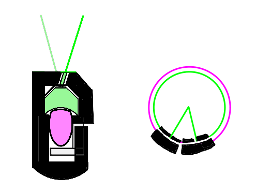
Today’s invention is a set of eight to ten, stiff rubber, G-section arcs.

ersatztyre

These would be carried by clipping them around the thinner frame members until a puncture occurred in the tyre (pink).

Then each of these would be pressed into place, as shown, around a spoke.

These would support the wheel rims whilst protecting the tyre from further damage and allow a return home, under pedal power, before bad weather can cause any additional risk.

#2221: CarandVan

In the near future, we may find ourselves driving about town in small electric vehicles (or being driven by them).

Today’s invention is a way to provide more flexible transport, based on a single, cheap motorised unit.

carttrains

Each unit can accommodate one person or a stack of cargo. It is also fitted with a motor and a set of wheels, the front set being steerable.

These units can easily join up, forming a ‘train’ with continuous or subdivided interior -suitable for family trips or public transport.

The motor units talk to each other to provide the optimal distribution of drive along each train, as well as having the steering of the whole controlled only by the front unit.

#2219: Panelamps

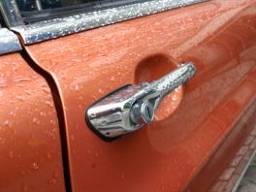
In the world of auto manufacture, creating mass-produced bodyshells which are almost geometrically identical is the name of the game.

The effort to achieve ever-tighter tolerances means that any remaining gaps between body panels at build lines now seem much more prominent than ever before.

Krzysztof_Kozerski_door

Today’s invention is a way for car makers to decrease the visibility of such gaps and give their products a more unified, streamlined appearance (especially on pale-coloured body shells).

Each vehicle would be equipped with an adhesive, flexible striplight located eg around the door sill interior and at other seams.

This device would emit light matched to the colour of the paintwork so that, when eg the bonnet or door were closed, it would come on and lessen the contrast between the car colour and the dark groove where the panels meet.

#2216: Wrenchain

Today’s invention is a special purpose spanner, designed to allow nuts to be undone inside complicated systems without having to dismantle them.

This takes the form of a chain of meshing gears, held together by a set of bars.

spannersnake

At the head of this would be a gear chosen to have a hexagonal interior to match the target nut. It would also carry a small, wireless camera, to help direct the ‘snake’ as more gears are added to the other end.

When the nut has been engaged, the bars would be locked in place and a motor drive applied to the distal end.

This would allow certain electromechanical systems to be diassembled only by the use of such a spanner…potentially increasing resistance to reverse engineering.

#2215: StepSearch

Very few products ever get any kind of stress analysis performed on their components.

Today my tumble drier packed up because of a stupid stress concentration in the door hinge.

stressconcn

Today’s invention offers a simple way to check for such sources of built-in obsolesence.

A manufacturer would apply a small programme to all of its CAD component geometries. Even without any knowledge of the loading regimes, this would detect parts which a) have a sharp change in cross section and b) are made of some brittle material.

These two factors would be enough to show up lots of parts which might make their products malfunction, in time for them to be redesigned (I’m looking at you, Hotpoint).

Local 3-D print shops could do this scanning too, in order to be ready in advance to make replacements for all sorts of machines.