#2196: FlowFenders

I submitted this months ago to an open innovation ‘contest,’ but received no response from the company to which it was forwarded. I really should know better than to get involved with this kind of scam.

The problem is about preventing damage to fast moving and fragile cans on a filling line.

Alaa_Hamed_cans

Today’s invention is the insertion of extra, ‘dummy’ items intermittently into the manufacturing stream. These would take the form of closed-cell foam elements, or blanks, each designed to mimic the outer shape of a real can.

The foam blanks would be very cheap to produce and reusable over an estimated lifetime of several months. They would require almost no modification to the standard high-speed filling line (except for some extra software to identify the blanks and avoid attempting to label or fill them. There would also need to be an extra chute for occasional injection).

Each of these foam blanks would have a small weight inserted into its base in order to ensure that it remained upright. The blanks would be much less massive than a full can and therefore require almost no extra power expenditure from the manufacturing plant.

They would be impacted by cans (full or empty), undergo microscale plastic deformation and thus absorb almost all of the surplus energy within the line. This would massively reduce the damage caused to the real cans by hammering into each other.

If the line speed were simply maintained, this approach would lower the rate at which cans were produced. Since the cans would be much better protected from impacts, however, the line speed could be significantly increased so that the the production rate of real cans was maintained.
#2192: Gripredictor

I love to drive with precision, although it happens less frequently than I’d like.

Don Palmer, driving guru, has made this video in which he talks about when wheels twist their tyres so that corners get turned at speed without losing adhesion.

slipangle

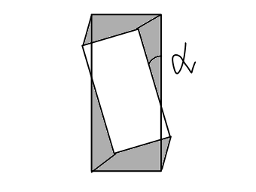
The twist is the so-called slip angle, shown in plan view as alpha on the diagram. This gets sensed by professional drivers in terms of resistance to turning of the steering wheel.

Today’s invention is an amplification of this sensation for we lesser mortals.

A camera would be mounted in each wheelwell looking vertically downward. Alpha would be estimated for each tyre using image analysis.

This would be combined with knowledge of tyre pressure, temperature and speed data to provide an estimate of how far away from slippage each wheel was at a given moment (based on previous test data for the tyre type fitted).

This knowledge could be used to make the steering torque required greater for bigger alpha. It might even allow it go prematurely ‘light’ (using eg a clutch mechanism in the steering column or even a drive by wire system). In this way, not only could rookie drivers be educated but accidents on slippery surfaces might be predicted and avoided.

#2190: PostJets

We’ve all heard the old story about the accdiental invention of the postit note.

Today’s invention brings the postit into the electronic era.

To leave someone a physical note, just imagine a pad of screen protectors which can be attached to one’s touchsreen device.

The device senses what one is writing on the screen, even in cursive script, and sends this information to a handheld inkjet printer in the form of a pen.

As one ‘writes’ across the screen, the pen generates beautifully clear printed letters onto the topmost protector.

This can then be detached and placed somewhere prominent, using the usual adhesive strip on the back.

#2187: BoomeRing

Mobile phones get lost all the time. Sensible folk will usually have some kind of access control code in play so that anyone getting hold of a misplaced device will not be able to read their texts or steal their identity.

This also means however that the device is very hard to return to its owner. Even if there is an address or telephone number attached, someone finding a lost phone may be unlikely to bother to make use of these.

These days there are phones which are specially designed to be ultra-robust. Taking that a step further allows for the creation of a phone which can happily withstand being sent through the post with zero packaging.

These phones would each have a combined barcode and numerals etched on the outside surface by the manufacturer.

When a lost phone is simply dropped in a postbox, the barcode allows it to be scanned and sorted by the normal postal equipment, returned to a regional office of the maker and eventually delivered to its owner, without displaying any easily readable personal identifiers.

After return of the device, a reward might be arranged when a returner enters the etched numerals from the device into a web form.

#2184: Edge-gregious

I spent a little time today thinking about car design and what in particular makes this one seem so ugly (I’m sure an estate version would be even worse).

My theory (probably 1.01 on the course in design that I decided not to enrol in) is that objects have to have sections of their geometry repeated to be seen as graceful or attractive. The Lamborghini Aventador has lots of discontinuities, but they are each repeated (in the same way as features in a face are).

Another example is the new VW beetle, whose windscreen meets its roofline at a sharp angle which appears nowhere else in this curvaceous vehicle.

Today’s invention is a program which analyses the lines in a CAD drawing of a product.

It checks how many times a line segment appears within a design, undertaking this work at a range of different length scales.

If segments are discovered which are unique curves, then these could be replaced by modified versions of other, more frequent, line elements.

#2183: Shredetector

There may be documents that should never be shredded.

I’m thinking here particularly about the antics of the East German Stasi when they tried to destroy evidence of their activities.

Subsequent efforts to restore the paperwork are heroic but fraught with difficulties.

Today’s invention is a simple modification to existing printers intended to make shredding itself less effective.

If we are talking about printing with black ink on a white surface, we could arrange that one of the components of the black (say cyan) would be decreased, perhaps linearly as a function of position across the page. Another colour component could be varied similarly down the page.

These gradients would be so small as to be invisible to the naked eye.

If such a document found itself shredded, it would be possible to use a sensitive colorimeter to arrange the fragments by position before reassembling the original.

#2181: MaGASine

Magazines for feeding ammunition to automatic weapons are limited in the number of rounds they can hold…mostly due to the Physics of the springs which advance the bullets towards the breech.

Today’s invention is to replace this spring with a piston, as shown in yellow (with apologies to readers who hate guns).

Several magazines could be joined to provide a large reservoir of ammunition, powered by a single piston.

This would be driven, in turn, either by a pre-pressurised pocket of gas inserted in the armoury or by the same recoil mechanism which chambers each new round.

Gas from each discharge would pass into the pocket via the pipe indicated in red.

#2179: Fadecimals

Today’s invention is intended as an amusing variant on a digital clock.

Instead of having the segments in a 7-seg digit flash on or off, each of these would fade gradually ie in an analogue way.

This would be emphasised by the use of two colours for each segment, say red and green.

“1” would always be wholly red and “2” green, etc.

As 1 changed to 2, the overlapping segments would appear in a varying intensity of yellow (as shown for 1/2, 2/3 ,3/4 and 4/5).

#2178: Uninterruptill

Several supermarkets now resort to the use of self-scanning tills.

This probably saves them a lot in terms of wages but the interfaces are so primitive that they deter people like me from ever going near them.

Today’s invention is aimed at making this experience slightly less harrowing.

Such machines are always located in a bank so that their insanely loud orders are barked out at customers often in quick succession.

This can create an echo effect which makes it hard to know which device just yelled “UNEXPECTED ITEM…” This makes everything even more disorientating -especially for the few remaining shop staff who have to listen all day.

So, why not have these machines wired together so that when one says something, neither of the machines to either side will speak until it has finished (and not duplicate what has just been said, if it happened say less than 0.5 seconds ago)?

#2175: Wheelwarmer

Racing cars sometimes have to have their tyres pre-heated in specially-designed, electrically-heated covers.

Today’s invention augments that process by using the engine exhaust flow to help warm the rubber.

Each exhaust pipe would have a nozzle, directable by use of a small motor, which could be rotated towards or away from the surface of whichever of the rear tyres it was pointed at.

This system could make use of a small thermal camera to gauge the tyre exterior temperature and then help divert the exhaust flow after the heating had had its effect.

A more advanced version could also warm the front tyres.