#2213: GearingHearing

My father in law has hearing aids that are highly tunable to enhance various different sources of sound, such as conversation.

This made me think that racing drivers, who can afford pretty much anything they like, should take this technology seriously and stop stuffing their ears with bits of foam.

stefan_choquette_monterey

The major noise source aboard such a car is the engine exhaust of course, with the frequencies varying from say 2000 to 12000+ rpm.

The distribution of these bursts is pretty predictable, in that drivers drive for a while with smoothly varying frequency before a sharp step as a gear is changed.

Removing all engine noise would seriously impair vehicle control, so today’s invention is hearing aids for racing drivers which communicate wirelessly with the engine management system so that noise suppression can be applied to any high volume spikes over a wide range of frequencies.

The system would also allow broadband reduction of noise, for short periods, to enable conversations with the pit crew to occur.

#2211: SkyPies

For people who are starving, food drops can be a life saver -since distributing food from the back of a truck often fails to get the nutrition to those who need it most.

Conventional airdrops run the risk, however, that a crate of food will hit someone and cause injury -or worse. They also allow large packages of food to fall into the hands of unscrupulous traders or armies.

poppadomdrop

Today’s invention is to create very high-calorie, vitamin-filled bread ‘bowls’.

These would be made with radial vents so that as they were dropped individually through the air, they’d spin and delay their descent.

The bowl shape would be stable in flight and allow them to be scattered widely across a village or a refugee camp.

On landing, these bowls would contact the ground only at one point, minimising the amount of contamination of their surface.

(I just heard the sad news that Gerry Anderson has died. This post is dedicated to his inventive genius)

#2210: Overider

For adrenaline-junkies, today’s invention is a mini theme park ride in the garden.

A swing would be embedded firmly in the ground. The chains or ropes would be replaced by solid shafts and the seat equipped with a serious funfair-padded harness.

Milan_Jurek_swing

The swing would be powered so that its occupant could be swung over the 12 o’clock position.

It would also be possible to program the rotation so that changes in direction and speed might occur at random…thus adding to the ‘thrill.’

#2209: PersonPod

Rear-engined cars tend to have no real rear passenger seats and a ridiculous gap under the bonnet.

Today’s invention is a modern redo of the old fashioned jump seat to help deal with the problem of limited seating.

jumpseat

This would take the form of a single-passenger module which would slot into such a car in place of the luggage space.

It would have a seat for an extra passenger who would sit behind a small extra windshield and experience an exhilarating ride -effectively on the outside of the car.

#2205: Twincycle

Today’s invention is an engine for bicycles.

Motorcycles have often had engines that acted as part of the frame. Imagine if the two rear frame members of a pushbike (yellow) were each the cylinder of a small IC engine.

bikengine

Each of these would contain a piston attached to a crank mechanism (red).

This could be powered by eg petrol stored in another part of the frame and provide assistance when travelling up long hills.

#2204: Afterrocket

What’s better than a jet engine? A jet engine with a rocket-powered exhaust.

Today’s invention is a hybrid rocket motor which can rotate around a pivot (blue) so that a cylinder lined with solid fuel is injected into the outlet from the jet.

jetrocket

This unit has an entrainment collar on the front so that air is sucked in and oxidises the rocket fuel.

This could be used to generate an enormous burst of thrust to escape when, say, being chased by a missile.

#2202: HipFlip

I did some experimental work a long time ago in connection with replacement hip joints.

Today’s invention is an alternative design, based on placing the cup part in the head of the femur and the ball component protruding from the pelvis (as shown on the right).

hipjoint

This might be advantageous for someone whose pelvis was much more frail and in need of reinforcement than their thigh bone, for example.

It also allows more space to insert some kind of spring-and-damper mechanism within the pelvic ball.

#2201: Eyesights

I’m increasingly scared about the hellish misuse of firearms, so today’s invention attempts to limit the damage which can be done from afar by the use of telescopic sights.

Such a system would have built into it an iris-recognition device, of the type routinely used in other security applications.

Another_Outsider_eye

On purchasing the sight, it would be trained to recognise only the iris of the purchaser.

When later attached to eg a hunting rifle, the sight would only open an internal shutter, enabling its use in aiming, if the recognition software remained satisfied the the weapon was pressed to the eye of a licensed hunter.

#2200: ArMouse

I sometimes develop muscle strain when using a mouse for extended periods (ie all day).

My elbow also suffers from the effects of being pressed to a desktop as it acts as a fulcrum for the mouse-wielding hand.

Armouse

Today’s invention is therefore a mouse which sits under one’s elbow and provides a comfortable pad which also has a low friction undersurface, so that the elbow can move freely wherever it needs to.

This would have a flat arm extending across the desk with a jointed front section to which one’s favourite mouse could be clipped.

This would allow full normal wrist movement but with added support.

#2197: Scaffoldelta

Explorers, colonists and armies are often faced with geographical barriers such as valleys, hills or lakes which must be traversed.

Today’s invention is a way to create the necessary ad-hoc viaducts quickly.

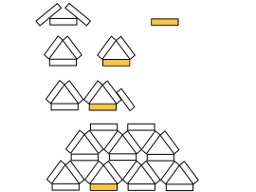
pyramid

Imagine a vehicle with tracks which rotate around its outer perimeter (just like WW1 Mk1 tanks). These would be simple, watertight boxes with motors aboard which could be controlled remotely.

The boxes would manoeuvre and ride up on each other so as to flexibly create triangles which would lock together at the corners into a rigid network structure.

A roadway or railtrack could be rolled across the upper surface to allow other, people-carrying vehicles not to be impeded by any surface features.