#2332: Escapullogy

Apparently, some people are reluctant to fasten their seat belts in cars because they live in dread of being trapped in a vehicle when it catches fire or is submerged in water.

This results in surprising numbers of fatalities which might be avoided.
beltslice

Today’s invention is a simple device which allows someone to cut their safety belt in the unlikely event that they are trapped inside.

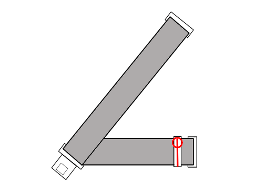
It takes the form of a guide which is bonded across the width of the belt in the factory.

Between the sides of the guide a small, ultra-sharp blade can be drawn, using a ringpull arrangement as shown.

The ringpull would normally be held in place with a blob of wax so that any tampering with, or accidental movement of, the blade would be obvious.

#2331: Portiles

Imagine if you could make, say, the hull of a spacecraft or an architectural design or a rocket motor with ports or doors which could be easily repositioned in its surface.

Today’s invention is to adapt the children’s 15-tile puzzle to allow this.

tilecraft

A cylindrical skin would be made using curved tiles.

These would be free to slide axially or circumferentially, one at a time.

This would cause the open port(s) to change position.

When its new location had been arrived at, a window, an exhaust nozzle, an open frame or a hinged hatch could be inserted in a given aperture to ensure that the pattern was maintained until the next reconfiguration was needed.

#2330: Steerslide

Today’s invention is another new steering wheel.

This consists of a circular disc, bonded to the dashboard so that it can’t turn.

staticturn

Two flexible handgrips, linked by a bar, clip onto the outer rim of the wheel. The grips would be coded so as to be usable only in one vehicle.

These are wirelessly connected to the steering mechanism of the vehicle so that their rotational position directs the car.

Steering would thus be inertia-free and the wheel, being stationary, could accommodate all manner of extra interfaces.

The driver would remove the grips on leaving the car, making stealing it impossible.

#2328: BounceBelts

Imagine a new form of tracked vehicle.

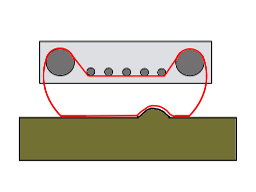
Today’s invention is a track which naturally forms a circle and which, if displaced from this shape, will attempt to spring back.

springtracks

Now wrap this track around the wheels of a vehicle, as shown.

This allows it to be driven forward by the large sprocket wheels as usual, but instead of having road wheels which run at ground level, the whole system is held well above the ground and supported on the sprung tracks.

The special track could actually be made of a conventional track, inverted and shortened somewhat.

This approach provides extra suspension over very rough terrain as well as some additional protection from IEDs and mines.

#2326: Swarmeteor

It seems that penguins in a huddle move around so that each one has to face the Antarctic wind for only a fraction of the time.

We now have cubesats theoretically capable of exhibiting such swarm-like behaviour in space.

swarmeteor

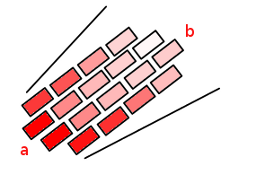
Today’s invention is a way for a large number of such small satellites to safely re-enter the Earth’s atmosphere, together, rather than burning up individually.

These mini spaceships would fly in close formation so that those at the front would be friction-heated by the atmosphere.

They would then fire retro rockets differentially and thus flow from front to back of the swarm, being continuously replaced at the front (a) by cooler ones from the rear (b).

Those devices with the most precious samples or data could be allowed more time at the back or even inside the swarm, in order to minimise the thermal damage to them.

These systems could then be recovered and reused.

#2325: NetNest

Airlines are very sensitive to the costs of their operations, so reducing the weight of aircraft is important.

Today’s invention is therefore a hammock-like seat for airlines with a much smaller mass than a conventional seat.

hammockseats

This would be made of a netting bag with a fold-down seat unit built-in.

A passenger could carry this aboard themselves and attach it to a hook in the roof.

The attachment might include a spring/damper/hinge unit to limit the amount of motion during eg turbulence. There might also be an elasticated cord between seat and floor.

Such a design would also speed boarding and egress, since the seats are easy to move past, automatically reverting to a narrow rope shape when not in use.

#2323: ForeveRings

3D printing is exciting, but it’s never going to revolutionise the world of manufacture on its own.

Today’s invention is a niche application of this technology.

Alice_Wycklendt_cancer_bands

Bracelets and other items of jewellery are often hard to fit precisely.

Imagine if you could place your arm on a pad within a machine and have it print eg a close-fitting, solid bracelet around your wrist, while you waited.

The semi-permanence of this kind of approach could substitute for tattoos. Also, engaged couples could wear rings that were physically irremovable (or at least tamper-evident).

#2320: Incognauto

If you have a valuable vehicle, parking it on the street is a risk that you may wish to reduce.

Today’s invention might help with that.

incognauto

It takes the form of a car cover…shaped to look like a larger and much less desirable vehicle than your own.

A driver could enter his or her car design onto a website and be offered a number of different unstealable car profiles guaranteed to fit over the vehicle of value.

The car cover would be inflatable using a remote controlled tyre compressor. This would grip the inner car tightly, retain the correct shape and also keep any unauthorised access to a minimum.

#2318: Driverless-on

Today’s invention is a driverless car -for a learner driver.

Since autonomous vehicles are now being licensed for use all over the US, one way to make some use of these is in teaching people to drive.

fcl1971_sign

(I don’t for a moment think that robot vehicles will stop people wanting their own licences).

These vehicles have a fine safety record, thus far: any accidents they have been involved in seem to have resulted from human drivers crashing into them.

So imagine a learner driver free to operate a vehicle on their own. He or she would be accompanied only by an autonomous vehicle system.

This would monitor the condition and location of the vehicle and take control if the driver’s choice of gears, speed, indicators, road position etc was outside the envelope which it would have chosen at that moment.

Repeated out of control situations would result in a smooth, machine driven return home and a detailed report about the errors made.

#2317: IsosceleShield

Today’s invention is an extra defence for vehicles against mines.

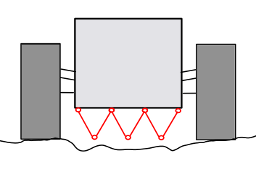
Instead of relying on a specially shaped hull design, a screen made of articulated plates would be attached to any vehicle about to be used in a dangerous area.

corrugation

This would normally be carried flat to the hull base, so that ground clearance was maximised.

When approaching an insecure area, the screen would be deployed from inside the vehicle. The hinges would slide rapidly along heavy-duty slideways and lock into place, forming an extra strong triangulated shield, resistant to blast waves.

These waves would also be channeled axially, so that much of the energy could escape without significantly damaging the vehicle above.