#2352: SlipShip

Apparently more than 2.5 cruise ships become grounded every year on average.

The cost in terms of tugboats and prestige must be enormous (Nearly as much as when the toilets all block up).

Slipway

Today’s invention is a simple addition to cruise ships to help them get out of these difficulties -whilst minimising the negative publicity.

A streamlined sledge is strapped to to the bottom of the hull. This contains a bank of sprung rollers, so that when the ship hits the bottom, the impact is less obvious to those on board.

Once stuck, the ties on deck are released and the engines thrown into reverse so that the vessel relaunches itself, leaving the sledge with a buoy attached so as to enable its later recovery.

#2350: PowerSocket

Replacing hip joints is increasingly common.

Today’s invention is for people who have this operation but who may have, or develop, muscular wastage which makes walking difficult.

pelvinduction

The hip joint has a strong magnet embedded within it (yellow).

The user wears a girdle which contains a selection of solenoids (red).

These can be switched on and off in a phased way, so that the system acts as an induction motor, rotating the hip joint back and forth through a controlled angle.

This supports the normal action of the leg muscles, either by way of permanent augmentation or during rehabilitation.

#2348: Trelliscreen

Windscreens are surprisingly strong but if you happen to have a collision with a wandering moose or some stationary street furniture, every additional reinforcement is welcome.

Today’s invention is a way to brace one’s windscreen and thus lessen the chance of penetration or widespread crazing of the glass.

barrierblades

Sensors in the bonnet detect the impact and cause the reinforced wipers to jump upwards as shown. These are longer and stronger than usual so that they extend over the top edge of the screen.

In this position, the wipers snap together to form a defensive barrier.

#2346: Footlights

Professional athletes in training expend a lot of effort attempting to learn to reproduce the optimal pattern of steps in their event.

This applies to sprint, hurdles, high-jump etc. -anything which depends critically on precise foot placement.

footbeam

Today’s invention is to equip an athlete’s shoes each with a tiny projector. Clipped to the top of the toe box, this projector would shine a simple outline of the left foot onto the track when the right foot impacted the ground…and vice versa.

This would show where one’s next foot placement should ideally be.

It would even be updateable in realtime….if, for example, a hurdle had been taken badly, so that the right foot landed in an unusual place, software would calculate the adjustment required to the planned left foot position to get back on track as fast as possible.

This might also be useful for teaching dance to those of us with two left feet.

#2343: StorageStoreys

I visited a supercomputer facility today which was located, for historical and security reasons, near the top floor of a tall building.

Today’s invention is inspired by the idea that, in the event of fire, or earthquake, a giant bank of servers and storage would all be destroyed (even if the data were backed up elsewhere).

dreamguy_supercomputer

So, imagine a supercomputer built into a purpose-built lift car, together with its cooling supply and electrical power supply.

This would allow the computer to be easily located at different levels within a building (by plugging into a network hub located near the lift shaft on different floors).

In the event of a fire, this lift would automaticaly disconnect, seal the doors and travel downwards. At ground level, the entire car would run out of the building, on rails, to a safe distance.

#2341: Bombrella

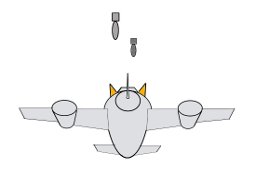
When nation A’s crazy leaders decide to carpet bomb the people of nation B, today’s invention is a defensive use of unmanned aerial vehicles.

Nation B would have squadrons of small robot aircraft, perhaps launched from a patrolling cargo plane when an air raid was threatened.

Bombrella

Since dumb bombs fall quite predictably in clumps and strings within the atmosphere, the UAVs would be able to locate them descending from altitude, fly underneath, at zero relative speed and catch the bombs before they could hit their targets in B-land.

The drones would automatically fly their dangerous cargo somewhere else (perhaps back to A’s territory) before inverting and dropping them to detonate safely.

Although some targets would still be hit, the effectiveness of such bombing, always questionable, would be further reduced.

#2339: BulletBrake

Since it seems gun control is hard to legislate for in some countries, today’s invention is a way to allow people to own guns for home defence which have severely limited range.

A conventional semi-automatic has a number of extra ports created in its slide. Its barrel too would have perforations around its circumference, corresponding to these ports.

recoil

When the trigger is pulled, the gunpowder ignites and the slide moves backwards as normal. Much of the energy in the cartridge is however lost as the ignited gas vents through the barrel and ports.

This greatly reduces the muzzle velocity, allowing a homeowner still to apply lethal force but with greatly reduced danger to bystanders from stray, long range shots and ricochets.

The ports and vents could be positioned circumferentially and sized so as to react accurately against the up-kick and torque which firing such a weapon generates.

The effect would therefore be to improve accuracy significantly at close range.

#2338: Cameractor

A film director may spend days working with cameramen to plan a complex scene with lots of actors. This is necessary to capture dramatic interactions without also getting bits of equipment in-shot.

Today’s invention is instead to equip each actor with a small, covert camera, which runs throughout a scene. This would involve a tiny lens probably best be positioned above an actor’s ear and, if necessary, coloured green to enable it to be automatically painted out later.

Andy_Barton_actor

This would allow the actors to move much more freely and generate point-of-view footage from several perspectives. The views could later be intercut into a final version (or perhaps multiple different versions).

Each actor’s camera could automatically process their view using aspects of their character (such as sepia, for an older person, enhanced shake for someone who was cold, defocussed for a person with a visual impairment etc.)

#2335: BodyWarmer

Cameras with interchangeable lenses pose a problem -how to swap optics without allowing dust to enter both camera body and lens system….especially if you are shooting somewhere with airborne particles.

Today’s invention offers a solution, at least for high-end optical gear.

Niels_Rameckers_camera

Starting to remove a lens would cause a small internal heater in the camera body to fire up briefly. This would pressurise the inside of the camera by a few Pascal over atmospheric pressure.

A gentle but steady puff of air would occur for a second or so through the lens attachment ring.

In this time, a new lens could be attached, thus minimising the amount of airborne grit etc which could get anywhere near the interior of the system.

The thermal effects on the optics would be not much more significant than those associated with photography on a hot day.

#2334: FanLander

Flying fixed-wing aircraft from ships is fraught with difficulties.

The pressure is on to create aircraft carriers which do not require a huge runway (since it makes them costly and vulnerable).

fanlander

VTOL aircraft are hyper expensive (especially if you’ve decided to ditch, rather than upgrade, the superb Harrier), so how to equip one’s comparatively bog-standard fast jets with seagoing abilities?

Today’s invention is a new concept in aircraft carrier.

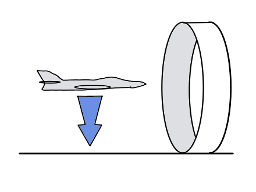
This is based on having a small ship, packed with planes and with several enormous Dyson-esque ring fans on deck.

These would be capable of creating such an airflow that an aircraft placed in front would rise vertically and fly through the hoop to take off.

To land, approach the hoop with a high airspeed but zero deckspeed and, by reducing the fan airflow, touch down gently.