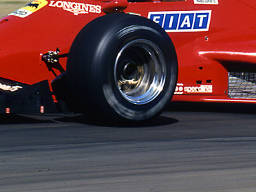
#2311: Heartaser

Today’s invention is a personal defence system for those who have already suffered some kind of heart problem.

This takes the form of a sub-cutaneous defibrillator with an additional two electrodes facing outwards just beneath the skin.
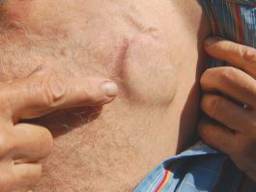
Julia_Freeman-Woolpert_pacemaker

If a user of such a system is grabbed by an assailant, he or she would give them a bear hug or divert their hand onto the skin over the embedded unit.

This pressure would activate a switch which sets up a sudden voltage between the outward facing contacts (without disrupting the heart of the wearer of course).

A voltage of about 2kV would thus be applied across a small area of an attacker’s body…quite enough to discourage any further aggression.

#2310: Arcroyal

Aircraft carriers are regarded as vulnerable targets in an era of smart missile technology.

Today’s invention is a submarine aircraft carrier, which would significantly lessen this weakness.

arcroyal

In the upper part of the image a water-level view of this vessel is shown.

A submarine, shaped like a banana, would open bow and stern doors to allow a telescoping set of circular arcs to emerge.

As the vessel heeled over a bit, These would form a conical-section runway, supported on the distal side by a small surface vessel (circular section).

Aircraft could then taxi out of the sub and undertake a circuit or two whilst gathering enough speed on the banking to achieve takeoff.

To land again, planes would fly in a circular arc, using autopilot if necessary.

(The view from above is shown in the lower part of the diagram).

#2309: Knottube

Today’s invention is a technique for making a tubular frame structure.

Instead of welding, brazing, bolting or gluing…why not try knotting?

Jointie

When making eg a bicycle frame, one tube would be filled with water under pressure.

The second tube would be similarly pressurised to maintain a mostly circular cross section and then bent, coarsely, into a knot shape around the first.

Both tubes would be subject to varying internal water pressure and tension applied to all four ends.

This would eventually allow a very tight knot to form so that both tubes would be pressed into each other, joining them tightly.

The tension and pressure would then be removed.

#2308: Blowattage

I usually manage to get a phone signal these days when travelling on trains but, on long journeys, my laptop batteries often run out of juice.

No problem, you say…just plug the power cable into the socket provided…

Santiago_Cabezas_fan

Fine, except that the train companies can’t keep even electrical power supplied to carriages reliably (100 different safety warnings at ear splitting volume, repeated at every stop, but no damned electricity).

So, today’s invention is a micro wind turbine device that benighted passengers can poke out of the window of their carriage when the train company has spent all its maintenance budget on directors’ bonuses.

This might even take the form of a secondary cpu fan on an extensible cable that could sit in the window frame, attached to the glass using a rubber sucker or two.

#2307: Clawinnings

Nail polish doesn’t appeal much to me. It works for Eddie Izzard but he has genuine class.

Today’s invention is intended to appeal to people who want to wear such varnish but who can’t resist picking it off in unsightly flakes.

juzara_hand

One would insert one’s hand into the slot of a varnish machine.

This would spray a code or symbol on your nail in a very tough varnish.

It would then apply a self-adhesive stick-on nail film in an opaque, contrasting colour to each of your fingers.

When you were later tempted to pick off the outer layer, the code would be revealed, potentially winning a big lottery prize by placing a call to the number shown.

Reader invention: Advertoasting

Here are a couple of genius ideas from readers Andy, Alan, Rob and Alex (with permission, of course)…

An internet enabled toaster that toasts customised advertisements on
your bread using a laser.

The toaster will be provided for free and paid for via the advertisers

Prior art: Scott van Haastrecht’s Super Mega Toaster

A thought from this morning. If the air in a Dyson Airblade hand drier
was heated up could a slice of toast be toasted more evenly?

I love these and think they are original (I have seen somewhere a memo toaster, via which family members can get their calendar entries and reminders to appear on toast).

It might be cool to print a QR code thing on one’s toast, so that you could insert it into a ‘spread’ machine which would read the code and squirt on jam or peanut butter…

#2306: Symmetrotor

If a helicopter sustains damage to its rotor blades, then it is normally time to attempt some kind of forced landing.

Today’s invention offers an alternative.

SONY DSC

If your chopper starts with blades at 90 degrees apart and one is eg partly shot away, then the damaged one would be jettisoned and the remaining blades would automatically reconfigure so as to space themselves out circumferentially at 120 degree intervals.

If an original five blades were suddenly reduced to two (at 180 degrees), there would probably also have to be some increase in engine speed, so that, in the worst case, a gentle landing could be effected.

In this way, your blades need only be controlled by a very simple swarming algorithm that says “maintain equal distance from your two neighbours.”

A similar approach might work for windfarms, since their blades are always breaking off.

#2305: Pitline

Yet another motor racing idea (somebody in motorsport should really be sponsoring all this activity!).

Today’s invention is an updated version of the pit lane.

pitline

Instead of numerous teams of earnest young men in button-down collars and logo’d fleeces, imagine if pit bays were each replaced by a high-speed locomotive (maybe based on a steam catapult).

Running on a very short length of rail (maybe only five or six car lengths), this would consist of a mobile on and off-ramp. The system would automatically accelerate very fast to match an incoming car’s speed exactly…so that racers, eg in 24 hour events, would not have to slow down.

In the 1 second or so during which the car would be ‘parked,’ on the moving platform, robot arms would change tyres, wipe screens, check fluids etc.

With these tasks completed, the loco would brake, ultra-hard, discharging the car back onto the track.

Slow motion reruns of these events could be played on tv, but without any danger to a pit full of humans.

It might even be possible to fit the pit with an injector seat unit, which would swap drivers from below.

#2304: FlapStrip

Flags are a bit boring on a windless day.

I have proposed before various approaches to blowing air across them but today’s invention is a different approach.

waver

A motor unit could be raised or lowered on a conventional flagpole.

On the top of this, a crank (grey) would be rotated. Attached to this is a shaft composed of many hinges, each free to rotate only a few degrees about a vertical axis.

The hinges would be embedded within the upper edge of the flag.

In this way, the motor could be slowly rotated, allowing the hinges to support the flag whilst also simulating the effect of wind-driven flapping.

#2303: GripMap

In Formula 1 racing, each tyre is expected to lose around 0.5 kg of rubber in the course of a race.

A large fraction of this comes off as granules which are blown or can be swept to the side of the track later.

file0001766816797

A significant amount, however, adheres to a racetrack surface, which makes the task of tacticians in the pits all the harder. Should we start on the softest compound…or wait?

Today’s invention is to allow abs brakes to be fitted to cars during practice.

Teams could thus identify precise locations on the track where wheels began to lose grip before racing began in earnest.

Teams would be required to pool their data, so that everyone would have access to a roughness map of the track on race day -to help them make more effective tyre selections.