#1789: Divertical

Formula 1 steering wheels are becoming stupidly complex. A system which needs so many electronic controls can’t really be operated safely by people using pushbuttons at 200MPH.

In particular, the need to turn the wheel, about a near horizontal axis, with all that inherent arm crossing, is a throwback to the days of sailing ships.

A much more ergonomic approach, for vehicles which never need to turn much and whose drivers are already fatigued, is to have a wheel whose movements more directly map onto the directions which the front wheels are required to follow.

Today’s invention is therefore a racing steering device which has all the usual bells and whistles mounted on a pad which rotates about a vertical axis (shown from above in the picture).

Push/pull seems much more natural than clockwise/anticlockwise -especially when supported by a spring and damper system.

#1787: Microtator

All microwave ovens have cools spots where the intensity of radiation may be lower than required to cook food properly.

Today’s invention is a way to ensure that your food gets heated adequately to suppress the proliferation of bugs and also to taste better.

A small disc-shaped reservoir with a microwave-transparent window and a rounded base is filled with water.

As the oven works, two tiny jets of steam are driven from the circumferential pipes shown, so that the reservoir spins on the rotating dish within the oven.

This extra rotation ensures that all parts of the bowl of soup shown will be irradiated correctly.

#1783: MealBrake

For people who want to eat in a more refined way and perhaps limit the speed with which they engulf their dinner, today’s invention offers some support.

It consist of a knife, fork and plate set in which both implements contain an electromagnet.

Powered by batteries in the handles, these would be actuated by a transmitter hidden in the plate. When the knife and fork were both in contact with the (metal) plate, a sensor in it would actuate the electromagnets at random intervals.

This would cause the knife and fork to adopt a one-across-the-other configuration ( as recommended by my mum’s table manners lessons to indicate ‘I’m still eating’).

This would have the effect of slowing one’s pace and provoking some prandial peroration.

#1781: HeatPhones

Surprised that I couldn’t find these within the random pile of online patent database contents…

Today’s invention is headphones for an MP3 player which contain a small heating coil in each one.

This allows them to act as super-effective earmuffs when these things are worn outside on a very cold day.

(This might require carrying around an extra battery pack of course).

#1780: Hospitalidry

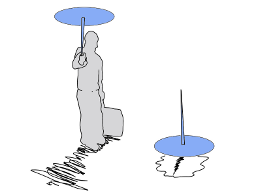
Hotels like to supply their guests with a way to get into a waiting car without getting soaked by the rain (assuming the absence of a liveried postillion with a brolly).

Supplying umbrellas becomes unpopular with hotel management, though, when people walk off with them.

Today’s invention is a novel guest umbrella.

It would be designed as a large flat disk with a long, thin conical handle. The umbrella would not collapse but would remain as shown.

A guest could pick one of these up from a nested, space-saving set in the foyer and use it to get into their vehicle. It would then be much too big to get in their car, even if they wanted to take it away and so it would be left, handle-upwards, on the driveway.

Cars could safely drive over the handles, deflecting them but not damaging them (or their vehicles), until they were later collected for reuse.

#1775: RoadTrunk

Where to put a new road is a major planning decision.

Today’s invention aims to make road network building more of an experimental science.

The basic unit of this approach would be a prefabricated tunnel module, as shown. This would be like a pontoon bridge but land-based and installed off the back of a low loader using a crane. Once in position, the road surface inside could be covered with a thin coat of tarmacadam and the exterior painted to blend in with the surroundings.

It would have a translucent section in the roof and solar powered lamps for night driving. There would also be sound and thermal insulation, as well as filters to absorb the worst exhaust pollutants before allowing air to circulate into the atmosphere.

A new section of road, made of these modules, could thus be tried out for a fixed period to see if it was working for all parties concerned. It might then be replaced by a conventional road, or allowed to remain as is, or moved to another trial site.

#1773: TwoTallows

Today’s invention is a metal collar, forming part of a candelabrum and which allows for less wasteful use of candles.

A candle (yellow) is fitted into an insulated base (grey).

Once lit, the candle heats an overhanging metal plate which is bonded to the candelabrum base (white).

The base contains a candle-shaped mould with a wick inserted (orange). This is heated by the action of the candle so that the run-off wax gradually fills the mould and creates a new, albeit smaller, candle (which itself can then be placed in the base and reused, etc).

#1772: DeckPods

Aircraft carriers are huge, expensive targets.

Today’s invention is to replace them with small submersibles which can be air-dropped into an ocean.

Each of these would be uncrewed and equipped with a quiet motor so that they could navigate autonomously but very accurately, sub-surface if necessary, to rendez-vous with any helicopters or VTOL aircraft. They would then surface briefly to provide a landable platform.

Offering a mobile source of stores and fuel, these pods would also act as stepping stones and thus allow such aircraft to cover huge ranges -whilst themselves being extremely hard to find and attack.

#1770: EscalAidor

Large transport planes fly fast with huge loads but are currently incapable of vertical take off and landing.

Today’s invention is to equip a large transporter plane with a set of strong hooks on its upper fuselage surface.

This would enable a handful of heavy-lift helicopters, flying temporarily from a remote mountainside, to take off, attach to the plane and fly with it until the airspeed was sufficiently low for them to land the transporter vertically.

The reverse process for subsequent takeoff of the empty plane would certainly require no additional helicopters.

In this way, remote regions could be serviced, with eg repeated emergency aid supplies, very rapidly and from very far away.

#1769: Cinemaximised

Film is still not interactive enough. Today’s invention attempts to make watching a movie more of a game-like activity.

Movies would be shot in high resolution, so that it would be possible to zoom in closely on certain parts of a scene.

An audience could decide, using standard clickers, to pause the action and zoom in on a region on the screen, in order to get an explanation of the plot or more information about the back story.

Only by extracting this information could a viewer expect get to the end and understand the whole thing.

This would allow movies to be made simply, without needing multiple parallel plot branches.

It would mean that each movie would probably require a few viewings for an audience to feel that it had got to the bottom of all the storylines. This additional business would be welcomed by the movie studios.