#1768: Adjustand

Over the weekend, I must have seen half a dozen performers come on stage and mess about with poorly adjusted music and microphone stands.

This breaks their concentration and disrupts the audience’s sense of anticipation.

Today’s invention is a tripod stand which can accommodate a smartphone. This runs an application which allows the playbill to be entered, so that each performer can specify in advance their preferred height for the mic or music stand.

The phone would then talk to a small motor and screw drive in the stand itself, so that as each player appears on stage, and touches their name on the list, the equipment adjusts itself smoothly.

An extra clever version would listen to each performance and work out when it was over, so that the next act’s height could be selected.

#1767: RopeRecord

I came across an article talking about how best to maximise the speed of a record-breaking skipping rope.

Today’s invention contributes to this specialist arena by making the rope out of very thin wire.

Onto this are strung small flat ‘beads’, each with an aerofoil section and the ability to rotate about the wire.

Each bead could also be individually weighted to ensure that, at speed, the catenary shape taken up by the rope would be the one with lowest overall drag.

#1766: StarPower

If old stars are actually molecular factories, pumping out complex organic molecules (like petroleum) into space, then that’s exciting for finding extraterrestrial life.

Today’s invention, however, ignores that prospect and uses the star effluent as fuel.

Since we know how to locate the kinds of old stars which seem to generate the hydrocarbons, a very long range robot explorer space craft, once launched, could target a bank of these stars and steer towards them using only inertia.

On arrival, eventually, it would fly through clouds of the free fuel, storing it in enormous tanks before deciding where next to explore.

#1763: GhostMat

As far as steering a cursor on-screen goes, I prefer the Lenovo nipple/joystick design myself.

Today’s invention, however, is for those of us who can’t get used to using a touchpad on a laptop and yet still want to use a standard mouse -despite not having adequate deskspace (when travelling, for example.)

It consists of a chain of large, plastic links which can bend only in the horizontal plane.

To one end of this, a conventional mouse is attached.

As this is moved through the air, the links in the chain transmit their relative rotations to the laptop, so that the cursor can still be accurately positioned on the screen.

The chain can be easily folded up and stowed, when not in use.

#1758: Antianimal

More playing about with camouflage. Alan Turing wrote the book on pattern formation.

One of his conclusions, from theorising about reaction-diffusion chemistry, was that small body parts were more likely to have stripes and larger body parts to bear spots.

Today’s invention therefore is to create a camouflage pattern which inverts this logic (eg for hunters to wear). Such an outfit would have spotted ankles, neck and forearms and increasingly stripy patterns towards the middle of the body.

The idea is that if game animals are naturally attuned to a particular arrangement of markings, as indicative of a large predator, they will be less likely to detect the shape of a person wearing a highly atypical variant on this.

#1757: Camoufoliage

It’s been a while since I indulged my boyish enthusiasm for things military, so here goes…

Today’s invention is an extra-tall periscope for armoured vehicles.

This would normally be clamped flat to the machine’s upper hull. When required, the turret would rotate, attach the periscope tube (yellow) to the gun mantle and slowly raise the scope until it was nearly vertical.

This would provide the commander with a good view of the surrounding territory, especially when fitted with infra-red imaging equipment. It would also isolate the optics from the main weapon’s normal impacts and vibrations.

The periscope would be stored with local foliage attached so as to give a good impression of a tree.

The rate at which this periscope would be raised, when not in a rush, could be controlled by computer so as to be too slow to be perceived by a human observer.

#1756: Espinage

I’m a huge fan of spy films and whilst watching ‘Tinker Tailor Soldier Spy’ recently it occurred to me that arranging items on a pegboard was an investigative approach worthy of an upgrade.

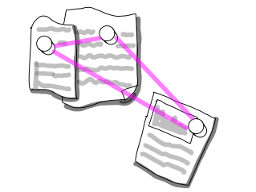
Today’s invention, therefore, is a smart pinboard.

As well as being able to write and draw on the background, as in a conventional smartboard, this system would enable documents etc to be attached to the board using magnetic ‘drawing pins’.

Each pin would contain a series of leds, each of which could be masked or illuminated in a chosen colour so that the cold-war era ribbons showing connections could be superseded. This would enable items of evidence to be assembled in a 2-D framework and their relationships displayed.

Any two items could be linked by the beam joining their pins. Beams would be frequency coded so that moving an item would allow the beams from other items to follow and maintain the pattern.

A pin might be able to read and store data from its document and even moved by computer-controlled magnets within the board so as to shake up thinking and spot possible new connections (arraying paperwork by date, for example, would be feasible).

#1752: DriverDuct

Following several tragic deaths and injuries to racing drivers recently, today’s invention attempts to provide a measure of added protection for the heads of drivers of open cockpit racing cars.

When any piece of airborne debris breaks one of a number of infrared beams which form a ‘cage’ around the cockpit area, the engine airduct is fired forward to encase the driver’s head and the rollbar.

The duct is propelled by a strong spring to cover the cockit in a few milliseconds. It moves on a pair of rails and when in the cover position, still allows the driver some forward field of view.

A driver might even be able to retract the hood, once the danger of impact had passed.

#1751: Roadisplay

When someone is going for a cycle-based land speed record, they really don’t need to be staring forward and thus boosting drag effects.

Today’s invention is a way to help such record breaking attempts.

The rider adopts a face-down position as shown.

A micro projector, attached to the frame and fed with imagery from a tiny camera, facing forward, shows a picture on the ground of where the machine is headed, together with real-time data about current position on the course and the pacing required for that stage of the run.

It might even display motivational messages or imagery.

#1747: MobileMobs

Since, it seems, the entire world economy depends on mobile phones, today’s invention is a new way to market these devices.

People could answer a questionnaire online. This would categorise them as belonging predominantly to one of a dozen or so social groups (eg jocks, hipsters, fogeys, petrolheads, goths, barbies, nerds, etc).

The sales website would then present them with the phone most likely to fulfil their needs (based on both the casing design options and the pre-loaded software).

Not only would this reinforce both people’s sense of identity and community, it would also allow them to be identified by members of other social groups, enabling the starting of a face to face conversation or an evasive maneuvre.