#403: Adverchains

Even in this era of global warming, there are large areas of the inhabited world still covered in snow. Some of these regions are populated by people with money to spend and therefore a pressing need to be advertised to (eg ski resorts).

Today’s invention is a set of snow chains which, when fitted to a giant 4×4, will allow it to leave behind wide tracks advertising some product or other. The links in these chains might even be reconfigurable to allow users to advertise their own local restaurant url or other apres-ski entertainment. They might just say “…Party –> Party –> Party –>…”.

Gözde_Otman_tracks1002.jpg

My postman wears snowchains on his boots in winter and so individual shoechains might be similarly constructed, with an advertising function in mind.

#402: Flagphone

Back in the old days, believe it or not, domestic cordless phones were thought to be technically advanced, allowing one to receive calls at the far end of the garden (?) Anyway, one advantage which they did provide (apart from no longer having to resist the homing instinct of the springloaded handset cable) was that they had an extensible aerial.

To make or take a call, you had to pull out a half a metre of shiny telescopic metal above your head. The benefit this provided was that everyone could see you were on the phone and give you a wide berth for a while. More recently, with the tendency to use ever smaller phones, it’s quite possible to walk up to someone who is listening on an undetectable phone and attempt to engage them in a second conversation…only to be faced with a great deal of frowning and animated gesturing to the effect that one should ‘go away’.

Franque_de_Win_phone1000.jpg

Today’s invention to to equip all phones with an ‘aerial’ which has no electromagnetic function whatever. It could be made in the form of a thin version of a metal tape measure. The tape housing could be attached to the phone body and when the phone is in use, the ‘tape’ would be extended, carrying a small pennant on the end for extra visibility.

This would be greatly preferable to a simple flickering ‘busy’ light on the phone and, if one cared more for ‘cool’ than ‘green’ the aerial could be pushed up by a small motor when the phone became active.

Printable pennant inserts would be made downloadable, bearing ‘clever’ daily mottos. I actually think that a small LED on the end would help to enhance phone sales significantly (and reduce any possibility of eye injuries).

#401: Doglock

For people who own a dog, shopping or visiting the library or bank can become problematic. If it’s an animal with any sense of adventure or market value, you really won’t want to leave it tied up in the conventional way outside the local store.

For securing your canine pal outside the shops, It might be possible to reuse some of those popular wall-mounted boxes intended to accommodate all that online shopping which arrives when you are out (probably shopping offline).

Meghan_Anderson-Colangelo_dog999.jpg

Today’s invention, however, is a cable lock which can be fed through a series of holes around a dog’s collar (or better, shoulder harness), and which allows them to be secured to anything stationary, without fear that they will be abducted. Owners would then be free to enter all those places from which dogs are banned (ie pretty much all public buildings).

#398: Lap(top)belt

Mobility is one of the great things about laptops. We encourage our sales staff to drive about the country with an occasional pitstop to take calls and catch up with the form filling on their flip-top friend.

Naturally, their machine gets tossed on the passenger seat beside them: -until there’s an accident, in which case it becomes a high momentum paving stone with an embedded sheet of glass.

thony_creativo_laptop990.jpg

Today’s invention is a variant on the standard Kensington-type lock. At one end of a short cable, the usual push-in-and-lock fitment attaches to the computer. At the other end, a clip which can be snapped straight into the passenger seat buckle housing (for easy removal when the driving is done).

The cable itself could be made with an embedded shock absorber in order to limit the damage to the internal drives and connectors which a collision could cause the machine itself.

#397: Easiearrings

I have discussed earrings a surprising number of times -ie more than zero. I’m certainly no expert in the design of jewellery, but it seems to me that there are people who don’t mind having holes punched in their ears and others for whom it seems a big concession to make to vanity.

Today’s invention is a way for people who will only wear clip-ons to be able to buy all those earrings intended to be pushed through a slot in one’s lobal cartilage.

Fran_Priestley_earring988.jpg

This consists of a small clip-on earring with a protruberance on the bottom of the clip side. There is a horizontal hole drilled in this which allows a push-through earring post to be inserted and locked in place, as usual (The clip-on protruberance thus takes the place of the ear). The dangly bit of the push-through hangs below the ear as usual and the butterfly spring locking part (if there is one) is hidden behind the lobe.

Ear piercing is thus no longer necessary and buying presents for glamorous females is (slightly) simplified.

#396: Treat vase

I used to be massively overweight. Eating when distracted is a great way to overlook the sheer volume of food being taken on board.

A particular technique which helps is to put some food eg on a plate but then realise that it can be returned to its wrapper or container…it’s easy to feel committed to eating a certain quantity, just because you have ‘chosen’ to put it on your plate.

Paweł_Zawistowski_nuts982.jpg

Today’s invention allows people to pause and question that commitment…which can make you feel much more powerful and in control of your eating.

Most food packaging is designed to help the user to get easy access to the contents. For treats like nuts or small sweets, I propose the following. Treats are placed in a simple cylindrical container which has an inward pointing conical neck (which can be unscrewed to allow food to be decanted in). The aperture at the tip of the cone can be adjusted to correspond roughly to the size of the treat (perhaps by pinching it into a narrower oval).

Inverting the container allows a small volume of treats to appear in the hand or in a dish. The cone makes it much easier to return some of the items to the container than it was to extract them.

This action alone sparks the realisation that not everything taken out must be consumed and builds confidence in deciding what to eat.

#395: Clamp foil

Having your wheels clamped can be both maddening and wildly expensive. It’s fair enough, I suppose, if you’ve parked stupidly somewhere and caused a dangerous obstruction. I’m less convinced, however, by the private companies who use wheel boots on cars parked on unmarked urban spaces (there’s usually a sign in 10-point font somewhere behind a lamppost saying “Park here and it will cost over £200 to get your car freed”).

So, today’s invention provides a way for people to avoid getting clamped. It is designed to make it hard for a car to be lifted safely onto a transporter too. This relies on the notion that a wheel clamper (or car tower) is concerned not to damage the vehicle in question (which is not always the case, despite the legal implications).

Joël_Dietlé_clamp981.jpg

The invention consists of a semicircular strip of metal attached to the car body at the 9 and 3 o’clock positions around the wheel arch (any garage can install this without fuss and it might even be a factory-fit for certain models). This strip can be freed to rotate out of the wheel arch so that its 12 o’clock point touches the ground.

A second strip, in the shape of another segment of a circular arch, is attached at the 12 o’clock position in the wheelarch. Its other end can be swung out and locked to the first arch, sitting on the ground.

This allows all four wheels to be defended from clampers by walking around the car on departure, swinging out eight metal strips and locking four locks. There is now no way to easily attach any kind of wheel clamp or to feed bars under the tyres to allow the whole car to be llfted (without damaging the vehicle’s bodywork).

On that point, all four ‘cages’ would be marked prominently with the owner’s telephone number and a warning about not attempting to restrain or move the car -on pain of extreme litigation.

#391: Graduart

Gauss, the mathematical genius, once said of his most elegant proofs that when a building is complete, the scaffolding shouldn’t be still on show. Actually, some of the intellectual scaffolding underlying his thinking might well have been messy but there’s surely huge value in being brave enough to show the process of creation as well as the polished result.

This applies, I reckon, to art as well.

dovile_butvilaite_paint970.jpg

Today’s invention is an advanced digital ‘photoframe’. Imagine a future larger-scale frame (or a bigscreen tablet PC) which comes supplied with only one digital content element. It is a second-by-second movie of a painting or sculpture in progress. Every brush stroke or chisel blow is shown from start to finish, when the final masterpiece appears.

In this case, the frame comes with no networking cards and it’s sealed to prevent anyone hacking the internal chips without destroying their content. No-one can make copies therefore (other than by filming the screen). There might only ever be one ‘original’ sold (at a very high price for the entire high-resolution movie).

This approach, however, opens the door for visual artists also to sell lower resolution versions of their work (at a much bigger range of reduced prices than conventional prints allow). There might be versions for example in which the development is shown only every day, or in which the movie stops a few days short of completion. The highest price versions could also contain some ‘special features’ such as interviews with the artist made throughout the creative endeavour.

#390: Screenscraper

Chilled by the process of scraping my windscreen clear of ice in the mornings, it seemed to me there must be a better way.

Today’s invention is an upgrade to the standard window cleaning device in which a magnetic handle is swept across the inside surface of a window, driving a magnetic pad to clean the outside.

dlee_ice968.jpg

Here, the external pad is equipped with a replaceable plastic blade (in the form of a credit card blank). This can be used to scrape at the ice on a windscreen -without having to stand outside.

The inside section could have a slender handle which would allow the far side of the screen to be reached from the driver’s seat and (if necessary) to carry a wire from the cigarette lighter to a heating coil inside the pad which is in contact with the screen’s inner surface.

This would work best in conjunction with a windscreen wiper motor circuit which, when sensing a fall in temperature below zero, would occasionally activate the windscreen wipers overnight and thus minimise the build-up of ice on the screen.

#388: Buttonsynch

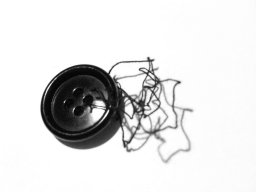
For children who are learning how to get dressed, dealing with buttons is a difficulty. For their parents, having to undo and redo these numerous times is simply a pain.

Today’s invention is colour-coordinated buttons and button holes. “Put the red button through the red buttonhole, dear”.

fausto giliberti_button962.jpg

It would, of course, be possible to manufacture press-on coloured spots for both buttons and holes in any garment.