#387: Heatlock

Opening the refrigerator door allows it to fill rapidly with air at room temperature. This causes the system’s cycle to fire up to cool the interior again. Running the compressor motor every time the door opens is potentially very wasteful of energy -especially if you are cooking a roast at the same time…or returning for ‘just one more spoonful’ of Greek yoghurt every 90 seconds.

Today’s invention is a way to avoid this wastage.
Andre_Veron_ice960.jpg

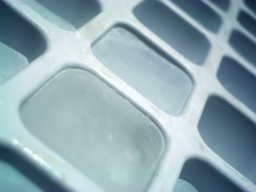
Each fridge door would come with a double-glazed window insert, making the inside clearly visible. There would also be an insulated glove penetrating the door and allowing items to be moved around and placed in the tray of an airlock set into the door.

After the normal (weekly) filling of the fridge, via the main door, the vast majority of articles could be extracted from and replaced into the fridge via this mechanism -without having to flood the cold space with warm air each time.

Restricting the ingress of water vapour in this way would also stop the formation of mist on the window.

#386: Appeteyesers

It’s a fact that food is more attractive (and will be judged tastier) if it is illuminated in the right way. This causes retailers to spend large amounts of cash in lighting fruit, meat and bread in stores (to say nothing of all those colour enhancing additives). Restaurateurs know that shining blue lamps on tables tends to reduce diners’ enjoyment of even the finest cuisine.

Today’s invention applies this knowledge directly to the process of eating. We could build lamps into the crockery (which would be ok, but hard to avoid backlighting making the food look uniformly black).

Colin_Smith_pizza957.jpg

Instead, each knife and fork would be equipped with a small lamp and a variably-coloured filter. The lamps would act as miniature, widebeam floodlights. Each item of cutlery might be set with a slightly different hue and intensity in order that a more interesting mix of appetising colours could be played on the meal.

The lamps themselves could be automatically activated when picked up and switch off when set down. They might even be set to decrease their intensity over the duration of a meal, in order to help reduce the total amount of food consumed.

#383: Weightbelt

Musculoskeletal problems often arise in people who carry heavy items about -especially if the loads are distributed asymmetrically. Classic examples are children carrying a schoolbag crammed with books (and mobile electronics) on a single shoulder and the accountant with a box case full of papers -gripped in one hand. (Actually it’s more likely to contain cash, for which complaint I have less sympathy).

Today’s invention is a new way to enable people to carry such loads more easily.

handle946.jpg

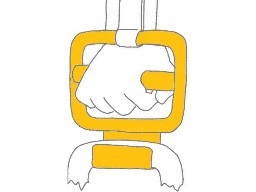
This consists of a pair of lightweight plastic handles connected by a webbing strap. A large weight can be held by the hook beneath one handle. This is then supported by the nearer hand, in the usual way (fingers fatigue under load, without other backup).

The strap allows the weight to be also spread across the shoulders and the distal hand, which can press down with elbow locked, to help support the load.

#382: Finz

Today’s invention is a simple way to reduce the heat lost by your gloved fingers by about a third.

It also allows me to indulge my limitless admiration for the zip fastener (again).

Andre_Veron_zip944.jpg

Each adjacent pair of glove fingers has a zip on the outer surface between them, which can be used to join the fingers together; reducing their area and heat loss.

This also allows e.g. the index finger to be separated occasionally for increased dexterity…just as long as that doesn’t involve something so stupid as operating a trigger.

#380: Sailing zips

Windpower is a pretty poor source of energy (at least over most of the Earth’s surface and in the absence of a government subsidy). It does, however, provide an effective way to distribute goods around by sea. Now the use of sailing ships is being widely revisited for this purpose.

Conventional sails require to be hoisted and lowered in order to maximise propulsion, and avoid damaging the ship to which they are attached. This is a laborious process, even if the hoisting is undertaken mechanically.

Carli_Donsky_sailing940.jpg

Today’s invention is a set of fixed sails on a large sailing transport ship. The sails stay in position, irrespective of wind condition. Each of these has a series of long, linear cuts made in it. The cuts can be opened or closed using large, robust zip fasteners.

These zips can be driven by computer-controlled winches to different positions in order to tune the drag of the sails and optimise their response to the wind.

#379: Opinionbin

Manufacturers usually have to wait for their sales figures to appear before they can detect the success, or otherwise, of some product line.

Today’s invention allows information about the satisfaction of large numbers of real customers to be gathered. This aspect of marketing is sometimes forgotten in the rush to move on to the next shiny product…but what customers think post ownership is increasingly important in the race to build brands.

It consists of a waste bin equipped with a cameraphone. Items of packaging which were just about to be thrown away are briefly passed in front of the phone’s camera which can image their barcodes and allow the soon-to-be-former owner to express their satisfaction with their purchase in a variety of different ways (depending on how much time they have available and how incandescent with rage they have become).

Zdeslav_Schreiber_bin918.jpg

These expressions could start at the level of scrolling to click a happy or sad icon (a little like the wall units found in motorway toilets). It would also be possible to provide more information, if the user desired, about eg how easy the product had been to open or use and about the value obtained.

This would then all be communicated back to head office via the normal cellphone system. A server would interpret the barcode image and link the code to details of the product.

#375: Readerbot

Young children seem to develop a strong attachment to certain storybooks.

It’s great to be able to calm them down at bedtime with a reassuringly familiar tale…although as a parent, reading the same book fifteen nights in a row (without being allowed to introduce any interesting characterisations to the narrative) can become a chore.

reading_hortongrou925.jpg

Today’s invention is a book cover which contains a small microphone and enough digital storage to record a version of every book in the house, being read by every grown-up family member.

The child recipients of these stories should still get cuddled during each performance, but parents can glaze over at the end of a hard day without having to actually say the words (again).

This would work particularly well as a memento of grandparents, after they are no longer around.

#372: Toastector

There was a furore when people suddenly discovered that the ‘standby’ condition for electrical devices allowed them to continue drawing current when not in use and thus wasting energy. I’m therefore amazed that I haven’t been able to find any reference to the following idea (at least in the course of a quick patent and web search).

Toaster technology is still pretty primitive…mostly it’s a story of an overelaborate initial design being multiply updated with rigorous cost cutting at every stage of evolution (I’ll no doubt return to the subject of that ridiculous universal clamping system in due course). When you shove in fewer than the maximum number of slices allowed for a given design, all the heating elements fire up, full blast.

Kyle_Sorensen_toaster919.jpg

Today’s invention is a simple optical switch that can be fitted to existing toasters to allow them to sense which slots actually contain bread and to allow current to flow in the corresponding heating elements only.

This allows up to a 50% saving in the cost of running a toaster, over the course of its life.

#371: Rainbow drinks

Drinking a tumbler full of cocktail or smoothie can become a chore by the end -you can adapt pretty quickly to one taste so that it becomes cloying…wouldn’t it be great if drinks had an element of surprise?

Today’s invention is a way to liven drinks up.

cup914.png

A honeycomb material could be supplied to bars. It would be closed on one side, open on the other (forming vertical tubes, each wider than a drinking straw).

When a multicomponent drink is ordered, a section of this material could be cut off and inserted into the right size of glass.

The measures required to make the drink would be poured in, as usual, but distributed non-uniformly by hand across the tubes.

A straw would be used to drain each tube in turn -each of which would contain a different combination of components -providing a much more exciting tipple.

Each tube would contain a different coloured mixture as well -making for a more interesting visual experience too.

#369: ImPrompTu

As teams of people increasingly work in distributed locations, it’s becoming harder to coordinate face to face activities.

Even organising a brief team-building lunch in advance can turn into a planning task more akin to hosting a UN convention.

Razief_Adlie_cups910.jpg

Lots of software exists to arrange meetings by specifying the possible dates and then maximising the number of participants available on the day. Today’s invention is a program which hunts for impromptu opportunities (at less than a day’s notice).

It constantly searches a shared online calendar system for spaces in which every member of a small team is ‘free’ and, subject to a set maximum frequency for such events, proposes a shared coffee or lunch break to all concerned.

This can be used to provide people with a source of pleasant surprises at work (as opposed to the drudgery of formal meeting arrangements).