
Today’s invention is really more a design.
It is a lamp with a solid base taking the form of the shadows which the body of the lamp would cast when the lamp itself shines on its components (leaves, in this case).

Today’s invention is really more a design.
It is a lamp with a solid base taking the form of the shadows which the body of the lamp would cast when the lamp itself shines on its components (leaves, in this case).
In olden times, when I was growing up, making do and mending was a common approach. Now it’s coming back into style, perforce.
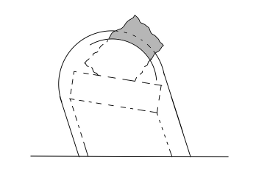
People may even begin using pencils again and perhaps not throwing them out when they become tiny stubs -as mine used to.

Today’s invention is a tube into which such stubs can be inserted and which retains the front one using a small screw.
This device maintains as usable lengths of pencil which would be impractically small. This also allows the front pencil stub to be sharpened in situ repeatedly and eventually extracted and thrown away.
I was talking with an inventive friend recently and she mentioned the issue of cucumbers not being naturally resealable (thanks Muriel).
Today’s invention is a way to seal up any longish fruit or vegetable in the kitchen which is likely to get dehydrated.

It consists of two forms of plastic ring element (light and dark grey). These can be screwed together to forms tubes of variable length so that, as a cucumber is shortened, the container can also shrink. This means that the air in contact with the fruit or veg is minimised and dehydration greatly limited.
The rings seal together in the same way as a contact lens case, and so it would be possible to store things with a liquid surrounding them (water, vinegar) if you wanted.
For someone who regards secrets as, in general, not healthy, I seem to spend a lot of time thinking about shredders.
Today’s invention is intended to add an extra measure of security to paper shredding by making the required orientation of the paper on insertion, non-obvious.
Thus, rather than just entering beautifully-aligned A4 sheets (which are measurably easier to reconstruct) this gives an added element of angular randomness to the direction of cut each time.
Using biometrics for access to computers is now common and works, sort of, for many low-security applications.
Today’s invention is to equip a computer mouse with a clear window in the upper curved surface where one’s hand normally rests. A small, high resolution camera shoots through the hole, together with an outgoing beam of light.

To start the machine, hold the specially curved surface of the mouse against one’s eye orbit. The light and camera are activated, taking pictures of both iris and retina.
These are automatically fed to the computer which confirms one’s identity to a very high level of precision.
The images are also stored so that, over time, these can be examined (perhaps automatically) for any telltale signs of incipient illness.
I was standing behind Clive James in a supermarket food queue once and, rather than engage him in discourse on Piero della Francesca, I merely scrutinised his basket. I was surprised to find him buying sausage rolls with tomato.
It made me seriously think about how I could live a small part of his life for a mere £2.49 (plus loyalty points). Today’s invention is a website which can be used by celebrities to publicise what they consume (whether food or books or whatever).

They upload their receipts (in return for extra discount and publicity). The rest of us get some kind of vicarious post-twitter contact with the media pantheon -and their shopping.
I tend to think that hunt sabotage has more to do with fighting the class war than saving creatures from suffering.
Today’s invention is weapon on behalf of the ‘game’ animals and the human beaters who find themselves economically dependent on this form of feudalism.

It is a swarm of small robots which can be used to pre-beat an area of moorlands so that hiding grouse or pheasant are driven away before the chinless hoorays range rover onto the scene.
These would be capable of maintaining a coordinated line across the terrain, moving quietly beneath the foliage so as to remain concealed. The failure or destruction of one would be automatically adjusted to by the others and they could be programmed to rendez-vous later in the back of a waiting truck (using eg GPS units built into each).
Most significantly, no human beaters would find themselves walking towards a line of shotguns held by merchant bankers.
I’m slightly surprised to see giant 4x4s driving around with ski racks on the roof.
A much less ugly approach, given their massive ground clearance, is to mount a shallow, tough box on the underside of the vehicle. Today’s invention would thus allow skis to be slotted in from behind the vehicle, making them much less likely to fly off in transit and also providing better aerodynamic performance (mostly by smoothing off the car’s neglected underside).

This discreet, tray-shaped box would also be potentially much more secure for expensive skis than leaving them roofside. The box itself might be used as a sledge.
I’ve been fascinated by self-erecting cranes for some time. These work by having a cage which can move up or down the column of previously built units (blue). When it stops, the bottom part of the cage engages with a unit and pushes upwards off its roof, lifting all those units above one unit higher.
If you want to build a tower by this method, the fastest approach is a)
keep the cage at the bottom and keep injecting units without waiting for them to be lifted any higher. If, however, you want to minimise the stresses on the cage, then b) is a better option ie insert units at the top.

If you wanted to build a towerblock in which each unit was a floor of the building, b) would be used. A novel, ‘instant’ fire escape would need to operate in a) mode.
Today’s invention is a simple algorithm for building such towers.
Knowing the maximum safe load for the cage, inject from the bottom for maximum speed of construction until this load is reached.
Then, move the cage up one unit and inject at this new level. Repeat this last step until building is complete.
Who says that wallpaper has to be as wide as it is? We have decorative (horizontal) wallpaper borders, so why not wallpaper itself?
Today’s invention is strips of (vertical) wallpaper which are much narrower than normal (eg perhaps 12 cm wide).

Although requiring more trips up the ladder, these would have the enormous advantage of being very much easier to paste and hang around tricky surface features (eg corners) than the usual stuff.
Once the first strip was hung correctly, using a plumbline, the others could be very easily butted up against each other. This would obviously work best for paper with a bold, vertical, striped pattern; hiding the joints and making pasting and pattern correspondence between adjacent strips very easy.
