#309: Socket lock

Designers of public buildings have to be fairly careful about where they place power sockets. Aside from the question of public safety, anyone with a compatible plug can insert it and draw power until they get told to stop.

Today’s invention is a power socket incorporating a lock mechanism. This might have internal barrels (just like a Yale lock) which make spring-loaded contact with one of the three pins on the incoming plug. This pin will have a corresponding key shape formed on one side, so that only certain plugs can enter the socket and draw power.
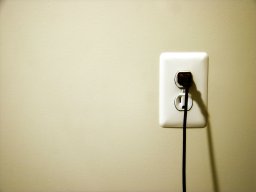
aaron_beall_socket743.jpg

Sockets could be designed to admit only a small number of different plugs (with each building or business having its own set cut by a conventional locksmith).

Foreign appliances would be excluded, preventing someone from using an electric fire in their hotel room or running a fast-food van’s fryer from a railway station supply. Picking the lock would be a perilous endeavour.

This approach might be extended to laptops, for example. Supplying each with a power lead with a key on the end entering the machine would decrease the chances of a machine being stolen when not attached to its (unique) lead. No-one would want to have to buy a replacement battery every time one discharged.

#307: Link enhancer

Just a few years ago, the idea of being able to embed a video in your website would have been thought far-fetched. The whole YouTube phenomenon now makes that routinely possible (even if their website itself looks like some kind of cutting room jumble sale).

Looks are important in this highly visual medium, especially if you’re relying on ad revenue -which brings me to today’s invention.

flamenchaos_pra737.jpg

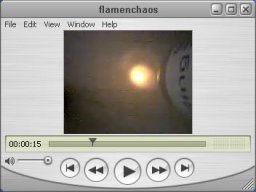
Often, when I run across some kind of a video link on another website, the still image which contains the link is ‘muddy’, indistinct, blurred and frankly uninviting. It usually consists of a single frame of video, so it’s not surprising that the perceived quality will be low, given how much mental work goes into interpreting any flickering sequence of images into a meaningful, continuous film. Take a look here at an example of exactly what I mean.

More often than not, this smudge doesn’t tie up wth the crisp text which surrounds it -lessening the chance that you will bother viewing the movie at all.

Today’s invention is a tool which enables anyone creating a link to a video to choose one representative ‘frame’ (by stepping through the sequence). The tool will then grab several before and after images and use these (together with the usual automatic processes such as contrast and edge enhancement) to make a clearer, more inviting image link.

#305: Flushbox

I’ve noticed that bathrooms tend to contain many items which just don’t get properly clean by being run under the tap occasionally.

This includes eg, toothbrushes, hair brushes, combs, soap dishes, shaving kit, sponges, nailbrushes, make-up ‘tools’ etc…even the dreaded dentures.

Christopher_Potter_bubbles735.jpg

Today’s invention is a scaled-down dishwasher system for the bathroom. As a subsidiary idea, I’d also like to suggest that dishwasher-proof detachable sleeves be fitted to all handles in the bathroom -so that once in a while these could be properly scrubbed (especially for those who insist on having a toilet brush).

Together, these could effectively limit the gradual accumulation of crud and germs (although toothbrushes and other items might need to be washed in a separate compartment).

#300: Ypod

A propos my recent ranting about personal stereo earpieces and the cables that are always in a knot, why on earth do they have to be so long anyway? Are there people who insist on storing the player in their sock, and running the wires up their leg?

Anyway, today’s invention is a DIY answer to the eternal question of self-knitting ipod ear bud wires.

David_Reimer_tangle724.jpg

Basically, the idea is to get a long zip (something like a brightly coloured, plastic anorak one will do). On each side of the zip, fold the fabric around one of the wires and glue it back onto itself to form a long, thin sleeve.

With the player attached to the lower end of the zip, you can now join the sleeves by running up the zip keeper up between them. Voila, you have just created a low-tangle, Y-shaped, wearable keeper for your music player.

If you need something even slimmer, then you could consider asking a plastic bag manufacturer to embed a few million metres of wires in a few million metres of zip-close bag seal…just be careful not to a) make the chopped lengths too long and b) retain some width of material in the ‘zip’, otherwise the whole thing returns to spaghetti.

#298: Raid braid

I’m increasingly amazed by the cheapness and memory capacity of USB thumbdrives. There are many documented attempts to make a workable RAID* array using these devices.

Today’s invention is another such attempt.

Martin_Luckner_usb706.jpg

Instead, however, of connecting a small number of these in the conventional way, into a common hub, I propose that each drive should have a USB connector on either end. This would therefore allow drives to be chained together (using flexible connectors), offering the prospect of a) a unified, massively scalable, logical memory system and b) a wearable storage belt, capable of being adopted as a consumer fashion item.

This might best take the form of two parallel ‘memory ropes, ‘ providing increased redundancy (either by mirroring: copying data to several disks or striping: splitting data between disks) in the event of some breakage under flexure. Someone seems to have picked up on the idea here and more recently, here.
*(Redundant Array of Inexpensive (or Independent) Drives (or Disks))

#297: Decal decoys

There’s a great emphasis currently on anti-theft design…rucksacks with integral knifeproof chicken wire, that sort of thing.

Cars already have the protection of a huge range of such devices from steering locks to trackers to alarms…to electrified door handles.

Nick_Cowie_rust714.jpg

Today’s invention is an addition to this armoury.

For ‘prestige’ vehicles, which are often stolen to order, having imperfections in the paintwork severely lessens their value. Despite what happens in the movies, thieves aren’t really interested in respraying vehicles.

So I suggest equipping such cars with a small collection of realistic stick-on transfers. Some would look like rust spots, others like obvious flaws in the paint. You could even apply apparent key damage scores.

These could be made very realistic: convincing to anyone walking by without a microscope.

Such special effects would strongly deter criminals and, when not needed, simply peel off the pristine paintwork.

#295: InterFace

Despite the huge effort that goes into designing digital cameras, they still suffer from some obvious and important flaws. On a £100 device, this probably isn’t that crucial, but if you are in the market for a £2,000 camera, and trying to take hard-to-get shots, the user interface shouldn’t be getting in your way.

Neither should your nose. Most ‘professional’ SLR’s don’t (yet) provide you with a preview screen at the back, so the user is obliged to peer through a viewfinder. Sometimes this even comes equipped with a nice squishy eyepiece. The problem is that lots of photographers have noses that make using an eyepiece damn near impossible. One solution would be create two large triangular recesses in the camera back on either side of the eyepiece. I guess you’d describe such a design as quirky or even ‘organic.’

Edwin_P_slr705.jpg

Today’s invention, however, is to place the final eyepiece lens at the end of a tube, sticking out from the back of the camera and thus allowing space for anyone’s nose. It might even come with a foam rubber pad which could be rotated about its axis to provide a cushion/brace for either cheek to press against (even when the camera body is being held at an angle).

For extra benefit, it might be possible to mould a cheekpiece for each individual (just as with boil-in-the-bag gumshields) and to make it transparent in order not to obscure the data on the rear display.

#294: Utilitool

What happens if you need a range of tools with you all the time but you don’t want to cart about an entire shedful of them? …often, a solution is to get yourself a penknife-leatherman-multitool and strap it onto your utility belt.

The original folding penknife idea is pure genius, of course. One problem though is that if you look through e.g. the Swiss army knife catalogue, only certain ‘blade’ combinations are possible. You can have the saw, the corkscrew and the small blade but not in addition to that pointy thing for getting stones out of horses’ hooves.

Patataj_Patataj_knife707.jpg

Today’s invention is a penknife/multitool implement which consists of a handle into which the user may choose to slot their own selection from a huge range of individual blades.

This allows you to have several such ‘knives’, each of which is optimised eg for gardening or electrical maintenance, rather than being a catch-all compromise.

#292: Cybercard

It’s impossible to do anything new in terms of business cards, right? Well here is an attempt to add some extra value to the whole exchange-of-dogeared-cardboard ceremony.

Today’s invention is a handheld labelmaker device which takes in your existing, paper business cards and prints, on the reverse side, a url specific to the meeting you are hosting. This might well allow you to print a personalised note to the recipient or remind them of a good joke someone made in the meeting. (The device might contain a high capacity digital audio recorder. This could make a recording of the meeting and automatically upload the file (or a transcript, if necessary) to the url in question).

Steve_Woods_card698.jpg

The people you have met thus have a reason to pay more attention to your card and to follow up the event by visiting a website (on which you may also choose to present them with other relevant information).

This would allow particiants to edit and agree any meeting note, online. Once agreed by everyone who was present, this could be used as a record of decisions taken and actions arising, without the need for official minute taking and with less scope for subsequent misinterpretation.

#289: Whispertone

It’s a fact that you can hear your own name being whispered, even against the background chatter of a roomful of people.

As I’ve mentioned before, it’s really disruptive if a mobile starts ringing suddenly…this is particularly true if you are sitting on a bus or train with people surrounding you who are trying to catch up on sleep.

Ryan_Glanzer_crowd689.jpg

Today’s invention is an alternative ringtone.

Get someone you trust, eg your mother, to record a short message into your phone: “Patrick, I need to speak to you.” This then becomes your ringtone whenever your mother is identified as the incoming caller by your phone. You can hear her saying your name, even though the volume is turned down really low, thus avoiding the opprobrium of waking everyone else up in the business meeting train.

This of course can be extended to everyone whose number is stored on your mobile.