#287: Handle glove

Handheld tools, everything from a dustpan to a screwdriver are designed for use by both left- and right-handed people. It’s a sad fact of life, though, that everything works better if it’s designed to be held in one’s dominant hand.

Suppliers are understandably reluctant to make everything right-handed, or even to manufacture numbers of products in the ratio of right to left handers within the population.

Ula_Kapala_grip687.jpg

Today’s invention is a way to allow people to make optimal use of their handedness.

Whenever a new tool is made, it would be supplied with a push-on, flexible rubber handle. This would conform to the geometry of, say, a right hand when holding the implement.

If a purchaser is left handed, he or she simply removes the grip and turns it inside out before pushing it back onto the tool.

The inversion results in a mirror image rubber handle.

#286: Forecourt torus

If I had paid £300 for a motorcycle helmet (only somebody with a £200-head economises here), I’d be reluctant to put it down on a tarmac forecourt, sopping in diesel and rainwater. Surprisingly that’s what often happens, when I’m enviously watching my two-wheeled counterparts fill their tanks.

Bikes these days often have narrow, dropped handlebars and razor thin seats, which can no longer accommodate a helmet when the rider has to go and pay (having been asked to remove it before entering the shop in order not to scare the counter staff). To preserve the beautiful multicoloured artwork or race replica stripes, the lid is set down on the underside: just right for collecting gravel, moisture etc on the soft edge of the liner/ straps and depositing it down the rider’s neck later.

ason_Smith_helmet684.jpg

Instead, I propose another product in the booming motorcycling aftermarket. A small steel plate is attached to the rear of the helmet near the neckline (using some of that thin, double sided adhesive foam). To this, a chemically resistant plastic ‘doughnut’ containing a magnet can be attached.

The doughnut can be ‘stuck’ on the plate in two positions. The first aligns it with the wake on the back of the helmet and reduces drag. The second causes a segment of the doughnut ring to lie beneath the neckline. This allows the helmet to be set down, stably, on any surface, whilst keeping the helmet substantially right-side up (in case helmet removal is unavoidable when it’s raining) and above the floor-level crud.

#285: Cinemabilia

Product placement is centred on the idea that Tom Cruise’s use of an Apple machine on screen will encourage people to buy one (or feel better about having bought one). Cinema memorabilia, ie selling props used in films, is presumably driven by the same need which people have for glamour -even if only by association.

Today’s invention is a tool to allow people to buy products appearing in digital films.

Many frames in a movie would have the objects within them tagged. Clicking on the screen of a DVD player or laptop would cause the movie to pause and show detailed views of the item for sale, together with the price, options to bid in an auction or even lookalike merchandise versions. Viewers could then actually undertake the transaction before watching the rest of the film.

Bart_Groenhuizen_film682.jpg

The tagging itself could be done manually or semiautomatically by image segmentation techniques (By first allowing a test audience to click on items they were interested in buying, a pattern of tag popularity could be developed. Those scenes which were tag-rich could be highlighted with a coloured dot appearing in one corner). It might even be possible to help this process by attaching a machine readable label to many props in a scene, tagging these locations and and then having the labels automatically ‘painted out’ in the final ‘print’.

Now that digital media prices are being forced down (due to the industry-wide failure to invest in security research) this provides both a way to add value to the original purchase and also extra revenue streams at different points in the value chain.

#283: Rays awareness

A certain fraction of the world’s population (especially red headed, cricketing Australians) are paranoid about skin damage caused by over exposure to the sun. The public health message is that a little sun is good for you (we all need that vitamin D) but that too much is a very bad thing. How much is too much?

You can use a watch to calculate when to put your shirt back on, but that neglects how strong the sunlight actually is on any given day.

Scott_Snyder_tan678.jpg

Today’s invention is a cheap tool to help protect people from sunburn. Take one of those ultra cheap credit card-sized, solar powered calculators and discharge it completely. Place a few layers of cellophane across the solar cell, calibrated so that the amount of sunlight required to first display “000000.00” is just less than the amount which causes skin damage. Attach the card to one’s clothing, where the display can be easily seen.

Once the safe limit has been reached, it’s time to head indoors. The card can be discharged and reused or simply jettisoned (given the fact that these are often freebies anyway). No more ‘boiled lobsters’ on the beach.

#281: Lumine-sense

It has been some while since I was caught in a power cut. Naturally, when one happens, the torch you placed in a position of readiness contains only batteries which ran out of charge some time before the Light Brigade.

Today’s invention is a simple combination of a matchbox inside a box of candles, with the outside decorated in glow-in-the-dark strips.

Innocent_Kapesa_candle673.jpg

It would be necessary to keep the box on an open shelf, but when the power station throws a wobbly, at least you will be able to locate all the makings of some domestic visibility.

#279: Slow glow

Brake lights only come on when you apply the brakes, but it’s perfectly possible for your car to decelerate rapidly, perhaps in front of another vehicle, without using your right foot.

It seems to me to be a good idea for cars to be equipped with ‘brakelights’ which come on to indicate any deceleration greater than a given, statutory value. (Actually, it would be even more sensible for their brightness to be in proportion to the strength of braking, but I imagine that is a tougher technical one to deal with).

myles_davidson_brakes669.jpg

A sudden slowing might be caused by eg, engine braking or running onto a steep incline (neither of which would currently be signalled explicitly to following traffic). It would be relatively easy to wire accelerometers into the brakelights system.

This would also help alleviate one of my problems when driving behind an idiot (-might even help people driving behind me). These individuals will tailgate the vehicle in front, whilst driving in too high a gear, and then repeatedly touch the brakes. This redlight flickering is distracting and also encourages me to brake intermittently as well: a tendency which gets passed backwards in waves to other cars, causing all sorts of irritation and interruptions to the traffic flow. If these tiny touches on the brakes were screened out by the proposed system, maybe this toe tapping effect would be neutralised.

#278: Jaywaking

I sometimes spend time in a city centre office, through the window of which filter all sorts of distracting noises. One of the most irritating is that ubiquitous, recorded alert that says “vehicle reversing” every second or so. People are so used to hearing that monotone that they don’t bother to look up -until they are alerted to the fact that it was addressing them by finding a 3-tonne truck rolling over their foot.

We have allowed urban environments to bring motor vehicles and people into ever-closer proximity and it’s proving to be a bad idea. Today’s invention attempts to reduce the accident rate caused by paying too much attention to incoming music or speech.

Christopher_Potter_crossing635.jpg

Vehicles would be fitted with two small, coded transmitters (one fore, one aft). The devices carried by earphoned pedestrians would receive these signals, enabling them to predict a collision (based on knowledge of positions, achieved via triangulation, and a simple computation of their relative motions).

On prediction of an imminent impact, the sounds being listened to would mute and a warning squawk would be issued.

This might even be extended to allow vehicles, sensing a pedestrian on their immediate trajectory, to brake appropriately.

#275: Yopod

There are hundreds of “solutions” to the problem of how to manage your mp3 players’ cables.

I’m quite keen on wireless headphones myself, but for those still struggling with stereo spaghetti, here’s a new option.

Farhan_Amoor_yoyo649.jpg

Today’s invention is to embed the player within a yo-yo and to use the mp3 cable as the yo-yo’s string. Obviously the player would be allowed to rise only as far as the user’s hand, not right up to the “v” leading to the earpieces.

This would be useable whilst the music played (without doing too much damage to the wires) and then instantly self-stowing on the final rise of the yo-yo.

An entertainment win-win.

#274: Eyes-right

In an urban environment, sometimes the amount of signage is overwhelming. When some of those signs are safety-critical, there will inevitably be problems.

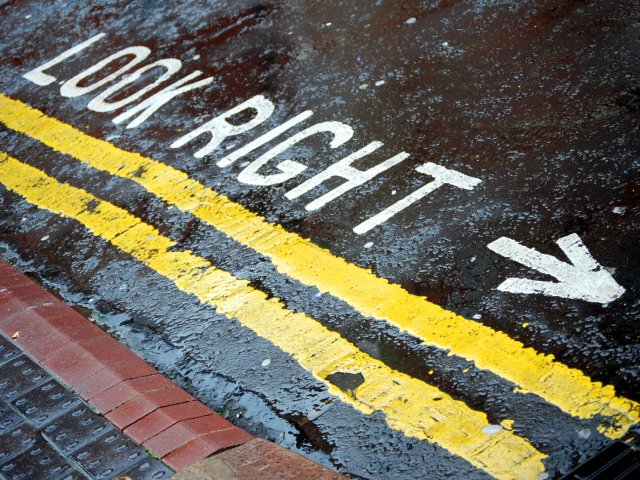
One example is when crossing a busy one-way street. Assuming traffic is coming from the left, on the road surface, at one’s feet are often printed the words “LOOK LEFT.” This is all very well, but on the far side of the road, adjacent to the pavement, the words “LOOK RIGHT” can be seen -upside down.

Dan_Shirley_left631.jpg

For some reason, I find that I rarely look at my feet when about to cross and so it’s the far set of instructions I see. Interestingly, the fact that they are upside down usually fails to register and I end up, in these circumstances, looking right; ie in the opposite direction to the one from which traffic is coming. Given enough time and attention, I can take another look and avoid disaster but some people must fall foul of a moment’s indecision.

Today’s invention attempts to fix this situation. On the vertical face of the far kerb, the words “<– LOOK LEFT" would be stencilled in the normal, readable orientation (and vice versa on the presently invisible, vertical face of the roadside on which one is standing).

This relies on the kerb being of sufficient height to display the words, but at least only one set is ever visible, reducing the  scope for fateful errors.

#271: Cred-id card

I’m pretty much against debt in connection with personal finance (don’t start me on the subject of mortgages, let alone overdraft rates).

Today’s invention is a simple attempt to decrease credit card fraud (at least when the cardholder is present) now that chip-and-pin technology is starting to come under pressure from clever criminals.

Lotus_Head_card623.jpg

When you apply for any of this plastic (or even for an account), you upload a digital photograph of yourself which the bank then laminates into the body of the card (occupying the full size of one side of the card). This makes a low-cost link between your credit status and personal appearance in a very cheap way, that retailers etc can easily verify.

(Naturally the image could have other security features embedded, in order to lessen the danger that a card might be delaminated and a false image substituted. A simple one might be to only have some regions of the face image visible from one side of the card and the rest only from the other side. This would require fraudsters to embed at least two substitute layers, yet shopkeepers could just spin the card about a given axis to see all of the face at once).

It has the added benefit that if you drop your flexible ‘friend’ on a bus, someone may recognise the owner and return it.