#241: Yellow peril?

Is the secret service really spying on people by encouraging printers to spatter coded yellow dots all over their documents? I must say I find it implausible.

For the determinedly paranoid amongst us, today’s invention provides an answer. Rather than scanning every document you print with a blue light (how’s that going to help exactly?) just arrange for your paperwork to contain lots of extra full stops. These would take the place of every space on a page and be printed in a very low-saturation yellow.

Marja_Flick-Buijs_dots547.jpg

Your identity can thus be protected by the old techique of hiding in plain sight.

#238: Mountain dissuader

Walking along a high-altitude path the other day, clad in about ten layers of thermogorexlactylite, I met a family who had decided to take their kids up the same mountain wearing flipflops and summer dresses.

When you’re standing at the bottom of a big hill, on a beautiful sunny morning, it’s very easy to think that a stroll to the top would be a fun, spur-of-the-moment thing to do for an hour or two. Four hours later, you can easily find yourselves soaked, lost in the mist and with chattering teeth in a wind-chill of -10. The mountain rescue services cost a huge amount to launch -and they may not get to you in time.

Angela_Costales_mountain535.jpg

Today’s invention is a way to help people to imagine what conditions on the way to the top can be like (I once worked on a naval firefighting simulation project with the aim of making the unimaginable real). This takes the form of an extra portaloo shell (many popular walks supply these facilities at the carpark anyway). This would have an entrance and an exit and be built into a fence so that the only easy way onto the mountain would be via this portal.

On opening the entrance door, showers inside would be activated, together with a powerful fan, in an attempt to create the worst thermal environment experienced on the mountain within, say the last month. Inside it would be kept dark.

Ill-equipped people would thus be made aware of the potential unpleasantness of their impromptu trip and either get correctly kitted -or dissuaded.

Better dissuaded than deceased.

#234: Cup chute

Whenever I try to grab hold of one of those plastic cups at the water cooler, it’s impossible. I mean it’s nigh-on impossible to get just one: about 85% of the time I end up with two or more extracted simultaneously. There is no hygienic way to shove the extras back in the tube from which they’ve just come, of course.

The reason is that these thin, flexible cups are so tightly nested together that air has difficulty flowing in between them when one is being pulled out. This results in a low pressure region between cups that serves to hold them even more tightly together. If you sense this resistance, you are likely to grip the end cup tightly enough to be also holding its internal neighbours and so more than one eventually emerges.

Marija_cup524.jpg

The cost of these cups is only a fraction of a penny each, but we still end up throwing away twice as many as we really need to.

Today’s invention is simply a delivery chute in the form of a gentle curve along the direction in which the cups are fed. The curve has the effect of opening up a gap between adjacent ones and thus allowing air to flow in more freely. One cup at a time can therefore be extracted.

The curved chute could be wrapped around the outer cylindrical surface of the water cooler carbuoy itself, for added stability.

#232: Can crusher

Recycling metal cans is ok as long as the metal is aluminium. If we are talking steel, there is no easy way to crush them flat for efficient storage and transport: short of giving them a good sledgehammering

To make life easier, simply disrupt the part of the design that provides such structural strength: their seams.

Each can would be opened at one end in the usual way and the contents removed. I’d imagine using an electric, wall mounted opener in which the can was free to rotate about a diameter halfway along its height (using eg a big suction cup, to help pour the contents into a bowl). A wide variety of can sizes could be dealt with by this technique.

Craig_Jewell_can521.jpg

This would allow the opener swiftly to deal with removing the other end of the can. The remaining open-ended tube would be much more easily flattened by use of a smallish lever (in the same way as Al cans are now).

#231: Duststubs

Every laptop you can buy nowadays is so pocked with ports and connectors and plugholes that they look like Swiss cheese.

It might seem mundane, but these tend to get clogged with dust, fluff and other extraneous crud. This certainly has a bad effect on the longevity of the machine and, worst of all, any contamination between contacts and you start to lose connectivity.

Majoros_Attila_laptop518.jpg

Today’s invention is simply a selection of rubberised ‘earplugs’ of various standard sizes and configurations which can be used to blank off these holes. Each would be backed with a plastic tab (in a variety of popular colours) for easy removal.

#230: Shredsafe

Using my shredder every time a single document needs dealt with is a pain because it’s noisy and slow. So I have been posting them into the bin which forms the lower part of the machine. Over time, this has filled up and there is now a pile adjacent to the bin.

I do this shredding thing because there are some documents that I’d prefer not to hand to thieves and blackmailers. It just suddenly struck me as ironic that all of this high-security material is now lying in my office in the vicinity of the shredder: it might as well have a big sign on it saying “Important, sensitive documents -please steal.”

Bob_Smith_shreds516.jpg

So, today’s invention is simply to equip the device with a laptop-like cable lock and a hasp. The hasp would link the bin (without obstructing its posting slot, of course) to the box on top with the blades in. This would also loop around my desk to make walking off with the whole thing significantly more difficult.

#228: Supersized bike

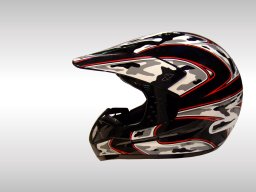
I live in a place with some of the best biking roads, but one of my major frustrations is not having a motorcycle.

Why? It’s simply because even the biggest motorcycles available just don’t fit my long back. The result is that when I sit on one, my head is way above the tank, leaving my chest right in the path of the oncoming airflow. That’s not the real problem of course, since I can easily hold on at my maximum speed of 80mph (on a dry private road, in a straight line). The real issue is that I look ridiculous sitting on a machine designed for a normal-sized adult.

G&A_Scholiers_helmet510.jpg

Anything that’s supposed to have been derived from a racing machine is out of the question, since it’s designed with the physique of an undernourished homunculus/jockey in mind. Some of the bigger bikes come close to acceptable, but I’m not prepared to fork out £12,000 for ‘close’ (to say nothing of all that ugly chromium).

Today’s invention is an optional, factory-fitted tall tank+big screen+high bars kit, for people over 6′. If a single manufacturer went to town and designed these parts to be both compatible with the rest of the machine and also aesthetically right, for a couple of appropriate bikes, I’m sure they would reopen motorcycling to a large section of customers.

The normal tank could be fitted to a high fibreglass shell integrated into the screen and (lowered) seat, so that the fuel mass would remain low and not affect the handling/dynamics.

#224: Stress alarm

How much illnesss is caused by stress? Nobody knows but it must be a lot and, as every £100k+ doctor is aware, healthcare is very expensive.

Today’s invention is aimed at tuning people in to the level of stress to which they are subject, before it accumulates and does them further, longterm harm.

Nadjib_Aktouf_stress502.jpg

A straingauge is attached to the inside surface of a molar. Clamping or grinding one’s back teeth is a sure sign of undue tension, so the straingauge can monitor the stress set up in the enamel and drive an integrated buzzer device.

If you are having a hard day at the office or trying to deal with customer service representatives who just don’t understand the concept, this will remind you not to grit your teeth.

Life’s too short to spend it in a state of perpetual dental compression.

#221: Waitless

People who have been trained to wait on tables have an uncanny knack of turning up to deal with requests at exactly the right moment. Such people are very rare.

It’s generally considered rude to attract the attention of waiting staff by waving or even snapping one’s fingers (despite the fact that they may have been discussing the football results together in a corner for the last 20 minutes). Not only that, but inexperienced staff may (eventually) respond out of turn to particularly intense waving or snapping -making everyone even more agitated.

Dora_Pete_restaurant457.jpg

Today’s invention provides a way for staff to be made discreetly aware of the requests of restaurant customers -and in the order in which they arise.

Every table in a restaurant has a torch fixed to the centre, pointing upwards. When people at a table need something, they switch the torch on and it creates a pool of light on the ceiling. A simple integral eggtimer simultaneously starts to pour sand in front of the torch lens, reducing the size of the illuminated region above each.

Staff can thus work out, by glancing upwards, which table has been waiting longest for service at any given moment.

#217: Streetstreaming

When fighting my way through congested railway stations or shopping centres, I sometimes like to think of myself as a particle in a fluid flow. To get to that ticket barrier faster, it would be really good to hitch a ride on a fast moving streamline.

How can crowds be streamlined? There is usually no chance to overtake that big guy with the rucksack who keeps stopping or the woman with the pram that’s holding everyone back.

riszka_Niewiadomski_crowd484.jpg

There’s a lot of research into how crowds behave. It seems that people tend to look ahead, spot potential obstructions and weave their way through any available gaps. They self-organise into lanes and thus decrease their ‘friction’ with other people who are advancing in the opposite direction. Tube station designers know something about crowds and they tend to rely on signs saying ‘Keep Left’.

Today’s invention attempts to enhance the natural self-organisation which runs into difficulties when crowding is so dense that weaving isn’t really an option. In areas of expected congestion, lanes would be painted on the floor in smoothly swooping layouts. Each would have arrows marked in it indicating the allowed direction of travel. There would be a gradation from left to right of speed: say ‘crawler’, ‘walking’ and ‘rush’ lanes.

People could thus make a choice to match their requirements on the day, in a similar way to the choice of lane on a motorway.