#2146: GreenGlazing

One of the features of sick buildings is that people have no control over the heating or window opening.

When these controls are available, occupants frequently run the heating with windows ajar. This is bad for fuel economy and probably kicks a carbon footprint-sized hole in the local climate.

Today’s invention is a two-part lock which should help.

One element covers the window lock, the other the radiator thermostat.

These devices talk to each other wirelessly so that the window lock will only be exposed if the radiator is off.

Similarly, the radiator can’t be turned on if the window is open.

#2145: Localaska

As one who prefers eating to making food, I rarely delve into the dark arts of culinary innovation.

Today’s invention represents an exception for those who like eating stuff which has spatially-varying temperature.

A microwave oven doesn’t heat the contents uniformly, which is why they tend to have integral turntables. In fact, the intensity of heating varies from point to point within the oven, so the temperature distribution resembles a patchwork quilt.

Today’s invention is a new, rapid version of Baked Alaska.

A base of eg biscuit crumb mix would have blocks of icecream placed on it where the microwave nodes occur. Then an additional layer of the crumble would be spread on top.

The whole thing would be microwaved on a grid standing above the turntable, so that only the antinodal regions would be heated.

This might also be used to insert other raw stuff inside baked goods…sushi pie anyone?

#2144: TwinFins

Frogmen often swim underwater using a relaxed body undulation technique that resembles the movement of a seal or dolphin.

Today’s invention is a modified set of swimfins designed to help this kind of stroke.

A pair of regular flippers have regions of velcro attached, as shown.

These can be slapped together, one atop the other, so that the fins stick temporarily together and act like a mermaid’s tail…providing greater potential thrust than the two separate fins.

Surprisingly, I can find nothing of this kind in any of the patent databases.

#2143: Hybrinjection

People crazy enough to be drag racing have been injecting nitrous oxide into their engines for decades.

Today’s invention offers a new way to gain extra speed off the line whilst not decreasing the danger.

A two-cylinder version of the engine envisaged is shown. Each cylinder has a tank of nitrous oxide with an electronically controlled outlet valve.

When one of these is opened, a stream of oxide passes into a hybrid rocket motor (orange) where it is ignited. This combustion process drives the conventional engine’s piston.

The gas valve then closes, ignition ceases and the exhaust stroke is shown in the bottom picture.

Safe? No. Fast?…potentially, albeit with an engine change every 200m.

#2142: Smashine

Today’s invention is an improvement on this one.

When a road accident occurs, there is almost always a loud bang.

Streetlights could be fitted with microphones to detect this, so that when there was a loud impact, the nearest few lights would flash on and off, indicating a problem to oncoming drivers.

The flickering of lights on either side of the bang could be timed so as to apparently point to the lamp nearest the accident (as cone lights currently do with eg roadworks).

The lights might also send a message to the police or at least take a photograph of the vicinity (when the lights were in the ‘on’ state).

A more advanced version would have the streetlight flashing be radio-triggered by eg airbag or bumper sensors within vehicles themselves.

#2141: HeatSeat

Motorcyclists have a hard time when it rains.

Today’s invention is a covert hairdrier for the seats on motorbikes.

A drier could be fitted under the tank, with air emerging through sculpted vents. The device would be run off the battery and might even use air drawn over the engine if it were hot.

This would quickly allow a soaking seat to be blown dry, reducing the time spent wiping rain away with one’s glove.

In very cold weather it could be used as a heater, whilst actually driving.

#2140: TalkTape

Imagine a tape measure which could react to voice commands.

Today’s invention is a measure which has an internal drive motor and a processor capable of interpreting a small number of spoken words.

This allows the user to say “12.3cm” and have the correct length of tape emerge.

You could also say “one third of that” and have the tape length reduce to 4.1cm at once.

It might also be possible to have the device announce the current length of the extended tape (in any units required).

#2139: StandGuard

Today’s invention is a novel bikestand.

This takes the form of a larger than usual mudguard (on front or rear wheel).

When you want to park the bike, unclip the mudguard, fold out the two semicircular side panels and lock them in position, so that they act as supports for the inverted guard on the ground.

You can then place the rear bike wheel into the secure slot formed and use a conventional U-bolt to lock it vertically in place through the hole provided in the stand.

#2138: ChainChange

Today’s invention is a bike chain which acts as its own simple gearing mechanism.

Imagine two conventional, fixed-size sprockets, one attached to the pedals and one to the rear wheel hub.

The chain connecting these has links which are sprung so that they would naturally compress together into a shape like vvvvv rather than – – – – – – (Shown at the top in yellow).

As the pedal wheel rotates, two C-shaped diverters are moved in and out independently. Moving in flattens the vvvvv shape into – – – – – – around one or both of the sprockets.

This change in radius provides four gear ratios, as indicated, without needing any kind of derailleur mechanism (beyond the small, sprung tensioner wheel shown).

#2137: Minimirror

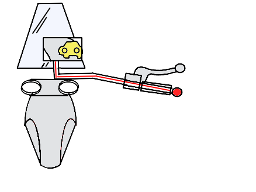
Today’s invention is a new mirror for motorcycles, or even bicycles.

It’s really essential that vulnerable road users are aware of what is bearing down on them from behind. I myself would be a stain on a Northern road had it not been for remembering to look over my right shoulder.

So, rather than use the standard drag-inducing mirror, located somewhere that requires you to take your eyes off the road, imagine a fish eye camera lens placed at the end of one’s handlebar (red).

The camera is connected, via an optical fibre bundle, running within the handlebar, to a small screen behind the windshield.

This makes any movement behind a two-wheeler immediately apparent -without the usual ‘messerschmitt-twitch’.