#2166: Targetext

When you are cutting code in a program editor, sometimes you can expect to find an insertion indicator which is brightly coloured, so that losing your place becomes harder.

When, however, editing a dense body of colourful text on-screen, it’s very easy to misplace the insertion point.

You can usually adjust the flicker frequency manually, but it’s not elegant and often the active location is hard to spot in one’s visual periphery, if you are momentarily distracted.

All these little delays add up to unnecessary frustration. Today’s invention is therefore an insertion indicator which automatically takes on a contrasting colour to the text around it.

Obviously white on black would be useless, but a simple lookup table would allow a user to choose a personal set of high-contrast colour combinations e.g. for black text on white, I might choose a red insertion point.

Start outling a section in red and the insertion pointer would change to green.

#2165: StickShare

It seems that ground-based pilots of UAVs are finding it hard to cope with the need to maintain vigilance during the long, uneventful hours of a mission and then suddenly to adapt to the urgent demands of an attack.

A similar difficulty was noticed during WWII, when British bomber pilots began to be chosen from the ranks of taxi and truck drivers -people who could maintain just enough attention throughout the course of a raid to keep their crews safe.

As unmanned missions get longer and more complicated, there may be many different phases, each of which demands a different mindset.

Today’s invention is therefore to draft in a different pilot to fly each phase of a UAV mission.

The steady, long attention tasks could be undertaken by the current pilots, but the attack phase might be handed over to pilots who were actually airborne.

They would flip on the auto-pilot, circle and be fed the on-screen data that ground pilots currently use.

#2164: Slidespiral

Today’s invention is a generic system for protecting against friction (and thermal damage).

A kevlar braid is pressed into a spiral-shaped duct.

A temperature sensor within the duct detects any build-up of friction on the pad.

This releases a lock on the braid so that it is free to flow from a bobbin behind the pad, around the spiral and be dragged out through the centre by the frictional force itself.

This means that the pad is rapidly self-renewing when abraded.

I imagine several of these being attached to a motorcyclist’s leathers, so that when they skid down the road, they will have lesser skin damage (although a similar approach might also work within an aerospace ablation shield).

#2163: MemoryFlash

People who bring their presentations to a meeting on a memory stick, often find themselves searching for a USB slot on a laptop.

When the lights are low in a lecture theatre, the problem is especially difficult.

Today’s invention is therefore a tiny, battery-powered LED on a memory stick, just like one of those keyrings which help you to find your car doorlock.

Pressing a button would allow the stick to be inserted with no fussing and no need to interrupt the mood of the meeting by turning up the main lights.

#2162: PowerPaint

Many large metal structures, such as bridges and supertankers, carry vast amounts of paint as protection against the elements.

This needs to be frequently replaced by teams of people doing a difficult and often dangerous job.

Today’s invention is a new type of paint which has a very high oil content. This means that the paint never dries to form a hard outer coating (like climb-resistant paint).

It also allows an army of small robots to roll over the surface continuously, providing much more frequent recoatings than human repainting would allow.

The robots would have magnets to hold them in place and a range of rotary scraping tools with which to scuff off the soft coating.

The paint itself would be made using cheap, heavy oil so the robots could burn it as their fuel source.

The base coat could be a conventionally hard, white one and outer oily coats would be in a contrasting colour so that detecting when the soft protection had been locally damaged or removed would be easy.

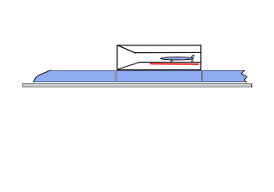
#2161: TunnelTrain

I just watched the movie entitled ‘Senna’ which left me feeling pretty uncharitable towards any French officialdom. This now extends to the FIA who seem to make all the rules in connection with land speed record setting.

Instead of having to tour the world for a level, flat surface several miles long and so that drivers stand some chance of not being killed, today’s invention is a rolling road for such record attempts.

This would be mounted inside a supersonic wind tunnel, so that the vehicle would experience exactly the same aerodynamic effects as if it were hurtling along a salt flat.

One difference would be that if the car became unstable, and ran off the rollers, a hoist to which the vehicle would be attached using a number of fine carbon fibre cords would stop it crashing off the simulated road surface (red).

The other difference would be that to get an inlet air speed of Mach1+, the fan would be assisted by mounting the tunnel on the back of a bullet train.

These tend to have long, straight, smooth sections of track without too many railway tunnels.

#2160: Rotakeoff

Today’s invention is a way to modify existing jets to give them vertical takeoff (if not landing) capability.

Planes would be fitted with an extra set of brakeable wheels on rearward-pointing stalks.

The nosewheel would be replaced with one that had a pneumatic cylinder attached.

This would be used to bounce the nose off the ground/deck and at the same moment, fire up the engines to achieve a near vertical takeoff.

This would require a degree of computer-aided coordination, but would also overcome many of the ground effects which cause difficulties for conventional VTO aircraft.

#2159: Skeweroll

Today’s invention is inspired by Anders Nils Gunnar Widgren, Inventor, who drew my attention to a new Swedish inventing programme on TV.

This featured sausages with triangular cross-sections (to stop them rolling off a grill).

My proposal is a new form of skewer which impales a sausage axially and on the end of which is a spiral, bimetallic strip.

As the sausage cooks, the strip heats up and rolls up tightly, ensuring that the sausage rotates and is evenly cooked automatically.

#2158: Dirijet

Today’s invention is another attempt at a personal flying machine.

This consists of a set of inflatable, cigar-shaped envelopes attached to the top edge of a large paramotor.

These small airships would be filled with eg Helium but angled so that a large component of lift would come from the angle of attack of the ‘wing’ they form (rather than just from buoyancy).

The pilot (and fuel tank) is suspended below the whole affair in order to maintain stability and would steer by tugging differentially on wires attached to the balloons.

#2157: Optimix

It’s sometimes hard to know when mixing of several liquids has been effectively completed.

Today’s invention is a system with a multispectral camera trained on the surface of a mixing vessel (eg for paint components).

Although the components may look similar, to such a camera they will usually be detectably different.

When the mixing begins the camera software looks for regions of the most dense, uniform colour and directs the mixing head there first.

This process would continue until no uniform swirls appeared from lower levels which were larger than a certain, threshold size.