#2518: CoolerFuel

In drag racing, durability is much less important than engine efficiency for a few, frantic seconds.

In such high-performance engines, an intercooler is often mounted between turbocharger and engine inlet. This boosts the efficiency of the engine and also lessens the tendency for knocking to occur.

Bless the Australians who seem to be experts in using a heat exchanger full of dry ice cubes to perform this function.

Today’s invention elaborates on this technique by using a block of solid nitrous oxide in an insulated box. This is dropped into place just before a drag race or timed run. According to my Boy’s Own Book of Physical Constants, this should remain a solid at atmospheric pressure whilst the temperature is kept below -90 degrees C.

Instead of having metal tubes running through the box (which add weight), my approach would be to freeze the nitrous oxide with a set of smoothly bent rods in place.

When these are withdrawn, a collection of smooth channels, corresponding to streamlines, remains, so that the engine inlet flow can be subject to minimal resistance.

As hot gas passes through the block it evaporates the solid nitrous -quickly widening the channels ( a bit like a solid rocket motor) and forcing combustion-promoting gas, plus cooled air, into the cylinders.

#2517: Pot-Talker

Today’s invention was inspired by my friend Muriel.

It is a plant pot with a built-in recorder, for those people who believe that this promotes their mutual wellbeing.

This allows a plant owner to record what they say to their plants.

If they need to go on holiday, then the recorder simply plays back a little chat each day, leaving the vegetation feeling less neglected.

#2516: FlashBoard

Road safety is increasingly important to vehicle manufacturers. This is especially true as populations age, road network complexity rises and insurance charges increase.

So, before the whole automotive world descends into autonomous transport, today’s invention offers a small safety upgrade.

When someone is driving and they enter a tunnel, their eyes do an amazing job of adapting the the lower light level. Many modern tunnels help this process along by providing entry and exit lighting which is intermediate between the brightness inside and outside.

There is a general problem, though, that it takes about a second or two for eyes to adapt and at motorways speeds, this equates to around 90m…during which time your ability to read a dashboard can be badly affected (especially if you are older or tired or have vision problems)

Imagine a dashboard display which was attached to a light meter located near a driver’s eyes. The system would use GPS to be aware of eg tunnels or overpasses in the next 500m or so.

Knowing the ambient light level (and thus current state of visual adaptation), the dashboard would automatically and smoothly brighten in advance of entering any dark space…so that, on driving into it, the eyes would be fully prepared.

#2515: CurveAlert

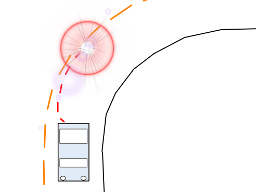
I’ve been driving on country roads this Summer and been unnerved, a number of times, when turning a corner only to find a sudden stationary queue of traffic.

The cars who are coming up behind, but which have yet to negotiate the bend, really need to be warned, somehow.

Today’s invention provides that warning.

A small radio controlled-type car is dropped from the underside of a vehicle, once its hazard warning lights are activated. This would then move about and find the white line in the centre of the road.

It follows the line behind its vehicle until it just loses sight of its home registration plate and then stops. At this point, a bright emergency light on top begins to flash.

Many vehicles might deploy their little robot cars at any point along the road. Each robot would receive a signal from its own car when the hazard lights were turned off. This would be its signal to return to its own car. Those robots that failed to make it back would attach themselves to any passing vehicle. These would incorporate ownership details, so that they could be posted home.

#2514: CocktailCrisps

I’m a huge fan of potato crisps (or ‘chips,’ if you live in a country that serves something called ‘french fries’).

There is now a huge variety of flavours, although I’m not really convinced by the grandiose ‘Anglesey Sea Salt’ or ‘The Amazing Adventures of Salt & Vinegar.’ These are fried potatoes, people.

Anyway, today’s invention is to offer two-compartment crisp packs, each of which would be filled with totally different flavours and separated internally by a ziplock bag closure.

This allows more access to bolder, pre-tested taste experiments. I’ve discovered that eg ‘sour cream and chives’ goes rather well with ordinary ‘salt ‘n’ vinegar’ -especially if one of these has the ridged texture and the other is flat. You get much more emergent variety of taste and mouth-feel texture this way than if you just apply the combined flavour to one crisp.

Maybe packets could contain randomly-chosen combinations which you only discover by reading two internal labels?

People could post their favourite combinations online and the manufacturers could then use these to guide future product development.

(One of my offspring just drew my attention to this, which is related, but not quite the same).

#2512: Roade-odour

When you are out driving, sometimes there are places which smell so bad you wish you’d diverted around them.

That isn’t always possible. though (I’m thinking of a particular landfill site next to a motorway I regularly use).

Today’s invention is a software program which runs in vehicles to help deal with roadside stench.

When anyone drives past such a smell, they can record its location via an app.

A bad-smell map is thus developed.

This is then used by your car, so that a few minutes before you enter a foul zone, the windows close and cabin ventilation automatically switches to recirculation (and might even inject some extra scent into the airflow). This could also take into account known wind direction, so that the switch-on would be optimally timed.

#2511: SelfieSpiral

Selfie sticks are a bit of a nuisance, it’s undeniable.

They do, however, seem to be greatly in demand at beauty spots around the globe. Today’s invention is my version…longer, portable and with added dramatic effect (as demonstrated by one of my daughters).

#2509: FingertipGrip

In summer, I have to spray myself liberally with bug deterrent chemicals.

These come in an aerosol, which is fine when I’m spraying my head and torso.

The problem comes when applying the agent orange to my lower half. If I hold the can as normal, with my index finger on the button, c, then I have to invert the can. This is an instant spluttering fail…next to no product emerges.

So today’s invention is a simple fix. It’s a plastic shape with its ends joined by an elastic band (red). This allows the V of the shape to fit under the crimped collar of any size of aerosol and be retained there.

Now, you can place index finger under ‘b’, middle finger under ‘a’ and thumb on the button ‘c’.

This allows the bottle to stay in its normal orientation (button uppermost) whilst still giving good control of the direction of the spray.