#2528: BaGape

Plastic bags are both a boon and a big problem. They are so useful, but so wasteful.

Today’s invention aims to offer bigger carrying capacity using less material.

The plastic carrier bag on the left has some resealable ‘ziplock’ windows moulded into it.

When the bag is loaded, on the right, the windows are opened, allowing weight to be supported by the unperforated bottom section, whilst boosting the overall space in the bag.

Obviously the bag windows can later be resealed and the whole thing reused.

#2527: TravelAgents

Today’s invention is an agent-based model of the fire escape process from an airliner.

The model offers a straightforward way to compare evacuation times for a variety of airliner fuselage and seating geometries. It provides proper 2-D movement simulation (not just linear queueing), with people obstructing/avoiding each other in realistic ways (See this).

The code is deliberately designed to be intuitive to understand (rather than super-efficient at runtime). Despite this, it seems to execute as fast as necessary, even for the largest plane sizes.

If you’d like to talk about how to incorporate this model into your design process, do get in touch.

(This was developed using skills developed on this excellent online course.)

#2526: GoGoad

Many people seems to freeze when an emergency occurs. In a crowded airline cabin, those people also get in the way of everyone else.

Today’s invention is a way to help airline passengers escape a plane.

It makes use of the seat-back screens, together with knowledge of the passengers’ identities and seat numbers.

At the moment when an evacuation is called for, the screens would be switched on and a personal message would appear (this could be agreed a long time previously and just left on the system).

Mine, for example, would use my passport photo and in large print it would say
“Get up Patrick NOW! Leave your stuff and get to an exit.”

This might additionally provide the message verbally (as recorded, say, by my wife).

#2525: WhizzDrive

Today’s invention is one I made earlier.

It offers a way to use a common electric toothbrush, with an oscillatory head, as a source of unidirectional drive.

Privacy notice: Playing this video may set cookies as described in Google’s privacy policy.

This might be used as eg a tooth polisher or as a low-torque screwdriver.

As an added bonus, this was achieved using the very low-cost internal ratchet mechanism of the ubiquitous clickpen.

#2524: DryMow

You can get pretty much any organic powder to explode, if it’s fine, dry and concentrated enough.

Today’s invention takes advantage of this to create a self-fueled, cordless lawnmower.

On a dry day, the user would start cutting grass in the old fashioned, push-mower style. There would be multiple, close blades on a single horizontal shaft, so that any grass would be very finely chopped.

This would create a cloud of dry particles which, when introduced into the combustion chamber of the mower engine, would act as fuel.

A conventional spark plug would ignite the powder/air mix. This engine would drive the many blades so that the lawn would all be converted into fuel for the mower.

There would therefore be no need to transport cuttings to a bin.

#2523: Adiabaticar

Consider the heater/air conditioner in a car. It has a lot of work to do in treating the entire volume of air in the passenger compartment.

This all has a cost in terms of both wasted fuel and the time spent waiting for the cabin to warm up or cool down.

Today’s invention is therefore a tightly-fitting blind which is pulled down between the front and rear seats. It would be held in place by slots attached to the walls and floor of the car interior. This blind would be made of insulating material, so that there is very little communication of water vapour or heat between front and back compartments.

The blind could be made with a glass panel to allow continued use of the rear view mirror.

For extreme environments, this might be extended by another blind, isolating the driver from the rest of the passenger cell.

#2522: PostPole

I know of at least one postal delivery person who has been seriously injured by delivering mail to a property where the domestic dog decided to inflict a nasty bite.

Today’s invention is aimed at helping post people make their deliveries in safety.

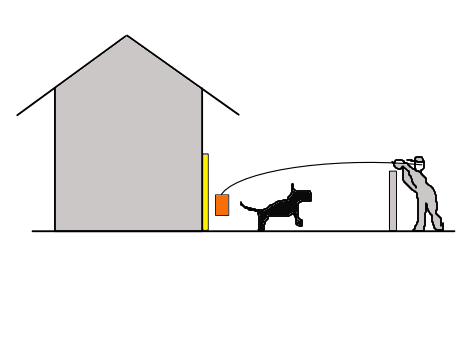
On approach to a house with a dangerous dog, a postal worker would extract from his bag a telescopic glass fibre fishing rod. This could be extended to reach over a very large yard, as shown.

The rod could simply knock the door and ask for the dog to be chained up, or it could be used (with practice) to slot letters through the letterbox. Parcels could be safely transported onto a front door mat (unless they contain anything edible, obviously).

#2521: LabRatory

Theme park owners are desperate for thrilling experiences -which are also 100% safe.

Today’s invention is an upgrade to the ancient idea of mazes, which is aimed at offering eg themeparks a more engaging entertainment.

A large number of tall privet bushes are planted in boxes with wheels, motors and wireless controls.

These bushes can be joined together to form walls of a reconfigurable maze.

Once a ‘player’ has penetrated the maze, cameras detect their eye movements and reorder the walls of the maze in areas where they are not looking.

This could be used to create a genuinely frightening experience…certainly enough of a challenge to those seeking something along the lines of a haunted house visit. The maze could have variations in difficulty, from static to inescapable.

(Cutting the bushes could be done by running them each through a stationary trimmer occasionally).

#2520: SofterSigns

There is a whole engineering field devoted to roadsigns. Part of that concerns itself with the balance between signs which are strong enough to stand up to high winds and yet not so strong as to cause extra injuries to vehicle occupants when a collision occurs.

(It’s disgraceful, by the way, that motorcyclists seem to have been already written off in connection with this analysis).

Anyway, today’s invention is a new form of roadsign. Instead of the solid flat plate on the left, it takes to form of a box structure with a round rectangle cross-section (This new design could be made of much thinner material than the flat plate, of course).

In return for less than 20% more material used, roadsigns can thus reduce their need to withstand wind loading by about 20%.

This means that the supports for these signs can be 20% weaker and therefore 20% less dangerous to motorists of every kind.

#2519: Driving flat out

Today’s invention is for owners of offroad vehicles who want to avoid spilling their champagne in transit across their country estates.

It takes the form of a control box and a table-supporting frame which has an attachment point on top of each of the windows.

As rough ground is encountered, the control box drives the windows up and down just enough to ensure that the frame (red) stays perfectly level.