#1784: 0-breeze

If I had only a year to break the man-powered land speed record I wouldn’t develop a whole new machine.

I’d take the best cyclist I could get and seat him on the fastest racing cycle I could find, as comfortably as possible.

Then I’d assemble a shell around him using oasis plant watering bricks. This would be very crude to start with but it’s sufficiently soft stuff to allow a really streamlined shape to be sculpted that weighs almost nothing. The critical element in reaching top speeds is the form drag -given a tight timescale I’d minimise wind resistance and forget the other details.

I’d also supply a leaning pad for the rider’s chest so that he could relax as much as possible (no need to steer in this record attempt).

The other critical aspect is to allow the ‘engine’ to breathe effectively. I’d run the record attempt somewhere at low altitude with lots of trees around for oxygenation.

I’d also cut a few discreet slots in top side of the oasis shell to ensure no buildup of carbon dioxide.

#1783: MealBrake

For people who want to eat in a more refined way and perhaps limit the speed with which they engulf their dinner, today’s invention offers some support.

It consist of a knife, fork and plate set in which both implements contain an electromagnet.

Powered by batteries in the handles, these would be actuated by a transmitter hidden in the plate. When the knife and fork were both in contact with the (metal) plate, a sensor in it would actuate the electromagnets at random intervals.

This would cause the knife and fork to adopt a one-across-the-other configuration ( as recommended by my mum’s table manners lessons to indicate ‘I’m still eating’).

This would have the effect of slowing one’s pace and provoking some prandial peroration.

#1782: Crustwich

There has been much talk in the press about the cheapest possible sandwich.

Today’s invention is an alternative to the toast sandwich.

It’s the crust-and-air sandwich.

Cut say two or three crusts off each slice of bread and place them as shown on one lower slice. Butter to taste and add the other slice.

As apparently thick as a regular sandwich but only 66.7% as many calories as the equivalent toast sandwich.

#1781: HeatPhones

Surprised that I couldn’t find these within the random pile of online patent database contents…

Today’s invention is headphones for an MP3 player which contain a small heating coil in each one.

This allows them to act as super-effective earmuffs when these things are worn outside on a very cold day.

(This might require carrying around an extra battery pack of course).

#1780: Hospitalidry

Hotels like to supply their guests with a way to get into a waiting car without getting soaked by the rain (assuming the absence of a liveried postillion with a brolly).

Supplying umbrellas becomes unpopular with hotel management, though, when people walk off with them.

Today’s invention is a novel guest umbrella.

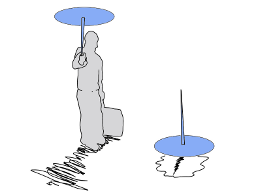
It would be designed as a large flat disk with a long, thin conical handle. The umbrella would not collapse but would remain as shown.

A guest could pick one of these up from a nested, space-saving set in the foyer and use it to get into their vehicle. It would then be much too big to get in their car, even if they wanted to take it away and so it would be left, handle-upwards, on the driveway.

Cars could safely drive over the handles, deflecting them but not damaging them (or their vehicles), until they were later collected for reuse.

#1779: QuadGuard

In former times, troops rode horses -making it possible for them to get from A to B as a dispersed group. Attacking them therefore had to be done largely one at a time.

Now that warfare (or ‘peacekeeping’) is mechanised, soldiers get into increasingly large vehicles which need massive amounts of armour to resist eg landmines and rockets.

Today’s invention is a way to protect soldiers from roadside bombs and other weapons directed at large vehicles.

It is the armoured ATV (or four-wheeled motorcycle).

Militaries around the world already use these vehicles and the cost of buying one per soldier on patrol is certainly less than buying the equivalent capacity in armoured Humvees.

By adding a steel shell around the driver of each ATV, it becomes much harder to kill numbers of soldiers, since they are dispersed, still quite fast moving and with some significant individual protection.

#1778: BuzzBurrs

Everyone knows about the invention of Velcro being based on observation of the burrs on Burdock seeds by Georges de Mestral.

Today’s invention is to take a step back from that and apply such burrs in a viral marketing campaign.

Natural burrs would be attached to a number of fabric patches applied in critical locations within eg an airport.

People passing would brush by these and attract some onto their clothing. In the train or elsewhere, later, these would transfer from person to person.

Each burr would have a small label attched, bearing a web address for the product or service being advertised.

The burrs themselves would be biodegradable and cause no damage to anyone’s outfit.

#1777: Extrapodium

Today’s invention is a way to better represent the relative merits of athletes or other sportspeople.

Instead of the usual podium, there would be long ramp. At the top of this, the gold medal winner would stand to receive his/her medal.

A display on the side of the ramp would indicate the relative positions of all competitors in the final -or even the whole event. This would allow athletes to take their places on the ramp, even if they weren’t medal winners.

The audience could thus get a better overall view of the competition result, as well as being more inclusive of everyone who took part.

#1776: Easieresale

Amazon have got around to allowing people to trade-in their books etc online.

Today’s invention is to add the next obvious step to this process by equipping users with a list of the books they have bought from the site itself.

These would be selected by clicking images of the covers and thus avoiding the onerous task of manually typing in eg ISBN details.

#1775: RoadTrunk

Where to put a new road is a major planning decision.

Today’s invention aims to make road network building more of an experimental science.

The basic unit of this approach would be a prefabricated tunnel module, as shown. This would be like a pontoon bridge but land-based and installed off the back of a low loader using a crane. Once in position, the road surface inside could be covered with a thin coat of tarmacadam and the exterior painted to blend in with the surroundings.

It would have a translucent section in the roof and solar powered lamps for night driving. There would also be sound and thermal insulation, as well as filters to absorb the worst exhaust pollutants before allowing air to circulate into the atmosphere.

A new section of road, made of these modules, could thus be tried out for a fixed period to see if it was working for all parties concerned. It might then be replaced by a conventional road, or allowed to remain as is, or moved to another trial site.