#1803: iBrowse

I read an article about ‘whimsical’ texting icons which are now available on the iPhone to help express a greater range of emotions than the normal smileys.

I think these emoji are graphically ghastly. I can’t imagine Jobs letting Apple use them.

Today’s invention is therefore an emoticon upgrade.

Messages of up to 140 characters would have an emotional tone specified (the one in the image is ‘surprised’). This might be automatically extracted from the text itself.

This emotion is used to select an appropriate layout for the words themselves (so that ‘surprise’ will cause some of the words to be arranged in such a way as to indicate raised eyebrows.

#1802: Pedalshredder

I walked past a lorry the other day shredding papers from an office building. The whole thing was covered in ‘confidential shredding’ notices and yet anyone could have walked off with a wheelie bin full of secrets.

Today’s invention is a way to ensure that if you are daft enough to commit anything private to paper, it will stay private.

It is a novel shredder fitted with a seats and a set of bicycle pedals.

A small amount of non-secret paper is inserted in the slot and the pedals are used to shred it initially into the collection box (which is sealed, apart from a small air inlet and a chimney which protrudes through an open window).

The cranking also causes a lighter flint to spray sparks on the paper, igniting it.

A small steam engine boiler is located within the system, above the burning paper. Once heated, this helps to drive the pedal crank, making the job of shredding less arduous.

In this way, the secret papers are rendered completely unreadable, there is no costly, street level lorry and office staff get some exercise.

#1801: Peripherollers

In search of ever faster bicycles, today’s invention is a new front wheel unit, without all the usual drag-inducing whirling spokes (and no significant weight increase).

Instead, the front wheel is a plain steel circle which has a smooth interior surface.

A single, aerodynamically-profiled fork blade carries two sets of small rollers.

The top set can be slid down the fork so that the rollers can engage with the inside of the wheel. The top set is then moved back upwards and locked in place, so that the wheel can spin, whilst staying in contact with all the rollers.

#1800: Reflectowers

Corporations place great emphasis on having iconic buildings.

Today’s invention is a tower which, when built beside a body of water, looks like a rippled reflection in a pool.

This effect would be extended to other buildings and street furniture, so that the actual reflections would mirror those simulated by the buildings themselves.

#1799: Offacers

Today’s invention is a way for police to retain some kind of human appearance, even when they are wearing protective equipment in expectation of a riot.

Each officer would wear a safety helmet with a lifesize image of his own face affixed to the outside of his face shield.

He or she would still be able to see through eyeholes corresponding to those in the face image itself.

In this way, officers could remain fully protected but still display their identities -and thus be encouraged to behave in a responsible way.

This lack of anonymity would also enable members of a crowd to identify later in videos anyone in uniform who had been misbehaving.

#1798: Hoodisplay

Today’s invention is a screen mounted on the underside of a car’s bonnet.

Once the bonnet is opened, the screen has projected onto it movies of detailed maintenance procedures with descriptive overlays (and even, using motion detecting cameras, clickable links to sources of parts etc).

Movies could be shown of factory experts actually undertaking particularly difficult tasks (and engine compartment cameras might be used to create films of events in the service history of a given vehicle).

This screen could also be used for providing entertainment to the passengers during rest stops.

Used in an armoured limousine with forward facing cameras, the screen could be flipped up when the vehicle was under attack and driven forwards using realtime images of the road ahead.

#1797: TwinTangs

For survivalists and explorers whose lives depend on their equipment, having a knife with a broad tang is important.

This makes it hard to break, but it adds weight and still provides only a single, large blade.

Today’s invention is a knife which has a large tang in which a slot is cut (so that it doesn’t lessen the strength of the unit significantly).

Into the slot is inserted from the far side a multi-tool penknife, one grip of which is expanded to provide the handle for the overall system.

If you need access to a wider range of smaller tools, simply undo the two knurled nuts holding the small tool and grip (blue) in place and detach the main metal work from the penknife/multitool.

#1796: SpareStruts

Today’s invention is a form of forklift truck with several sets of detachable forks.

This can be used to create improved accommodation within eg tall industrial units by introducing mezzanine floors, but without the costs of building permanent, single-use, structures.

A fork lift can thus be used to raise one end of a steel decking unit, leaving the (locked) forks behind to act as supports.

After attaching a new set of forks, the other end can be raised and locked in place, allowing the truck still to be available for other lifting duties (using the other spare fork units with which it comes equipped)

#1795: FormaliTee

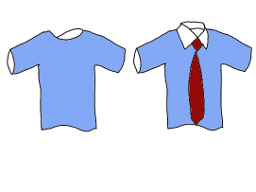
Geeks only ever wear a T shirt, but when some ‘suit’ arrives at their garage or lab, offering vast amounts of investment, they still may want to look briefly businesslike.

Today’s invention therefore is a clip-on collar-and-tie unit which disguises a plain-colour T as a short-sleeved business shirt (using a press-stud to join the collar halves at the back of the neck.

(This might easily be adopted by ironic boffins eager to mock any newly MBA’d managers).

#1794: RampRoof

It takes surprisingly little structural steelwork to hold the weight of a car safely overhead.

Today’s invention helps deal with the shortage of urban parking spaces as well as providing weather protection to pedestrians.

A ramp allows cars (blue) to drive up onto a trackway over the pavement and park.

Another raised lane is provided to allow parked cars to pull out overhead and rejoin the street via a second ramp.

Pedestrians thus are sheltered by the cars themselves and the roadway has an extra lane (yellow) that would otherwise consist of (filled) parking spaces.