#277: Spinspecs

Boats have been fitted with rotating windows for some time. The idea is that, by attaching a spinning, transparent shield onto a fixed window, it will sling off any water or other debris that contacts the rotating one.

Today’s invention is to adapt this idea for use in spectacles. As a recent conscript to the ranks of the myopic, I’m now always staring at the world through lenses which pick up all sorts of grime and debris.

Wout_J_Reinders_glasses658.jpg

Most annoying is that raindrops also collect there -which limits my enjoyment of being in the great outdoors for large fractions of the year, given British weather.

Each lens would have a press-on, circular housing probably made in clear, low-friction plastic and retaining a clear disc with gear teeth on the circumference, free to rotate within it.

Each disc would be driven by a small electric motor.

#276: Bibliometer

Looking down from the escalator in a bookstore the other day I was amazed at how many books are competing to be bought.

People are very much encouraged to browse in bookshops (the word originated in the offline world) but how can they decide to purchase, or not, based on a few seconds’ exposure to 500 pages of text? The buying decisions are presumably mostly based on the author, blurbs, reviews, cover…and price.

brendan_gogarty_bookstore652.jpg

Today’s invention attempts to support the decisionmaking process of the bookbuying public.

Books would be displayed in piles, for sale, as currently happens, except that they would be sealed and unopenable. Some designated tables would be reserved for browsable copies, with a few of each book present. Each of these would be wired to the table, so that lifting a given book would break a circuit and allow information about how long it was inspected for to be collected. (It might even be possible to extend this to switches between individual pages ( eg by printing contacts/circuits on adjacent pages using conductive ink). In this way, information about which parts of a book were open for longest could be gathered on behalf of writers and buyers alike).

Large volumes of data would be gathered, across a chain of stores, about books which were heavily browsed and this could be correlated with sales figures for the book in question. These browse times would be displayed beside the books for sale -as indicators of interest in them.

Don’t judge a book by its cover, they say…

#273: Evacutube

People who need to escape from a tall building are usually faced with either a “Don’t use the lifts” notice or to scramble down multiple flights of stairs.

An alternative, today’s invention, is a hybrid of abseiling technique and the traditional fireman’s pole. It requires almost no technique, avoids panic-related bottlenecking and doesn’t depend on physical strength.

James_Burt_escape628.jpg

Buildings would be equipped with an array of fireproof, (opaque) cylindrical shafts. Down the centre of each, a pole would run from the top of the building to the ground. There would be multiple discs centred on each pole and free to slide down it. The annular gaps between disc and pole and between disc and cylinder would be sufficiently narrow that they would provide viscous air resistance to the downwards motion of each disc.

In the event of eg a fire, people could enter a cylinder, stand on a disc and descend the pole at a rate which would quickly settle down to a fixed velocity (this would be designed to be slow enough to allow people to jump on a disc, as in a paternoster system, but fast enough to allow effective mass egress).

Nearing the bottom, an electronic stop would ensure that each disc would only be free to cover the last 2m or so, once the person beneath had stepped out of the tube.

#272: Learning scales

I spent a lot of time at school being force-fed detail in a number of subjects. This was hard work for all concerned. One of the errors which teachers can make is to jump straight to the minutiae, because that reflects their enthusiasm and expertise -often at the expense of the learning process. I realise now what I needed was to be shown the underlying structure or shape of information and only then to attach progressive levels of detail, as required.

Geography is a case in point. It’s not necessary, in my view, to be able to reproduce the exact course of the Thames or the shape of Luxembourg unless you happen to be walking through the landscape. Fractal geometry has taught us that local shape depends on the measurement scale being currently used and a similar thing seems to go on when we try to memorise new information. I studied geography for four years and yet I can’t even picture the relative positions of Hungary and Bulgaria. The big picture needs to be explained first, only then followed by increasing detail, to an appropriate level.

oil624.gif

(Imagine each novel on an English course being supplied with a precis which explained what it was all about. When first teaching someone how to program, it might be more useful to start by showing a box diagram of interacting modules, rather than the minutiae of how an ‘if’ statement is handled by a compiler running on a particular CPU. )

In subjects like geography or electronics or taxonomy or even computer programming, where the information to understand can be represented as a 2-D drawing or map, this can be done semi-automatically, by applying filters at a coarseness which decreases as expertise progresses.

Today’s invention is to apply this technique particularly to chunking e-learning material into a hierarchy of diagramatic lessons, elements of which can be expanded to supply further levels of detail by hyperlinking (e-learning is often deliverered via systems with limited bandwidth/ screen resolution where progressive detail representation is essential). This would map on to the kinds of multiscale mental representations people seem to use and allow individuals to drill down for more information only in areas which they found interesting.

#269: Hill limiter

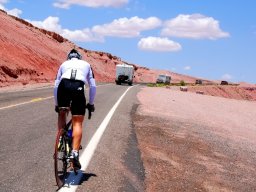
In Summer, I often see people enduring a long-distance cycling holiday. My personal view is that they tend to be carrying way too much stuff on handlebars, rear rack and two double sets of panniers, one on each wheel. Many of these people must thrive on the challenge presented by mountain roads, on which even the most helpful gearing allows progress upwards at only a snail’s pace.

Most people, however, are not King of the Mountains and would appreciate a less steep route, where they could view the scenery without gasping for breath all the way.

John_evans_ascent530.jpg

Today’s invention is a web-based tool designed to help them plan a cycle route between any two locations, subject to a maximum combination of local gradient and its duration. This would mean that cyclists could enter start and end locations and their estimate of how long they could pedal upwards at what rate without discomfort (based on experience of their previous efforts or lab data).

A program running on the webserver would check a very large number of possible routes and provide some alternatives, each with a maximum (gradient*duration) less than the allowed threshold. Obviously, if no routes were available, it would be time to grit one’s teeth for a sharper ascent or opt for a different destination. This would result in a printable (lightweight) section of map with the route marked for each day’s ride.

#266: Fuel feedback

According to DaimlerChrysler, fuel economies of up to 25% can be achieved by modifying driver behaviour. This is hugely more significant than any foreseeable technical advances: it’s mostly about pressing the accelerator pedal less.

Feet, especially those shod in heavy duty leather, aren’t exactly sensitive to angular position. Secondly, we tend to judge how hard to press by watching for changes in ‘optic flow’: how the environment rushes past. This is by no means an accurate measure, yet that’s how we mostly determine vehicle acceleration.

lhotellier_simon_fuelcap615.jpg

Today’s invention provides a simple way to lessen the consumption of fuel. There are lots of gauges fitted to cars which throw a needle across a dial to indicate how economically, or otherwise, one is driving. What is actually needed, though, is a more direct psychological link between pressing the accelerator pedal and throwing money away.

A digital display on the dashboard would respond, very sensitively, to depression of the ‘gas’ pedal by showing how much of the last fuel load had been spent at any given moment (calibrated directly in eg £). This would require the driver to type in the cost of fuel added in the garage (in the absence of a wireless data transfer from the petrol pump itself).

#265: Zoovision

Keeping wild animals in captivity seems to me hard to justify, especially now that we can buy a DVD of their life in the wild full of amazing insights and knowledgeable, whispered commentary. I know that, by doing research on such creatures, we may be able to promote breeding and preserve species better -although an even more successful technique would simply be for Homo Sapiens to keep the hell away from their habitats.

My main concern is that, whilst it’s fine by me to cage birds or iguanas, it really can’t be ok to lock up jaguars and polar bears -these creatures are prone to develop all sorts of apparent disturbed mental states, as evidenced by pacing and self harm behaviours.

Thomas_Picard_polarbear614.jpg

Today’s invention is an attempt to alleviate the boredom which such animals must surely experience. Existing ‘enrichment’ activities…ie the odd rubber ring tossed over the fence, would be enhanced by use of in-cage VR. One wall of an enclosure could have projected on it films of the animals’ native environment (these could be fed, in realtime, from webcams eg in Africa or wherever, so that the sound effects and light levels would be real).

I’d also try techniques such as playing noises of predators occasionally and even releasing into the cage robotic ‘prey’ which could be chased by the animal in question. The introduction of interesting smells might also occasionally help to maintain mental health.

#263: Stunt doughnut

We are being told, by different authorities on child development, that today’s youngsters, lifted and laid by overprotective mums and dads, need to be allowed to take risks when growing up.

How many of these people have ever actually been a parent? I understand where they are coming from, though.

ehsan_namavar_tree608.jpg

Today’s invention is intended to help encourage tree climbing by the offspring of even the most timid.

It consists of a foam-filled, disc-shaped cushion made of the same plastic-coated material as eg punchbags.  Laid at the base of a big tree, a cylindrical hole would be left in the middle (of diameter say 50cm) to accommodate the trunk.

The disc could be designed in two half circles, linked by large velcro patches, more easily to fit in the back of an estate car.

The outer diameter could only be around 4m, thus also limiting the height of trees which it could be used on…an extra safety feature.

#262: Autopacity

Whoever thought that wrapping the windscreen of vehicles all the way round was a good idea?

Now that we are in the era of experimenting seriously with autonomous vehicles, do we really need to stare at the road through a glass bowl?

jorge_vicente_armoredcar607.jpg

Today’s invention is a roadgoing vehicle bodyshell with no windows. The driver, if there is one, would see only a wraparound image of the outside world projected onto the inside surface via a redundant array of high-quality cameras.

A shell such as this would provide ample room for internal wiring and airbags, hugely increased impact resistance and improved visibility for a wider range of body sizes (with no pillars to get in the way).

An additional benefit would be that all roadsigns could be removed (they deface the visual environment anyway) and replaced by icons injected into the display at GPS-determined locations.

#260: Dance mannequin

For those of us not blessed by an ability to make coordinated movements, learning any kind of formal dance moves is torture. It’s especially difficult to concentrate when holding a member of the opposite sex.

Today’s invention is a mannequin torso equipped with a small screen, mp3 player and a webcam.

Scott_Snyder_dance602.jpg

The camera is attached to the base of the torso and relays an image of one’s feet to the screen. On this screen (mounted on the mannequin’s shoulder) is also displayed a pair of footprints showing the correct foot placements -coordinated with the music being played, via headphones, on the mp3 player.

One assumes no need to show the feet of a competent dance partner. It might even be possible to play the music at reduced speed -for complete neophytes or the terpsichoreally-challenged.

So, no more counting “1,2,3” whilst sweating into somebody’s corsage.