#325: Cleaning tracers

I made the mistake of being at a conference the other day in which industry gurus pontificated about forthcoming commercial opportunities for technology.

One comment that did make me sit up and take notice was that consumers now have an expectation that even mundane products will need to entertain to be commerciallly competitive. One way to achive this would be to turn even boring tasks into a form of game (people already watch the tumble dryer, play with the programmable vacuum cleaner and communicate via the message-writing toaster).

Yvette2_carpet775.jpg

You don’t want to just clean up the dirt, you want to zap it in some kind of challenging shoot-em-up.

I’ve noticed that it’s often quite hard, when using e.g. a vacuum cleaner, to be clear about what parts of a floor have been effectively cleaned.

Today’s invention is an attachment to such systems which distributes (spatially randomly) a quantity of high visibility particles onto a carpet. These act as tracers so that when they have been all recovered (to be scattered again elsewhere later) the carpet will have been effectively visited everywhere and therefore cleaned.

Unpleasant employers of domestic cleaners could use the returned particle count as a measure of diligence.

#324: Cassette case

I’m driving around in a car so old that it only has a cassette player (Surely I can’t be alone in thinking that CDs and cars never worked well together?)

Anyway, I’d like to be able to play my MP3 music via my ancient car hifi (but without paying a few hundred pounds to fit a whole new system in a car that will probably only last another year).

Emiliano_Spada_cassette780.jpg

Today’s invention would enable that, by providing a cassette-shaped module into which any MP3 player could be fitted.

The module would then be inserted into any tape deck as normal. This would be engineered to pass MP3 output signals by electrical contact with the wires leading from the (now redundant) tape reading heads. It could also act as a case to accommodate the (detached) earplugs and spare batteries.

#322: Signal signing

The poor old signature is running out of steam as a guarantee of identity in this digital era.

The shape of a signature alone is very easy to fake, given just limited amounts of practice. Those systems which still use signatures tend to monitor the dynamics of how the letters are formed just as much as the final image…and this requires cameras, touchscreens, accelerometers and who knows what else in terms of computing.

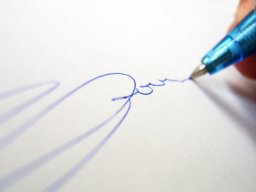
carl_dwyer_signature747.jpg

Today’s invention is a ballpoint pen which writes, as normal, on any old piece of paper but which whose output incorporates biometric information about the dynamics of the writer’s hand.

Think about writing with a tube of stripey toothpaste, except that the stripes are of different colours (or consist of dots and dashes with different mark/space frequencies). Scale this idea down a little and you have a pen which will output different ink composition, from millisecond to millisecond, dependent upon the direction of movement of the ball relative to the barrel. (Obviously, the pen would need to be held consistently -perhaps by moulding in fingerpads into the outside of the pen itself).

This could be detected (coarsely) using only a magifying glass and would reduce any doubt about the ownership of a signature or even of an author’s manuscript. In particular, a computer loaded with statistical directional characteristics of one’s writing could generate a phrase (in black and white text) for a signatory to copy and have analysed to confirm their claims.

#319: Spot filler

Each eye has a ‘blind’ area containing no photoreceptors, where the optic nerve connects to the retina.

Even for people with two working eyes, it’s perfectly possible to be unaware of small objects when their images fall into retinal blindspots. Normally such an image will correspond with only one eye’s blindspot, leaving the other eye clear to see it.

Robert_Elliott_lens766.jpg

If one eye is, however, obstructed by a door pillar, and the image of the object in question falls within the other blindspot, it simply won’t be seen.

This is true of objects as big as 16 full moons: potentially very bad news if it’s a motorcycle or a pedestrian on a crossing.

Today’s invention is a pair of contact lenses which contain only a small refractive region aligned with the blindspot in each eye. This forms a tiny diverging lens which bends light, which would fall into the blind region, outwards onto the light receptors at its edge.

The brain is good at joining up such signals without creating any perceptual gap (on closing one eye, you aren’t aware of a blank space in your other eye’s visual field). This would prevent all but the tiniest objects disappearing and enhance safety in numerous contexts… from driving to sports to piloting aircraft.

#316: Stapless

I have alow opinion of conventional wire staples…they usually fail to penetrate the massive volume of paper I confront them with and then they tend to empale one’s fingers when trying to separate the paperwork later.

It seems that $10 or so buys you an alternative these days…a way to join paper by punching a tag (of paper) through several other sheets. The trouble is that this really only works for a very small number of pages.

corner_cut759.jpg

Today’s invention is a way to join arbitrarily large numbers of sheets of paper but without the need for wires. It is based on an electrically driven desktop drill. As shown in the diagram, on the left, the pile of papers to be stapled is loosely bent around a bisector of one corner and slightly separated into two roughly equal sections. The hole cutting drill operates once, at the location indicated by the “+” to create one set of sheets with a tang in the corner and another set containing a hole.

As indicated in the right hand part of the diagram, the tang can be inserted in the hole, joining both sets of paper. Several drilling operations in one corner could be used to create tangs at opposite angles for a more robust joint.

#315: Igloop

People can find themselves suddenly without a roof over their heads because of eg war or some natural disaster. Maybe the following automated building tool would help.

A small, autonomous robotic truck would be capable of moving only in circular arcs (of fixed length). Placed on a field, it moves backwards, along a circular arc and scoops up some earth. It then moves forwards and, injecting small quantities of water, it exudes a stream of mud paste along the arc. This backwards and forwards motion continues forming a spiral which overlaps itself (with gradual decrease in arc radius) until a hemispherical ‘igloo’ has been constructed -a little like a wasp’s nest).

Karla_Portch_clay758.jpg

For people who may be too weak to build their own shelter, this ultra-simple machine would be able to deliver a large number of rudimentary dwellings, working 24 hours per day.

If you required some extra headroom, the truck could, at some point, cut through the wall of the hut and excavate earth in circular arcs from the floor inside.

Since writing this, I have come across this recent development.

#314: Keymound

I’ve been sifting through some crazy patents lately. It’s hard to believe quite how many have been granted in connection with the humble keyboard.

There are keyboards with keys whose size corresponds to their frequency of use, inflatable and self-illuminating keyboards, radio-controlled ones and even some made of chocolate etc, etc.

Bjarne_Henning_Kvaale_wall756.jpg

I’ve noticed that those of us who type a lot, and are wary of carpal tunnel syndrome, tend to have their keys arranged in a well-defined ergonomic ‘mound’. People who do most of their work on a laptop are not so well catered to, however.

Today’s invention is an ergonomic keyboard for laptops, consisting of keys the individual height of which can be set. This would allow you to experiment with having eg the most frequently used keys standing up more than those less used ones. More practically, it would allow the formation of an ergonomic mound arrangement.

On opening the laptop, each key would be driven, by a small spring, to the comfortable working height determined for it by the user.

Once the work was complete, the screen would simply push the mound flat, as the laptop was closed up in the usual way.

#311: Portable keypad

It’s a tough job to make public-access interface systems, such as the keypads of ATMs, which can stand up to all forms of ‘use’ (Including attack by blowtorches and portable roaddrills- I’m not kidding).

Today’s invention is an adaptation of the well-known sliding tile puzzle which allows ATMs and other public kiosk systems to be simplified and made more robust. Each authorised user would be equipped with a puzzle, perhaps the size of two adjacent credit cards. The tiles would be movable from behind, whilst the user held the puzzle in front of a camera lens, located behind a small area of armoured glass.

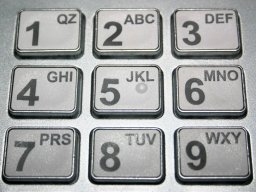
darcy_p_keypad751.jpg

Different configurations of the (clearly marked) puzzle pieces (of which there are 16! for a 4*4 grid) would be interpretable as instructions to the kiosk eg “withdraw £10”. This would allow the guts of the device to remain almost completely inaccessible to would-be thieves and vandals and the code embodied in the arrangement of an individual’s pieces would make their interpretation by any shoulder-surfer almost impossible.

It would also shorten queues, since people would array their pieces on approach to the machine. Each time a puzzle is used, the pieces would be slid a little away from their last-used configuration, making stealing someone’s puzzle a waste of time.

#308: No-trip wire

Even if your computer is plugged into the wall using some kind of magnetic (dis)connector, there is stiil that nagging doubt that someone will fail to see the cable and manage to trip the whole thing (or themselves) to oblivion.

Today’s invention is to supply many valuable electrical items with a power cord which consists of, or carries, a section of light rope -the kind of stuff used in discos and naff shop displays the instant anyone mentions Christmas (ie from late July).

Rajaram_R_cables744.jpg

This would allow passing foot traffic to see a moving pattern of lights ‘pointing at’ the computer/ hi-fi /TV in question and thus to increase their chances of avoiding it. You might be able to choose to have the pattern change according to the current activity of the machine in question.

Now that these strings of lights are available in a ribbon-like form, it might make sense to use that, lying flat on the ground, in order to further minimise the trip hazard.

#306: Motion highlighter

Attention! this might just be important. The problem is that so many things compete for our attention that we are in danger of missing crucial events (such as a pedestrian stepping off the pavement into the path of our vehicle).

We are usually understood to be able to keep track of only about six things at a time. The real world contains many more possible calls on consciousness…we are often blissfully unaware of how much we miss. One example (which I’ve mentioned before) is that, when attempting to detect the seemingly imperceptible differences between two “alike” images, all you have to do is “fuse” these by crossing your eyes a little and visually superimposing them. Areas of disparity then all stand out simultaneously as twinkling regions.

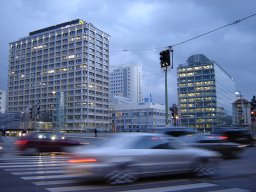
Jan_Zabroda_blur738.jpg

Today’s invention exploits this phenomenon. Imagine a driver wearing a small display on which is shown an image of the scene as it looked (to one eye) a few minutes ago. His other eye views the scene normally and these two images will naturally fuse in the brain.

Parts of the scene which have changed in the last few moments will be highlighted in one’s visual field as twinkling regions. This allows a driver, for example, to detect even slightly moving objects more easily -and avoid colliding with them.