#365: Shelf-awareness

365 daysToday is the first anniversary of IOTD. I’d like to say thanks to all my readers, especially those who have left comments. Keep watching this space!

For people who still can’t resist the lure of buying books, being able to find the one you want, within a bulging bookcase, can be a daunting task. Even if you can be bothered to sort the damn things alphabetically, every birthday or booksale means another cartload of titles has to be added in the right positions. I’d rather spend the time reading the contents than searching the spines.

Today’s invention is a way to find the book you want, without having to do any manual shelf sorting.

Mateusz_Żdanko_books890.jpg

Almost every book now published has a barcode printed on the back. Each time a new book is bought (or a read one replaced), you scan in the barcode using the reader attached to your bookcase.

Each shelf has a narrow strip of continuously barcoded plastic attached across the width of the bookcase. As each book is replaced, it must be set on the shelf so that it stands, for a moment, between its new neighbours and covers a section of the barcode tape, corresponding to the width of the book.

Whilst in this position, the scanner is used to record the sequence on the tape running up to the front of the book and after the back face. This specifies where the book is and is recorded by the system. The book can then be pushed backwards off the tape and into position. This will automatically update the locations of all the books on that shelf (by an amount which decreases with distance from the replaced book).

The tape also carries human-readable numbers so that the system, when asked, “Where is my copy of Ulysses?” can respond “It’s at indicator 20115 in bookcase 3. It was last accessed one year ago. Your library is now 2301 replacements away from alphabetical ordering”.

#363: Flight safe

It’s a little absurd but apparently the world’s airports are now clogged up with a surplus of nail scissors and swiss army knives.

The US Transportation Security Administration (who thinks up these grandiose departmental titles, The Directorate of Official Administrative Nominativism?) said 10 million prohibited items have been seized or voluntarily turned over this year nationwide. So much so that auctioning these items, in small lots online, is actually a pretty profitable sideline for the airport authorities.

Steve_Woods_flight873.jpg

So I wondered recently when having to surrender my olive oil-filled can of Baltic herring at an Estonian airport, how do these things get transmitted to their new owners? If any of these confiscated cannisters actually do contain explosive material, then sending them via the post, by loading on a different plane, truck or ship would seem like a pretty bad idea. Imagine the lawsuits if an airport transmits a bomb to some hapless bidder?

Anyway, today’s invention is a simpler approach to those items which are considered too dangerous to enter the cabin but which are not suspected of being explosive. The airport would sell passengers a metal box each, into which they could place their nailfiles, skinning knives and handcuffs. This woud then be locked and the key posted to a passenger’s onward address, enabling their box to be carried aboard but opened only when their journey was complete.

Passengers might be allowed to reuse their box, buying just a new padlock from security for each trip.

#359: Firelights

It’s ridiculous to expect people to choose between extinguishers when they have just discovered a fire. Interpreting iconic or written instructions, when you can feel the flames, is really not a viable solution…especially since using the wrong extinguishant (eg water on a hot oil fire) can have catastrophic consequences.

Today’s invention is a way to deal with this issue.

Felipe_Horst_fire881.jpg

Each bank of three or four different extinguishers would be equipped with an “electronic nose” capable of determining the nature of the fire by analysing the airborne combustion products. This would be helped by locating the nose sensor at the inlet to the extinguisher hose (or horn), being held towards the fire.

If the sensor detects e.g. the products of burning electrical insulation, it will decide to allow use of dry powder and to restrict any attempt to use a water-filled unit. This choice could be indicated by having a green led light up on any available extinguishers which are appropriate to the current fire.

This might be further automated by equipping smoke detectors each with one of these ‘sniffers’ and a low cost infra-red camera to locate the seat of the fire. This could then allow the right extinguisher to be automatically pointed and activated.

#356: Atm PO

Although it’s inexplicable, there are still some people and institutions who prefer to send hardcopy documents rather than electronic ones (Only a couple of years ago, the Law Society of England and Wales, for example, declared itself to be ‘against email’).

This means searching for a post box and ensuring that the right stamps have been applied. After that, you just wait for some response (assuming no postal workers’ strike that week).

Oliver_Gruener_envelope875.jpg

Today’s invention is an alternative way for the Great Unwired to send hardcopies to each other.

Banks are still reasonably trusted institutions (if you ignore all those missold pensions, Nick Leeson, sub prime mortgages…). They have ubiquitous ATMs which are capable of handling deposit envelopes and a secure way to gain access to and, if necessary pay for, their services.

People wanting to post a letter could write it as normal, print an address on a deposit envelope and enter that into their local ATM. The content could be automatically extracted, scanned, identified from bank address records and sent electronically to whichever ATM the intended recipient used next. On logging in with their pin, the ATM would print a copy of the document, insert it in an envelope and drop it into their hands.

#355: Flexipoint

I’m not one of those people with a phobic reaction to having a cannula inserted into my arm (especially if it’s done by a professional, practised nurse, rather than some bleary, junior medic).

I’ve noticed that a lot of thinking has gone into the design of these things to make them easy to insert and keep them sealed against infective agents. The English NHS buys about 20M of these a year, so the cost implications of any change are significant.

cannula858.png

One problem is that this design of cannula creates a finger-sized protruberance from the the surface of one’s skin…just asking to get snagged on a hospital gown, bedclothes, stethoscopes etc. After a few hours, any movement of the needle, driven by the external plastic collar, is painful and messy (forcing the needle into the vein wall).

Today’s invention is a fine nylon tube which is driven down the inside of the needle, after it has penetrated a blood vessel, by the attachment of a syringe or a tube leading to a ‘drip’. This proboscis greatly decreases the damage which the needle can do to the inside of a vein and the discomfort of wearing a cannula for a few days is therefore lessened.

In addition, when the needle is withdrawn, the nylon tube still protrudes from it, making it very unlikely that medical staff will prick themselves on a ‘sharp’ covered in someone’s blood.

#353: Hybriders

It had to happen, I finally got around to reinventing the wheel.

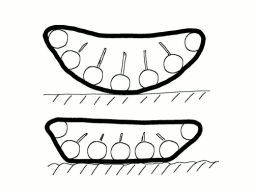
Rather than persisting with that simple old round geometry, today’s invention is a way to have wheels (top of the image) transform themselves into tracks (bottom of the image) by varying their internal geometry. The suggestion is to do this by using an outer track with driver wheels raised off the ground in both cases. Idler wheels would be moved radially inwards or outwards within slots to create a circular arc or flat profie (or intermediates between these).

In the wheel case, the idlers might even be locked in position around the circumference of a circular hub, so that the whole thing could roll, effectively using the track only as a wheelrim.

track867.gif

This would provide, when a wheel’s low-rolling and turning resistance weren’t required, a better response in terms of grip and load distribution.

Someone has now built a version of this (although they seem to be using extensible tracks and only two idlers, in a rather complicated mechanical system -but it certainly works).

#352: Virtual planning

When planning permission is sought for some new building, it can send small ripples of uncertainty around a neighbourhood. Amongst the local residents, there will usually be some knee-jerk noes and some don’t knows and some don’t cares.

In order to help people form a more informed opinion, today’s invention is simply to create a VR simulation of the proposed building, based on any CAD drawing that has already been prepared.

Viktors_Kozers_house864.jpg

This would need to be rendered in sufficient detail that issues like the before-and-after light levels could be investigated, together with questions regarding access, services, etc. I’d like to see an acoustic model incorporated which could help assess how noise levels might be affected for example, and for industrial buildings, how waste might be managed.

Only then could all parties really begin to understand the implications of a planned development -and have their concerns validated or negated.

The effort required to build such a model would be substantial (although more useful than a cardboard version) but it would provide a valuable extra hurdle in helping to prevent unwanted development or unfounded objections.

#351: Academics anonymous

Academics are restricted sometimes from making full use of their mental powers because the nature of their profession is that reputation counts for a lot. This can be easily misinterpreted to mean that making any unsubstantiable suggestion, or even slightly crazy proposition, is forbidden to them.

They therefore need a way to bounce early-stage ideas around with more than their trusted collegiate peer-group -but without exposing themselves to embarrassment.

Sue_RB_stjohns865.jpg

Today’s invention is a bulletin board for academics on which their postings appear anonymously. This allows them to contribute ideas without jeopardising their reputations or being intimidated by the “standing” of others. It would also mean, of course, that they would miss out on the credit for any of these ideas. (This could actually be good, in screening out those people for whom the business of intellectual creativity is just an ego trip).

At any time, anyone posting to a given thread could propose a group meeting to advance their thinking face-to-face (with a view to building some kind of research programme, perhaps). There could even be a mechanism by which those who were against a meeting might find themselves simply not invited to it.

#350: Monotrain

It’s been assumed, since trains were invented, that they would be giant, friction-driven monsters made of cast iron and brass.

Today’s invention revises that idea…by suggesting (again) that the existing tracks be used to carry micro-carriages.

Dave_Seeley_track850.jpg

These would flexibly transport small freight packages (maybe as small as a suitcase) and would run on only one track at a time. This would avoid all the nightmarish scheduling issues to do with having thousands of two-directional trains vying for the same track space.

Each small carriage would be made of lightweight materials and be individually driven by a small gas turbine -or even a modern steam engine with a low pressure jet exhaust (anything other than rail friction -maybe even mag-lev?).

What happens when vast numbers of these are heading for multiple collisions across the network? Well, each would also carry a lightweight sigmoid-shaped bridge rail. When a collision is predicted, the carriage would lower its bridge rail section to one side of the track and either park itself momentarily, in its own mini siding, or place it between the tracks in order to swap rails.

This approach would also allow all conventional rail traffic to continue on its merry way as normal.

#349: Screensaver

Cars should, in my view, not require any kind of fettling these days…even having to stop to fill them with fuel is a total pain (especially at £1.01 per litre). I take a similar view of having to fill the windscreen wash tank…ok, the water is free, but it’s still an unnecessary hassle.

Today’s invention is a water recycling system for car windscreens. Wipers would, instead of firing the water off sideways onto unsuspecting pedestrians, deflect it down the screen into a gutter at the base of both front and back screens. (I’d also site the spray nozzles at the top of the screen…I believe in making use of gravity, whenever possible). Dirty water would pass from here to a very crude filter tank (to remove the bugs, leaves and some exhaust particulates)…maybe even by a combination of centrifugation and settling.

john_macleod_wiper848.jpg

In a country where it rains every day, this would reduce the frequency of water tank filling to an acceptable once a year chore.

Use of a better filter would enable radiator top-ups to be taken care of automatically also.