#392: PuzzLed

Have you ever thought about what the ultimate jigsaw puzzle would look like? At a certain level of complexity, puzzles based on static images all seem to become indistinguishably different. Whether it’s a closeup of a plate of baked beans or an image of the cut lines on the back of a jigsaw, recut into a different jigsaw…or whatever.

I hate solving jigsaws only slightly less than watching someone else work on one, but designing the ultimate puzzle is still something I’m thinking about.

Maxime_Perron_Caissy_rubik973.jpg

Anyway, on a related theme, Rubik’s cube is both mechanically ingenious and a challenging puzzle…two things I greatly admire. I lost interest in it when they started having robots undertake the solution algorithm and it became just a wrist exercise.

There are now versions of the original cube which contain some lights, but today’s invention is to improve on these by fitting each of the square facets with an LED (and no sticky coloured squares). The lighting behaviour would be programmable, so that it would be possible to challenge your smartest friends with a cube algorithm whose target end state was, for example, that in which the lights on the cube faces mirror the colours on the conventional cube.

The difference with this design would be, though, that the lights would be free to switch colours, depending eg on the colours of their neighbours. This could be made fiendishly difficult and keep any computer scientists you know completely absorbed and thus out of trouble when away from their workstations.

Imagine believing that you were one move away from completion, only to have the colours then change, under algorithmic control, on a far-side facet ; )

#389: Traintail

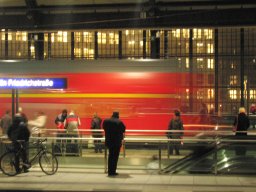
Railway aerodynamics is thought to be important only for bullet trains.

Slower-moving engines and carriages would also benefit, however, in terms of fuel economy, from a less blunt profile to their rear ends in particular. The trouble is that operational flexibility requires that engines and carriages swap positions within a train: none can rely on always being at the trailing edge.

Sid_Kelly_train963.jpg

Today’s invention is an inflatable envelope (similar structurally to a rubber lifeboat).

This would be attached to both ends of every blunt railway vehicle leaving a door-shaped aperture to allow normal traffic between compartments or, in the case of engines, forward vision via the windows.

When not on the end of a train, the envelope would partly occupy the air gap between any two items of rolling stock. On sensing that it was on a last carriage or engine, it would inflate using compressed air and provide that vehicle with a smoothly tapering rear geometry. This would greatly lessen the form drag and therefore the running costs.

A version of this could also be developed to smooth off the running gear which, on most trains, is exposed and anything but streamlined.

#385: Threedeesee

Tracking eye movements accurately, without a massive amount of lab equipment in tow, is still not easy*. If you try to do it by finding the irises in a digital image of the face, for example, the processing required to cope with high speed movements of up to 700 degrees per second is phenomenal…doing that with any degree of precision still poses difficulties.

Today’s invention is a direct contact eye tracker. I’ve talked before about using a single optical mouse to crudely detect movements of the eyes. Now imagine taking the sensors from a dozen or so such mice and embedding them circumferentially in a soft, transparent ring which is lightly held in contact with the eyelids by an adapted pair of spectacle frames.

Georgios_Wollbrecht_eye953.jpg

This approach, which relies on low-cost, high-precision technology, could be especially useful for people with insufficient manual dexterity to control a joystick or by advertisers interested in where people look as they walk freely around eg a shopping centre. A two-eyed version could compute vergence, at least at close range, and provide information about what’s being observed in 3-D space.

*Predicting the direction of eye movement precisiely and quickly might be done by sensing electrical signals to the eye muscles (When preparing to make an eye movement for example, a copy of the ‘movements-to-be-made-next’ program (efference copy) is used to predict where, and at what, we will be looking next. We then compare this expectation to what actually happens. It’s thought that any discrepancy gives a measure of the extent to which external influences eg anomalous head movements, have occurred). As far as I know, there is no easy way to do this non-invasively.

#384: Looklights

I once knew someone who, having made a lucrative deal in an oil town, celebrated by buying himself a 500 horsepower sportscar. He rarely drove it over 50MPH, however, explaining that people couldn’t recognise him in it if he went fast.

Today’s invention attempts to reintroduce personal recognisability into driving.

Juliano_Monroe_driver950.jpg

As each seat is occupied in a car, a small light would shine on its occupant’s face. This would enable travellers in a vehicle to be seen by other road users as individuals, (rather than as the anonymous contents of a car with a fixed personality given to it by some industrial designer).

This being seen would result, I believe, in more responsible road use…people would slow down and be less inclined to road rage if they were appearing in a public space, rather than hiding in the privacy of their own metal carapace.

#378: Salient web

Whilst we wait for the arrival of the semantic web, it seems to me that search engines are not performing nearly as well as they might. When a web crawler examines a website, it can only form a very rudimentary view of what the important content actually is.

Today’s invention is a user generated salience measure.

melanie_kuipers_index928.jpg

Each time a webpage is loaded into a browser, a visitor would be asked, with a certain probability, whether they wanted to answer questions about the page (in return for entry into e.g. a prize draw).

If the response were positive, a user would be invited to click, in order, the five most important parts of the page (or the five most annoying ones).

These data would be stored over time, suitably encoded within the page itself. This would allow the possibility of automatically reconfiguring both the nature and structure of the content.

More importantly, the stored information would be read by crawlers visiting the page and used to help index its content more effectively (by weighting the words in the index according to the significance accorded them by users).

#377: Stripseats

It’s ridiculous really that people who have paid for tickets on public transport don’t get to sit down (especially on long journeys).

Today’s invention offers an alternative in the form of flexible plastic seats like those which sometimes appear in playparks by way of replacements for traditional heavy wooden ones.

jonathan_malm_swing934.jpg

There are almost always handholds on the shoulders of seats bordering the aisle in a bus or train. Using these, to each seat on one side of the aisle would be attached permanently a flexible, rubberised seat/strap unit, so that it hangs down beside the seat when not in use.

Once the seats fill up, rather than have to stand, people can grab the free end of the seat and attach it to the handhold on the seat on the opposite side of the aisle. This would be achieved using a robust, easy to use clip…which would support a passenger’s weight but disconnect easily when flicked upward (e.g. when evacuation is suddenly needed).

This arrangement would be no less safe, in the event of say a fire, than having to fight one’s way past numbers of standing passengers. Sitting down might well result in fewer injuries when some kind of collision occurs.

#376: Sidelongs

It’s widely believed that the (unusual) whites of people’s eyes may have evolved to enable other humans to work out what is being stared at. Meaningful glances can sometimes be socially instructive and much less overt than blurting out “Look at that!”

For anyone who needs to avoid people knowing exactly where they are looking, however, today’s invention aims to help; based on the above information.

eye.931png

A pair of contact lenses, one all-white, one with a fake iris and pupil, are overlapped, joined and placed in one eye.

The white lens covers and obscures the natural iris but can still be seen through (as can the other, false iris). This arrangement gives the impression that the wearer is looking eg left, when in fact she’s looking straight ahead.

This could be useful to security staff and surveillance agents who want to monitor suspects covertly. Obviously both eyes’ lenses need to be similarly orientated to avoid drawing attention to an unnatural squint.

#373: Quench control

Heat treatment and thermal control is important in creating the required properties of forged products. This allows relief of internal stresses and grain structure control, which provide improved material properties.

Now that thermography is a commonplace industrial technique, today’s invention is to use this to help control the local properties within forged components. This could be achieved by directing a jet of coolant gas to provide computer-controlled, spot cooling of the hot regions in a forged workpiece (it doesn’t have to use air, if you are concerned about oxidation).

Armin_Hanisch_forge921.jpg

This would allow greater certainty about the local rates of cooling and thus help to form components with varying properties in different regions. A bearing surface could be specially hardened, whilst leaving a defined level of elasticity in the shaft section of a single, multiproperty forging, for example.

This would certainly require very high speed, very narrow gas jets in order to achieve refined cooling within the body of a thick-section component.

#370: Spoke springs

I once had a Yamaha motorcycle with wheel spokes which were curved (made of cast aluminium alloy). There was much tutting at the time, in the technical press, that this was an example of form over function.

In view of the fact that lots of today’s bicycles have several springs, swingarms and dampers embedded in their frames, why not just simplify things and use spokes which are inherently springy? Most conventional thinking about spokes says that they should be as rigid as possible; stiffening the wheel to ensure effective ‘feedback’ from the road surface (and limiting fatigue damage).

Charles_Toepfer_spokes911.jpg

But what if you want to be transported on a featherbed and don’t much care about performance? As long as the spokes are stiff in the wheel axle direction, they can stand to be pretty flexible radially. This would probably mean that the hub of the wheel remains slightly eccentric when in motion, but to anyone who has tried to ride over cobbles, springy spokes have got some obvious advantages.

I’d suggest making the spokes C-shaped in the plane of the wheel (allowing alternating tension and compression) and with an oval section with its long axis parallel to the wheel axle (to ensure the rim stays coplanar with the hub).

#367: Aeropants

Racing cyclists have resting heartbeats of 32, shave their entire bodies and dress in skintight lycra. These characteristics alone would mark them out as ‘different’ but they are, as a breed, also uniquely fetishistic about their kit. You can pay £700 for a pair of turboflex graphite composite aero blades…without having a clue about why they can cut your triathlon time by 0.0001 sec…you just have to buy them.

Today’s invention is for all those obsessives to whom such cycling minutiae matter.

Silk_Word_bikes902.jpg

Given that aerodynamic forces are highly significant, I suggest that one of the most obvious sources of drag are the legs of the rider thrashing up and down. If you don’t want to encase him in a monocoque, then you have to live with that…well, no.

Each leg of the cyclist’s skintight outfit would be equipped with four, tubular air bladders (one for the front and back of the upper and the lower leg). Each of these would lie flat when deflated and when inflated, take up a triangular cross-section -like the trailing edge of an aerofoil.

As the cyclist presses down on the pedal, (ie leg moving backwards relative to the air) some of his effort is used to pump up the bladders on the front of his leg, providing it with a temporary, low form drag configuration. When the foot pressure is released (leg moving forward), the air is transferred to the bladders on the rear of the leg.

This can be accommodated within a standard flexible suit and would also provide an illusion of enhanced muscularity.