#257: Sunblind spot

Sunblinds. There’s a piece of technology unchanged since the model T. It’s not that I’d ever advocate change for its own sake but sunblinds just don’t work well.

Turn towards the sun and flip that foam-covered velour screen down. Suddenly your driving world changes from sun-dazzled to ubiquitous, impenetrable, dusky gloom. You then have to drive along peering under the blind and hoping that those indistinct objects moving about outside aren’t on a collision course.

Steve_Woods_sun577.jpg

Today’s invention is to replace those unsightly blinds with a smoked-glass disc attached to each windscreen wiper. Each wiper would need to be driven by a big stepper motor because the glass disc would be constantly moved by the wiper in an arc to lie directly between the occupant’s eyes and the sun.

The wiper arms would be constantly repositioning by using data from a clock-compass combination (to tell when the vehicle was turning into the sun). A disc of only around a 10cm in diameter would be big enough to cope with almost all changes in road gradient (it would have to be initially positioned according to the height of each driver). This would mean that only a small section of the visual field would be obscured and driving safety enhanced.

Admittedly, when the wipers are required to drive rain off the screen, this whole approach would cease to work, but you don’t get that much rain on days when the sun is bright enough to impede driving.
#256: Salescreen

It always surprises me that tills in shops are now surrounded by screens. Surely, by the time customers are there, the buying decisions have mostly been made? (apart obviously from the last minute chocolate impulse).

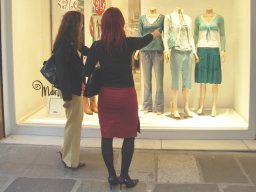
Today’s invention is to link the tills to a big screen in the shop window.

roberto_tostes_shop586.jpg

As each item is rung up, an advertisement image of the product appears in the window (including pricing information).This is intended to attract attention, illustrate strong trading activity and drive buying behaviour (just as when market traders ‘plant’ customers apparently spending large amounts of money).

#255: ‘Fire’ safety

I noticed a motorcycle rider hammering down the motorway the other day. He stood out against the traffic, which included lots of other bikers, because be was wearing a tattered old plastic vest over his tattered old leathers. The vest itself had once been luminous green but was now a dirty shade of grunge. What made him so noticeable was its movement in his slipstream.

This set me thinking about how to make motorcyclists more visible by equipping them with a source of illuminated flickering. We are super sensitive to this kind of motion: perhaps because it resembles fire.

miles_eliason_flames595.jpg

The trouble is convincing riders to wear anything that is a) uncool looking and b) tainted with the word ‘safety’.

Today’s invention is to provide each new machine with a small harness of fibreoptic cables attached to a variable speed strobe lamp at one end. The cables would be distributed around the machine (avoiding the rider and pillion) providing it with a christmas tree effect when in motion.

In order to avoid being described as such, the lights could be lit in flickering, wave-like sequences which resemble streamlines or flames and in colour(s) to match the bike itself.

#252: Forecourt trunk

Half the spaces at petrol stations go unused these days because people will only fill up using a nozzle which lies on the same side of the vehicle as its filler cap.

People will rarely walk around and put the nozzle in a filler tube on the ‘far’ side of the car because this requires them to park in exactly the right place (given the short length of existing hoses) and then to stretch a filthy, heavy-duty hose across their shiny paintwork.

Kiril_Havezov_pump581.jpg

Today’s invention is to supply petrol pumps with a simple hose extension which is attached to the existing nozzle with a jubilee clip. This still allows use of the existing trigger but enables the extension to easily reach to a filler cap on either side of any car.

The extension tube needn’t be particularly high-specification, since the pressure is restrained by the hosework already in place. It just needs to be fitted with some ‘fronds’ (made by eg attaching a small forest of long cable ties to it) which will support the hose and avoid any danger of scratching the paint.

This would significantly improve the utilisation of spaces and reduce queueing at the pumps.

#250: Invisible wipers

I’ve gone all automotive again, but who cares?

Windscreen wipers. Why on earth are we still making these in black metal and black rubber? Metal is hard to see through and very distracting when flashing back and forth across your visual field.

john_macleod_wiper578.jpg

Today’s invention is to make windscreen wipers of transparent stuff. The arm could easily be designed in a perspex material and the blade made in a clear, durable polymer.

This would almost certainly improve road safety in poor weather conditions.

#247: Roadshield

I was driving along recently when someone in a parked car decided to fling their door open: right in my path. Fortunately, I managed to swerve out of the way (and, happily, without getting into the path of anything oncoming in the opposite direction).

It made me think about why vehicles actually need doors on both sides. (You could, for example, have a rear-facing loading ramp but that makes getting Granny in the front rather difficult).

float_car_door568.jpg

Today’s invention is to build cars with no offside doors. This would eradicate the danger people face when standing on the roadway, fiddling with their keys or a childseat, as traffic surges past. It would also hugely strengthen the bodyshells of vehicles, leading to improved safety in collisions. We already make left/right hand drive variants, so this would be just another of those.

This approach would mean that bench seats would have to make a comeback and that Granny would have to remember how to slide along them.

#246: Mobile trainwash

Railways act as if urban real estate was free. They have such a vast acreage of property and yet they are always moaning about having no resources to enable the trains to run on time.

Today’s invention is an attempt to free up some of that valuable urban land that they now use for washing trains -to very limited effect.

Adam_Page_train565.jpg

Instead of having centralised train washing facilities, imagine that on many trains there is a washing car. It needn’t be a whole car of course, more a railway trailer. This would be equipped with tanks and water jets. Whenever the train pulling this trailer passed another train, it would automatically activate the washers and spray clean one side of the oncoming vehicle. No need to attempt to spray both sides, since the two machines are bound to encounter each other again soon and clean the other side then.

There would only be a limited need for high pressure delivery, since, by angling the jets appropriately, it would be possible to make use of the oncoming train’s speed to achieve a much greater cleaning effect. Ideally, it would be possible to reuse collected rainwater and thus minimise the need to cart around tonnes of liquid.

#244: Printerdict

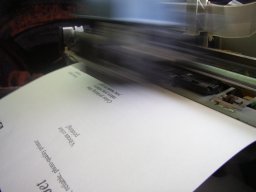
Ever on the look-out for ways to save a) the planet and b) some cash, I started thinking again about my occasional need to print documents on bits of paper. The standard Word tool: ‘view as a really messed up version of a novelette’ clearly doesn’t help much…is splitting them into two-page format really supposed to make reading big documents on the screen easier?

Today’s invention is a tool for lessening the amount of waste paper which people generate.

Marcin_Kubas_printer561.jpg

Every time a document is submitted to a printer, its name will be recorded (or if it has insufficient memory, these data could be stored on a print server).

If you attempt to print more than a specified number of copies of this document, within a particular period, an alert will be issued asking you to refer to the previous printout. I’d be keen to have it say “no more prints of this are allowed” but that is a little redmondite, I guess.

With only a small amount of extra ingenuity, it would be possible to adapt this approach for photocopying, so that a document could be OCR’d, recognised and a similar restriction placed on the number of further copies generated.

#240: Accessibility calls

Lots of facilities are designated as usable only by eg people who are disabled, or pregnant or aged. People in these groups may find themselves having to negotiate with young, able-bodied interlopers, who sometimes don’t see the need to make way for less able individuals.

Today’s invention is a simple system that gets around eg misuse of disabled parking badges and a lot of social embarrassment.

Teri_Holzmann_chairs546.jpg

All systems and facilities, from disabled seats on trains to parking spaces to wide access toliets to seats for old people, would be, by default, locked closed. They would each have a telephone number prominently marked on them and a phone activated unlocking mechanism.

Anyone in one of the preferential access groups would be allowed to register their mobile phone number (online) and by simply calling or texting the number marked on the facility, it would allow them access (naturally people using a particular facility on a regular basis could have its number stored for one-button speed-dialing).

Phone companies would be encouraged to charge almost nothing for the duration of these ‘comfort calls’ so that the phone would stay activated during occupation of the facility. After use, a single click to end the call would lock the seat or whatever up again.

#237: Memomeals

Call me obsessive, but I need to return to the subject of paper security.

It seems to me that if an organisation insists on printing out documents, it should do so only on rice paper. Using flavoured, organic ink (perhaps even containing vitamin supplements) would turn unwanted printouts into a company-wide source of low-cost snack food. Only a little imagination is needed to imagine adding milk and making a form of rice pudding.

Bret_Underberg-Davis_rice515.jpg

It would certainly save on the costs of commercial shredding services and reverse digestion is never going to be a practical approach -even for the most ardent data thieves.