#459: Autofelling

Harvesting trees, in even a responsibly managed plantation, is a messy and energy sapping process. Even when they have been cut down, the forest floor is still littered with roots, making it harder to replant.

Today’s invention is a way to allow the trees to grow naturally, whilst making their harvesting more straightforward.

Kinga_Lipp_trees1140.jpg

Each seedling is planted in a thin layer of soil under which has been buried a small, square flagstone. The stones are impenetrable to tree roots and they interlock so as to form an effectively continuous surface.

The trees grow roots laterally and within a limited depth of earth. At harvest time, a root cutting saw can be guided along the edges of the square stones (perhaps mounted on a small robotic carriage). This will so destabilise the trees that a moderate wind will then be enough to fell them (pulling up most of the remaining roots at the same time).

Placement of the seedling stem to one side of each stone, when planting, will allow the direction of its subsequent fall to be predetermined.
#456: Colourwash

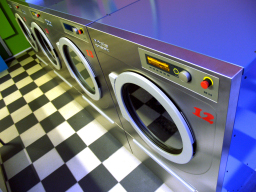
Who can be bothered sorting clothes before piling them into a washing machine? Actually I learned this lazy habit as a student, which accounts for the fact that everything I wore eventually took on a neutral khaki-grey hue (fine if you’re an Engineer, not so good at art school). Nowadays it’s just easier to wear navy blue exclusively.

For people who aren’t rod monochromats and who inexplicably like to wear delicate, coloured clothing, shouldn’t the washing machine be capable of working all this out for itself?

peter_lammers_washing1129.jpg

Today’s invention is a simple barcode reader attached to such a machine. Each item has its code scanned as it is passed through the door (it might require that anything you care about be equipped, post-purchase, with an iron-on patch, since RFID doesn’t seem as if it will be available any time soon).

The scanner allows the machine to issue a verbal warning before the item has entered the machine saying eg

“It seems that you are about to add a bright red woollen jersey to a whites load…but this is the fourteenth time this item has been washed, so it should be ok…proceed?”

#455: Layer hook

When hillwalking for example, it can be a major burden to be having to constantly swap clothing layers dependent on the whims of the weather.

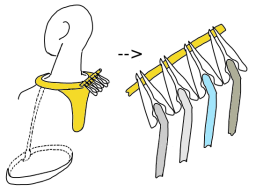
Today’s invention is therefore a neck-mounted hanger which allows layers, when not being worn, to hang down the middle of one’s back (protected by the outermost waterproof layer, if necessary. This would be restrained in front using a strap attached to one’s belt in front. A padded ‘spine’ would support the clamps gripping each fleece, coat etc. This would run down one’s back to spread the weight and torque exerted by the hanging clothes.

hooks1128.png

This presents difficulties when used in concert with a rucksack, but at least the need for such a bag is lessened if it doesn’t have to contain a lot of extra clothing.

It may even be possible to design a narrow rucksack that hangs on the outermost hook of the neck hanger.

#452: Pecking orders

Email is great because it makes all organisations flat. You can contact anyone foolish enough to equip you with their address. Email is awful for exactly the same reason: your inbox is quickly filled by the well-intentioned communications of legions of people -each message having largely the same level of priority.

Today’s invention aims to deal with information overload in an organisation. It does this by exploiting the established chain of command. The following rules would be embedded within one’s email client (which would need to know about the underlying organogram).

B_S_K_team1125.jpg

You can send email to anyone but those messages which arrive in your inbox from people to whom you report, or who report to you directly, are given priority. In fact, a scale of priority is provided such that e.g. those who are three levels away from you (up or down) are assigned a third level of priority. You can see these (as headers only) but you can’t open them until after having dealt with all messages of priority one and two for example.

The other rule is that if someone at a high level in the organisation is demanding to contact you, his/her message will be treated as described above (potentially low priority) but automatically cc’d to your immediate ‘superior.’ This has the effect of ensuring that the chain of command is maintained and that one’s boss can boost the priority of this demand on your time if, he/she deems that appropriate, by emailing you about it ( with priority 1 ).

Email in support of management: what a revolutionary idea.

#451: Wineslice

I’m increasingly irritated by trying to fit some large, spherical wine glasses into a small, rectangular cupboard.

Today’s invention is a new glass design which resembles those new vases I’ve seen: curvaceous strips sandwiched between two plexiglass plates.

glass1123.gif

As shown, this would allow the glasses to nest together neatly, Escher style. Storing these on their sides would save space and lessen the tendency for glassware to find itself nudged off the shelf and into oblivion via contact with the kitchen floor.

Careful design would also allow the ‘stem’ section to act as a glass too, as shown in the right hand picture (maybe taking on the role of sherry or port receptacle).

#450: Twinnedscreens

I seem to be seeing a lot of patent applications, made by major electronics corporations, covering things like new ways for a sliding clamshell phone to be switched into a fliptop rotary keyboard interface etc… These guys are definitely in the fashion business, rather than technology.

Today’s invention is a new laptop interface combination: consisting of a normal screen and a touchscreen in one machine.

elena_buetler_laptop1121.jpg

The touchscreen would take the place of the normal keyboard (no more bits of lunch, dust or coffee between the mechanical keys). This would be thinner than a keyboard (which I can never get the hang of) and open up all sorts of opportunities for interfaces -including eg the much heralded new era of ‘surface computing.’

Drawing or typing on the horizontal touchscreen would cause the output to appear on the upright, conventional one. Otherwise, the laptop would perform as usual with the normal screen acting as the stand-up display.

Turn this system through 90 degrees and you can read content just as in a book (with one page informing the other) or even set up a stereoscopic display for 3-D content viewing.

This approach would surely also work for mobile phones.

#448: Buzzcast

It’s a recognised problem that people who have to wear a surgical cast for a long period develop circulatory problems, leading to eg a certain amount of muscle wastage.

Today’s invention attempts to lessen the severity of such symptoms. It consists of a process in which two or three cheap old mobile phones are strapped onto the limb in question before being encased in plaster (or hard shell bandage).

Jacque_Stengel_cast1117.jpg

These can be called periodically and caused to vibrate, thus promoting local circulation and helping to preserve tissue health.

#447: Paperaser

It’s pretty annoying that we are exhorted at the end of almost every email to ‘save the planet’ by not printing things out -and yet paper is such a convenient, portable, readable medium. Actually, you can’t easily beat pencil and paper for overall ease of use.

Today’s invention is a small printer which moves a printhead about in the usual way but which writes using a small stick of graphite (fed automatically, as in a propelling pencil).

Shannon_Pifko_pencils1115.jpg

This printer has no paper tray because it uses only one sheet (until it wears out). Once having ‘drawn’ out the required map or shopping list or child’s drawing, the sheet can be reinserted (probably in the oposite direction) and the printhead then applies a small, rotary eraser to the places previously drawn upon.

In this way, we get all the convenience of using paper and we also ensure that many fewer trees get the chop.

#446: Movary camera

I was talking to a friend the other day who had managed to gain access to a very high speed camera (nominally for filming various biological processes). 2500 frames a second results in a lot of data to store and it occurred to me that much of it is bound to be of not very much happening.

Just as with the various attempts to create videophones, one way to minimise bandwidth usage and storage is to detect from frame to frame when things are changing and transmit only that changed information.

Keith_Syvinski_camera1113.jpg

Today’s invention begins from a similar starting point. It’s a video camera which detects when frame content is changing rapidly and increases the rate at which images are captured. By contrast, the frame rate could be drastically reduced in situations where people were making movies of one static view of eg King’s College Chapel, or other essentially motionless subject matter.

This would obviously increase the amount of material which could be captured in the onboard memory of a movie camera and allow it to be more easily transmitted across networks.

#444: Glowstools

Having recently become a dog owner, I’m now painfully aware of the need to avoid standing in the excrement which she deposits liberally around what’s left of our garden.

You can, I understand, now buy dog food that’s laced with fluorescent material, precisely to deal with with this issue. Who knows what effect this synthetic stuff may have on the animal’s metabolism in the long term, though.

Adam_Truncale_poop1107.jpg

Today’s invention is an entirely organic, natural alternative.

Bioluminescent funghi, such as those available via www.nipht.com, are remarkable organisms which glow bright green. They could be supplied as a healthy food supplement for dog food (a multi-billion dollar industry). The glowing dogpoo which inevitably results would be easily detectable and removable.

Any deposits which weren’t removed (eg by irresponsible owners) would at least be avoidable and might be even more quickly broken down by the action of these smart toadstools.