#482: Vieweather

Weather forecasts usually get represented iconically in the news media. To quote Mandelbrot, however, “Clouds are not spheres” -it’s usually pretty difficult to anticipate what the weather will actually be like by viewing these simple diagrams (especially if you live in a variable climate).

Today’s invention is a personal weather view. Images of different weather, as viewed via one’s favourite window, would be gathered over say a year or two. If the weather for tomorrow were forecasted to be snowy with some sun, then representative historical images gathered via this window would be used to show what was about to happen.

Claude_Hugenot_rainbow1192.jpg

These might be movies (or automated composites) and they could be displayed on a screen in the very window from which they were first seen or on your desktop, a day in advance.


#472: Hearabouts

Car drivers often complain that they feel isolated from their surroundings, unlike their counterparts on motorcycles, for example.

Today’s invention is to connect their in-car entertainment system speakers to a GPS unit and a mobile comms link which will provide a local soundtrack -based on the vehicle’s location (and perhaps also the current weather conditions).

Karunakar Rayker_bee-eater1173.jpg

This might involve regional music, snatches of conversation, wildlife noises, wind-in-the-trees, birdsong -anything which could help provide passengers in a car with an experience which is more embedded in the surrounding environment (It probably wouldn’t include enhanced road noise, if you were travelling on a motorway).

This might even have a calming, and slowing, influence on motorists.

#471: Dirtsquirt

The inside of my car is like a midden. It was bad when we had children but with the addition of a dog to our family all the interior carpets are now impregnated with sand and deer excrement -not the kind of mixture the average valet service is prepared to tackle, unless supplied with a bacteriological warfare suit.

Today’s invention is a simple system to remove the dirt before it gets inside the vehicle.

Cathy_Kaplan_dogwash1169.jpg

There would be a small shower head fed water from the windscreen washer tank via a plastic hose. An additional pump would probably be required, rather than relying on the standard built-in version and the water would need to contain only human-compatible screen wash.

Sandy feet after paddling (or paws) would be sluiced off into a plastic tray. The resulting dirty water would then be pumped back into the tank via a simple washable filter (I wouldn’t care too much about washing my windscreen with slightly less than sterile water).

#466: Fistassist

As someone with surprisingly small hands, I’m often amazed by the degree of extra grip which a pair of stout gloves can provide. I guess it’s partly just that their leathery padding removes a large amount of potential pain caused by sharp metal edges attempting to rasp their way through my lily-white phalanges.

For people who need to hold a tool of their trade all day…such as mechanics, tennis players, housepainters, blacksmiths or gardeners, maintaining a grip, under sustained load, becomes second nature -but I’m sure it does longterm damage to joints and nerves. As for weekend tool wielders, we need all the help we can get.

Hannah_Boettcher_fist1158.jpg

Today’s invention is a pair of gloves with assisted grip power. These would be of breathable but heavy duty material, possibly with gel-filled palm pads. On the outside, a series of stout rubberised straps would be fitted…the ratchet-and-flip-catch kind found on eg ski boots or divers’ watches.

There would be a strap running from the back of each finger to the inside of the wrist and from the thumb across the closed fist to the back of the hand. These could all be pulled taught to provide massively increased grip, without demanding a high level of muscle contraction.

Each flip catch and rubber strap-end would have a bite pad to enable these to be done up and released without relying on the other hand.

#464: Pace-sweater

It’s often very annoying that I can be doing my best impression of exercise when the music on my MP3 device starts playing at completely the wrong beat.

Today’s invention is therefore a mechanism on a portable music player which will allow selection of a particular beat and play only tunes with that rhythm (or one close to it).

Iwan_Beijes_jogger1156.jpg

This could also be interfaced to a rowing machine or treadmill so as to select tunes that corresponded to the current stroke rate or pace. Ideally this would be set to choose a beat which was slightly faster than the current exercise frequency in order to keep up one’s work rate.

I’m not sure exactly how sensitive to rhythm variations we are, but it might also be possible to play any given piece of music at a slightly elevated rate, in order to better match the target level of effort.

#463: Meshaping

Finite element methods are commonly used in engineering design. You create a CAD drawing of your component, automatically divide it up into a mesh of a million tetrahedra, apply some realistic loading boundary conditions and material properties and finally compute a detailed stress map within the design. If you are nearing yield stress anywhere, it’s time to think again either about geometry or material spec.

Today’s invention is simply then to use the 3-D mesh of tetrahedra as a specification from which to actually build your design. I’d like to see this happen using a rapid prototyping system. Each tetra could be ‘printed’ as a net of four triangles, joined along three edges. As each is produced, it would be automatically folded and the six free edges bonded into the 3-D ‘pyramid’. The system would spit these physical elements out in the correct sequence (and orientation) for them to be bonded together to create the overall design.

mark_robbins_ducati929.jpg

This would already have been shown to withstand the required in-service stresses. It would represent a huge material saving, compared to using bulk material, and although the final shape would still have a rougher ‘crystalline’ outer surface, this would be a structure with low form drag and a genuine wow factor in the marketplace (think Ducati frame taken to extremes).

#458: Tat-two

Disliking tattoos as I do, I’m surprised to find myself suggesting today’s invention.

It’s simply tattoos which are drawn (inscribed?) as a stereo pair. Each image would be of some favoured 3-D object seen from a slightly different angle, so that people could ‘fuse’ the 2 images and see eg a 3-masted schooner sailing across somebody’s backside.

Beatriz_Chaim_tattoo1047.jpg

For those people who haven’t yet learned how to fuse two images, by slightly crossing their eyes, it would be possible to tattoo one image in red, one in blue and then view them through a pair of colour-filtered spectacles.

Certainly a talking point at beach parties, athletic meets, biker rallies and high-security prisons.

#457: Dregs dredge

It’s not like I’m tight with money (honestly!) but waste bugs me. (Actually the biggest waste is of human creativity, which is often devalued because it challenges those without it so effectively -rant ends, or at least pauses).

Anyway, today’s invention is yet another way to get at the dregs of something valuable and viscous, rather than pitching it out with the packaging.

dregs1135.png

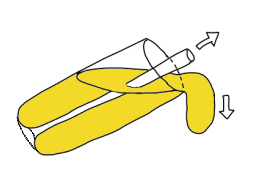
A container is made of flexible plastic, in the shape of a cylinder, as shown. It would have a screw-off lid as usual and when this was removed, contents could be extracted by driving a rod (supplied with a hook at the end) upwards against the base, inverting the cylinder.

When enough product has been extracted, at a given sitting, the hook on the rod would engage with a simple bar inside the base and allow it to return the cylinder to normal shape, by dragging it backwards.

This avoids any contact with the content, keeps whatever it is reasonably well mixed and eradicates the possibility that anything remains in the package because it can’t be accessed.

#454: Lidspeak

People who wear full-face motorcycle helmets usually have some difficulty making themselves understood by the unhelmetted subspecies of people. This can lead to unfortunate hand gesturing etc.

Today’s invention is a microphone to be worn inside a helmet which then feeds to a loudspeaker on the outside. This allows better communication with fellow road users and pedestrians (eg ‘Get out of the way please’).

Idac_motorcycle1127.jpg

In the event of an accident, the system could be arranged so that when in a lying down orientation for more than say 30 seconds, it issues certain messages automatically eg ‘Do not remove helmet’ ‘Call 999’ ‘My name is Tom, call 0181 223 334’ etc pre-recorded in the voice of the wearer.

#453: Hingehorns

Bicycles are always a nuisance to manoeuvre within limited spaces. This applies especially to attempts to bring them aboard trains.

Today’s invention is to reuse the quick-release levers mechanism, which often holds the front wheel in place, to lock the transverse handlebar on top of the forks. Actually, only one of these would be required, the other side taking the form of a hinge.

Neke_Moor_bars1126.jpg

When stowing the bike in a shed or on a train, the bar would be undone and then relocked in a vertical orientation.

This would enable bicycles to be stored conveniently and compactly and also allow rolling the bike eg through crowded streets without impaling pedestrians on the ‘horns’.