#2371: StatueWet

Today’s invention offers a way to help ensure that statues don’t get sprayed with graffiti.

A statue would be made with a water pipe terminating at the top of the statue’s head.

OLYMPUS DIGITAL CAMERA

This would be supplied via a pump at a rate that allowed a continuous, laminar flow of water to move down over the stone/metal surface.

An almost invisible, slow moving water film could be maintained by texturing the statue surface and by slow rotation of the supply nozzle in the head.

This would make any misguided attempt to apply paint extremely difficult.

#2370: ZipPairing

I’m regularly driven to distraction when trying to close up my coat in a sudden rainstorm.

The main difficulty is that the moving zip part (carriage?) and the retainer get misaligned and/or separated by even a small amount.

zipmagnet

This makes it impossible to insert the other side of the zip properly, thus causing me to have to bend over and watch what I’m doing in some detail.

Today’s invention is a pair of small magnets to remedy this situation (shown in yellow).

Simply moving the zipper down as far as it will go will automatically attach and align the zip and retainer, allowing the wearer to avoid spending crucial seconds getting wet.

#2369: FuseBuses

It’s common to see buses travelling slowly side by side in city streets or parked in parallel.

Public transport is increasingly used to advertise movies, so that all the buses in a given district will carry the same adverts.

buses

Today’s invention is therefore to apply a stereo pair of images to the back face of buses -to advertise a 3D version of some forthcoming movie.

People watching these vehicles would be able to cross their eyes a little, fuse these images and see a stereo advert.

This could be enhanced by applying the images to buses known to pass each other on certain regular routes.

#2368: Annulift

Contra-rotating propellers are a neat idea in that they they can be arranged to generate no reactive torque when the blades spin up or down (and thus remove the need for a tail rotor, in the case of a helicopter).

One problem, however, is that the turbulence created by the upper set tends to disrupt the lift efficiency of the lower set.

contras

Today’s invention attempts to lessen that problem by having one collection of blades which consists only of an outer(upper) length and another set which are shorter (and slightly lower), as shown.

The outer set’s speed and size can be chosen so that the best possile combination of lift and balance is obtained.

#2367: TasterTill

I can’t be the only person who finds self-checkouts intimidating.

It’s not just the hectoring tone of voice -every store that has these uses a radically different interface. All of them are confusing and ugly with no sense of process built in (Look at all the green boxes in the photo). Frequently, they require interventions by the few human store staff left, just to correct the inevitable errors.

autotill

Assuming that retail chains have invested such huge sums that these systems can’t be fixed or scrapped, today’s invention is a simple online training simulator.

Each different type of machine in use could be selected by a customer in advance of going to a particular store. The website would reproduce all the ridiculous interactive elements -including the noises.

This would make mildly Aspergers people like me, who get overwhelmed by the horrible, illogical detail, slightly better prepared.

#2366: Divairsion

If you are an airforce tasked with enforcing a no-fly zone, or if you need to intercept a plane without destroying it, your options are currently limited.

Today’s invention is an unmanned aerial vehicle which might help.

lamprey

This is capable of flying at great speed and with none of the manoeuvring restrictions imposed by a flesh-and-blood crew.

The aircraft would approach and attach itself across one of the control surfaces of the target plane (probably using small harpoons and a number of high-tensile wire lassos).

It would then fire a retro rocket, causing both craft to slow significantly and allowing other such interceptors to catch up and latch on to flaps or ailerons.

Their coordinated activity would allow the target plane to be directed away from its current course and forced to make an emergency landing onto eg a nearby body of water (or a remote runway using the UAVs’ own wheels).

In this way, interesting military secrets could be obtained or terrorists thwarted, without loss of life.

#2365: UnwrapFlaps

Airliners which have suffered a complete engine failure need all the help they can get.

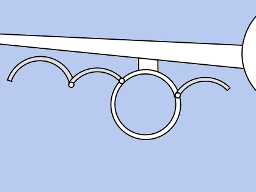
Today’s invention is a jet engine casing which can unfold as shown and lock into position, forming a significant extra wing area.

nacellewing

In such an emergency, the engine could be jettisoned through the bottom of the nacelle so that a rapid glide back to the runway could be achieved with maximal control.

#2364: CarriageUnder

Today’s invention is an alternative undercarriage for heavy planes.

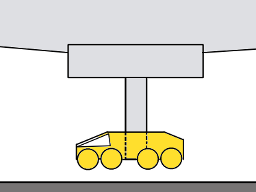
Rather than the traditional set of three wheels, a single tractor unit is centrally mounted.

carriageunder

This emerges from the belly of the plane when preparing to land. A pilot then controls the landing process from within this vehicle, which is large enough to support the aircraft, once landed, on its own.

Having parked, the vehicle can then be driven off, leaving the plane standing on the central pillar.

The undercarriage vehicle can be stocked with food, fuel etc elsewhere, then return with these supplies and replenish the plane via a lift in the support column.

#2363: SaddleStool

Today’s invention is a bicycle saddle with an elongate saddle post.

When the saddle is removed from the bike, two small posts fold out, forming a tripod.

saddleseat

This allows the bike seat to act as a stable seat…so you can watch as the Tour speeds by.

#2362: BladeBoard

Cooling computing equipment is a significant headache. It’s also a prime example of one of my particular bugbears: using random electronics engineers to design mechanical equipment.

Every odd-shaped electronic connector with graunched pins is evidence of that crappy practice (or snapped-off battery clip…I’m looking at you, Lenovo).

chipspin

Today’s invention is an advance in the area of electronic cooling.

Instead of having up to five fans per desktop machine, the idea is to create a motherboard in the shape of a fan. Power would be fed in via a set of central slip rings.

Twisting the blades would cause throughflow (the thermal advantage being that, unlike spot cooling, there would be no stagnation points).