#2194: Democrasound

Even though automated telemedicine is all set to take over healthcare, people will still need to see a medical practitioner in the flesh on occasion.

Their fee rates require that there will always be too few of them to go around -which necessitates, in turn, the survival of the waiting room.
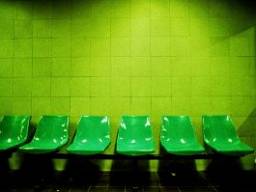
Jeroen_Visser_waiting

The ancient, germ-promoting magazines will eventually be replaced by tablets or interactive surfaces.

Today’s invention is an application running on all such networked machines. Since the ability to control one’s surroundings affects people’s health this would allow the current constituency of waiting folk to vote for which selection of music or TV channel should currently prevail.

This system would allow a truly democratic choice to be made, rather than the default ‘middle of the road easy listenin’ of eg Radio 2.

A rolling average choice could be calculated every 10 minutes or so.

Such a system could easily be provided in hairdressers, airports and bars as well and should also offer the option of silence.

(If you really must have a recorded soundtrack, you can bring your own speakers and plug them in -before visiting the audiologist).
#2193: MunitionMirror

Many armoured vehicles carry extra plating in order to pre-detonate incoming armour-piercing shells.

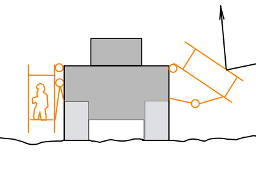
Today’s invention is to extend this idea to the provision of a double layer of plates to each side of such a vehicle.

skirt

This hinged plate unit could be moved to an angled orientation in order to provide improved deflection capabilities for incoming rockets etc.

The movement would be electrically driven and controlled from inside.

In defence against small arms fire, this unit might even be swung outwards under electronic control to ‘bat’ missiles back at those who launched them.

The double wall would also allow infantrymen to perch and shelter within this gap during movements towards a battle area.

#2192: Gripredictor

I love to drive with precision, although it happens less frequently than I’d like.

Don Palmer, driving guru, has made this video in which he talks about when wheels twist their tyres so that corners get turned at speed without losing adhesion.

slipangle

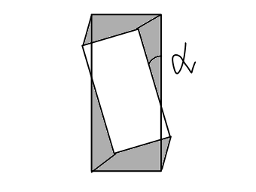
The twist is the so-called slip angle, shown in plan view as alpha on the diagram. This gets sensed by professional drivers in terms of resistance to turning of the steering wheel.

Today’s invention is an amplification of this sensation for we lesser mortals.

A camera would be mounted in each wheelwell looking vertically downward. Alpha would be estimated for each tyre using image analysis.

This would be combined with knowledge of tyre pressure, temperature and speed data to provide an estimate of how far away from slippage each wheel was at a given moment (based on previous test data for the tyre type fitted).

This knowledge could be used to make the steering torque required greater for bigger alpha. It might even allow it go prematurely ‘light’ (using eg a clutch mechanism in the steering column or even a drive by wire system). In this way, not only could rookie drivers be educated but accidents on slippery surfaces might be predicted and avoided.

#2191: Swardrawing

I’m a great admirer of this technique for creating images in grass by controlling local photosynthesis.

Today’s invention is related but perhaps more prosaic.

It’s a robot lawnmover the depth of cut of which can be varied in the course of its transit across a lawn.

It would therefore leave behind patterns corresponding to the greyscales in an image.

Pictures could be programmed into one’s grass including those which are distorted so as to appear standing up from the ground (when viewed, eg, from one’s house).

People with gardens alongside motorways, trainlines or runways might be paid to have their robot mowers advertise certain brands.

#2190: PostJets

We’ve all heard the old story about the accdiental invention of the postit note.

Today’s invention brings the postit into the electronic era.

To leave someone a physical note, just imagine a pad of screen protectors which can be attached to one’s touchsreen device.

The device senses what one is writing on the screen, even in cursive script, and sends this information to a handheld inkjet printer in the form of a pen.

As one ‘writes’ across the screen, the pen generates beautifully clear printed letters onto the topmost protector.

This can then be detached and placed somewhere prominent, using the usual adhesive strip on the back.

#2189: Elevatexit

I have been hearing some dreadful stories about people marooned in lifts.

In movies, such unfortunates always find a trapdoor to allow them to climb up or down the liftshaft. This would be highly dangerous and today’s invention offers an alternative.

A lift is shown stuck between floors 3 and 4. Conventional lift doors would be impossible to open.

Instead, why not have doors which are made in horizontal strips?

These would normally be locked together but when the lift emergency button was pressed, the strips (yellow in cross-section) would be individually rendered free to swing outwards (blue). This would limit any sudden vertical movements of the lift whilst occupants exited to either floor n or n+1.

The potential mind-numbing effects of a long weekend in limbo would thus be avoided.

#2188: Dextroustext

Which words are the easiest to type for a person using only one hand?

Every word in a dictioanry could be evaluated in terms of the total distance one’s hand has to move to type it, if you are doing it with only one finger (There might even be a slightly different calculation based on a user’s average finger length).

Words could then be ordered according to how much finger movement distance was required to type each of them in.

A keyboard user would then be able to use this scale to influence their autosuggest function (on the basis that they will probably want to type the easiest version of any given word).

#2187: BoomeRing

Mobile phones get lost all the time. Sensible folk will usually have some kind of access control code in play so that anyone getting hold of a misplaced device will not be able to read their texts or steal their identity.

This also means however that the device is very hard to return to its owner. Even if there is an address or telephone number attached, someone finding a lost phone may be unlikely to bother to make use of these.

These days there are phones which are specially designed to be ultra-robust. Taking that a step further allows for the creation of a phone which can happily withstand being sent through the post with zero packaging.

These phones would each have a combined barcode and numerals etched on the outside surface by the manufacturer.

When a lost phone is simply dropped in a postbox, the barcode allows it to be scanned and sorted by the normal postal equipment, returned to a regional office of the maker and eventually delivered to its owner, without displaying any easily readable personal identifiers.

After return of the device, a reward might be arranged when a returner enters the etched numerals from the device into a web form.

#2186: SipFlask

If you buy a hot drink to take away, then it will often be served in a cardboard cup with a plastic lid. This arrangement is also good for warming the hands on a cold day.

Today’s invention extends this concept to create a new form of hot drink container.

This would be in the shape of a hotwater bottle, with moulded-in surface bumps to allow prolonged skin contact.

A flat, flexible bottle could be made using bio-inert plastic and, rather than being disposable, could be washed and stored in an outdoor coat for example. This would have a screw-fit seal and might be dispensed initially from a vending machine.

When you were standing at a sports event in winter or on an icy station platform you could insert the container into an interior pocket, or up your jersey, in between drinks.

#2185: CarCall

I’m fascinated by the use of lifts in big buildings. According to this article, people get impatient if they have to wait longer than 20 seconds.

I get impatient a lot faster than that.

Today’s invention is therefore an app which the user clicks on, probably whilst sitting at their desk, to specify that they want to go to floor X.

This is effectively a remote lift call which alerts the system to calls all over the building and does its best to schedule their arrival.

Since mobile devices can be allowed to detect where people are, one’s smartphone or tablet knows the time required to walk to a lift lobby.

With this information, the app can beep you when it’s time to start moving, so that you arrive just as the lift appears and step on.

Any waiting therefore happens somewhere you choose.