#413: Academos

The UK government is still wrangling with the question of how to hand out public money to university researchers: the infamous Research Assessment Exercise.

Since it’s so insanely costly to work out the ‘value’ of what researchers produce (some would say it was wrongheaded) there is a move to count up paper citations and use that as a metric for distributing the cash.

Zern_Liew_lab1026.jpg

Today’s invention is a better, ultra cheap metric method. Ask all academic staff (I’d certainly include postdocs) to rank the Professors they most respect at other institutions across the country. Money would be handed out to Professors (I don’t mean US-style university teachers) for their teams in proportion to the number of votes cast in their favour.

Some Profs wouldn’t get any votes -that’s called peer review and means they would only do teaching. Some would enter into backscratching cabals, but this would be easy to detect and very difficult to effect widely. This approach would weaken the old boy network and make it much more difficult for ‘political’ academics to influence research funding decisions.

I’d also scale down the funding councils to administer equipment/travel expenditure only (this would allow researchers to do fundamental work without being driven by a short-term political agenda).

The proposed scheme would also allow universities to buy and sell professors (with their groups) on a transfer market, according to their rating (which would be excellent for cross fertilisation of ideas). It would also work in both Arts and Sciences, be demonstrably fair and achieveable during a single afternoon via a secure website -thus saving millions for research rather than bureaucracy).

#412: Parapillow

I’ve made a number of parachute jumps…one is a number. I was inspired by my late uncle who was killed during parachute training in the desert war (the big one in 1941).

As I made a dent in that field in Kent, it occurred to me that the parachute landing fall I’d been taught wasn’t exactly very effective -I still have twinges in my right hip 26 years later.

Tamlyn_Rhodes_parachute1023.jpg

Today’s invention provides a way for parachutists to be better protected from terra firma. They would be equipped with the equivalent of a small inflatable lifeboat.

At an altitude of say 20 m (the last few metres seem to go by unusually quickly) a small cannister of compressed air would inflate this rapidly, in a similar way to the airsacs provided for the Mars landers. This would cushion the inevitable impact and reduce the number of injuries which occur -especially when parachuting during high winds.

The pillow might deploy automatically (like an automobile airbag) and it could be equipped with a pressure release valve so as to provide an effective cushion which would not rupture; allowing its reuse.

#411: Steambeam

When my tyres lose pressure I find I’m strangely reluctant to root about in the oily grime of the local garage forecourt in attempts to get the airline to work (for which experience I may also find myself charged 20p).

Today’s invention is an alternative approach, which removes the need for all of that nonsense about tyre valves too.

jello_fishy_tyre1021.jpg

When a tyre is fitted to a wheel, a small volume of water is placed inside the tyre. A low intensity microwave emitter placed in each wheel well then fires a beam through the tyre tread and is absorbed by the internal water, turning most of it to steam, which inflates the tyre.

Placing some fluorescein dye in the water provides the added benefit of easy leak tracing, should you happen to drive across the usual collection of nails and broken glass to be found in many public car parks.

This approach has the added feature that the tyres can be warmed quickly for better grip, even on frozen roads (and because the rate of diffusion of water vapour through rubber has got to be less than that of Nitrogen, the tyres will stay inflated longer).

#410: Moodmask

It’s a well established fact (although not a well explained one) that smiling makes you feel happier. It’s something to do with signals from the muscles which normally create a smile being fed back to the brain. Maybe these signals get sent when we smile naturally and the brain therefore interprets any such messages as a sign that we are smiling for real -and that this must be for some good reason…(but who knows).

Today’s invention is a way to exploit this. Telling people ‘Smile and you’ll feel better’ is likely to be greeted fairly unenthusiastically by anyone who is actually glum. Instead, I propose a mask which has internal padded stubs (like erasers on a pencil). These stubs are moved inwards into contact with the facial features and then moved laterally so as to stretch the facial tissues gently into the shape of the opposite expression (eg a frown) from the one desired.

celiece_aurea_smile1019.jpg

When after a few minutes, the mask is removed, the muscles overreact in the opposite direction to produce a longlasting expression of happiness….and one’s mood therefore lifts (Think how hard it is to look exaggeratedly sad, without breaking into at least a smirk).

#409: Bootbags

Just walking about on uneven, slippery terrain is hard work. Conventional boot design is based on the idea that one’s foot has a hinge at the instep, allowing the forefoot and the heel to bend upwards from a normally stiff, flat-footed orientation. This seems to be more for the convenience of footwear manufacturers than footwear wearers -since it places large tensile and compressive loads on the achilles tendon when walking up and down hills (even if you are wearing boots with stiffened ankles).

Today’s invention attempts to both ease the stresses on a walker’s foot and to provide improved grip on unstable surfaces.

boot1017.png

It consists of a pair of beanbags strapped tighly to the soles of one’s shoes or boots. The bags would have a textured surface and be made of a material which would either be durable for only a small number of walks before being binned and biodegrading…or of a tough, rubbery material which could stand longterm use.

I’m suggesting walking about wearing something like a pair of deep-section hot water bottles, part-filled with biodegradable beans. These would be soft enough to conform to an uneven track (alowing the foot to stay basically horizontal) whilst also splaying out somewhat to provide better grip.

#408: Accele-rating

I reckon I can now watch “The Italian Job” in about 20 minutes, “Blade Runner” takes longer. These are films I know well but I don’t necessarily enjoy every scene equally, which allows me to repeatedly fast-forward to the next interesting bit. It’s still important to view the intervening action, but I’m quite happy to do that at an accelerated pace.

Now that people have much less time to spend, even on entertainment, today’s invention is a digital recording system which will enable a large test audience to watch a movie online and then a record can be kept of which bits they fast forwarded through.

Linnell_Esler_popcorn1014.jpg

A version of the movie would always be available for download (perhaps at a different price) stored in such a way that each section was re-recorded at a speed proportional to the amount by which people had fast forwarded during their viewing. Boring bits would therefore be shown at an averaged higher speed, significant or simply much-loved sections would be run at normal pace.

This would save both on time spent viewing and the bandwidth required for delivery. It might also provide filmmakers with more objective understanding of what the most enjoyed sections of their movies really are (ie that ten-minute car chase with multiple explosions might get omitted from a final cut).

If the members of the test audience could record their age, sex etc, then versions of a movie might be created, tuned to specific demographics.

#407: Snaptrap

Rooms in office buildings which are sealed using a keypad lock naturally present a challenge to those people with an interest in seeing what’s inside (possibly even attracting extra attention).

Today’s invention is designed to discourage anyone from speculatively attempting to gain access, by trying a selection of likely n-digit entry codes.

Melodi_T_keypad1013.jpg

The lock mechanism would be equipped with memory to record the last say 10*n digits entered. If the latest attempts were insufficiently close to the correct code, an embedded digital camera would covertly take a picture of the individual keying them in.

This would allow Security to contact that person later (without mentioning the camera) and remind them that playing with locks is a bad thing to do.

#406: Siteweb

I’ve always had a bee in my bonnet about the 2-D, boring nature of website display. Having to view a site one page at a time is just so last-century. Web architecture used to be something I got paid to do, and so I’m aware that most sites are woefully inadequate in terms of the thinking underlying their structure.

As a technique for animating website maps, today’s invention is to use software like Prefuse.

Andrew_Beierle_mosaic1011.jpg

With this, I’d create an entire website in a single page (I can’t seem to find any examples in which this has been tried, but I can’t believe that none exist). Each old-style page would be represented as a scaled down version of itself, with visible links to others (similarly scaled). Searching for a given keyword would bring to the front those pages in which it occurred. Similarly, clicking on a small page would bring that scaled version to the front and centre position, whilst deemphasising all the others. Clicking again would fill the screen with the chosen page in the usual way.

This would also have the effect of forcing designers to consider the readibility of their pages (because they would need to be identifiable at a smaller scale). It would also highlight websites with too complicated an internal structure.

The ultimate tool would be one that could convert existing sites to this form of display automatically.

#405: Eyemax

My first ever i-max cinema trip took me into space aboard the Shuttle. I was impressed by the perceptual effectiveness of just having a big, enveloping screen.

Today’s invention attempts to recreate a version of that experience at much lower cost and in a portable format.

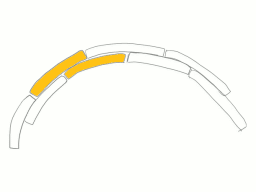
phones1009.gif

Take several banana slide type phones and clip them together as shown (one such phone is highlighted in orange). Insert your face into the arc which is formed and play coordinated moving images on the screens, so that a wraparound visual patchwork is created.

The arc might even be made long enough to encompass the user’s ears, so that a form of surround sound could be generated.

#404: Pink splash

If you are designing a garden ‘water feature’, ie a stream which splashes into a pool, how can it be made to emit the most pleasing noise, for a given flowrate? Some current systems I’ve listened to provide a pretty consistent hiss, most unlike the natural stream or waterfall I suspect they are supposed to be impersonating (actually more like the effluent pipe from some highly efficient industrial process).

One possibility is to use an archimedes screw mechanism. This could most easily take the form of a hose wrapped around the outside of a pipe which would, when rotated axially by a small motor running at constant speed, deliver gouts of water from a reservoir).

ramzi_hashisho_waterfall998.jpg

Using a bank of such screws arranged concentrically (each with a different screw pitch), it would be possible to supply a large number of small dollops and a much smaller number of large dollops -somewhat more like the pink noise which might be expected to emanate from a natural waterfall.