#1219: Segmentyre

Today’s invention is a new form of tyre which can be changed without removing any wheels and jacking up a couple of tonnes of steel.

It is in the form of a number of rubber compartments, each with a metal foot bonded on. These feet are slotted axially into a hub, as show, by slightly deflating the adjacent segments using the valve which each incorporates.

Repressurisation allows the whole tyre to be used rapidly…there is no longer any need to carry a giant spare tyre…a couple of extra segments should suffice.
#1218: CautionMan

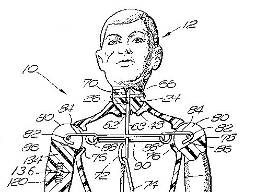
Parents these days are often unhappy about equipping their progeny with ‘war toys.’

I used to love playing with Action Man (or GI Joe as the original patent specified). Today’s invention is a new version of this old favourite with a slightly more moral approach.

This takes the form of a figure fitted with a wii-like accelerometer and a microphone. If the figure is subject to too much noise for too long, some of his joints are automatically loosened (using a battery-powered, geared internal motor which withdraws the screws holding limbs in place).

After a ‘recovery period’, the joint friction is restored by reversal of the motor.

Excessive noise and impacts would result in limbs becoming fully and irrevocably detached, thus illustrating that even legendary warriors are not invulnerable.

A range of scale equipment, specifically aimed at rehabilitating such wounded servicemen, would also be on sale.

#1217: Turner

Abstract paintings can be fun, but let’s not pretend it’s art (ie ‘something designed to communicate an emotional state’). No, it’s decor.

Today’s invention is a picture frame which contains an old-style acoustic burglar alarm, wired to a small motor. The frame can accommodate any abstract work of your choice.

A few random times a day, if the sensor detects that no-one is in the room, the motor rotates the picture quickly through a random multiple of 90degrees, giving the owner more visual variety and an added talking point.

#1216: FeatureFocus

The web is full of sites which provide a shopping function like this, in which a chosen region of a product image can be shown in close-up.

So, the bits people look at can be used as a way to discern what they want to buy. If they pay attention to the fur collar, the zip, the pricetag, that tells you something about their interests. Whether they buy or not, you get a wealth of information about their priorities.

Today’s invention is a tool which simply monitors the close-up window’s placement sequence and spots patterns which enable enhanced product development decisions. If a number of people leave the page without buying, having just seen the details of the leather grain, you know something needs fixing.

The tool would also do some tricks like issuing messages such as ‘was it the [leather]? Maybe look at these items instead…’ It might even be possible to offer realtime, personalised discounts: ‘Maybe it’s not exactly what you were looking for -so how about 5% off?’

#1215: DamnedSpot

Today’s invention is another tool to help improve the handwashing of hospital medics (a New York Times article recently claimed that washing only happens about 1/3 as frequently as training requires).

All medical staff in contact with patients would wear a brightly coloured bracelet. This would contain an aerosol full of harmless, water soluble paint.

The bracelet would also contain a timer which would ensure that a small spot of bright paint was delivered onto the back of a medic’s hand, say every ten minutes throughout the day.

Appearance of the paint would remind wearers to wash their hands at once. Patients could raise an objection if either the bracelet wasn’t worn or there was a spot of paint on the hand of their examiner.

#1214: FallFan

I’m contemplating getting aloft using a paramotor. If the main ‘glider’ (sail-type parachute) fails, one is ordinarily equipped with a reserve chute, but this is of little use at operational flying levels of ~200m.

Today’s invention is therefore a paramotor fan which can tilt from a horizontal axis to a vertical one, when the pilot realises that a crash landing is imminent. It would automatically jettison the glider canopy once the decision to use the motor in this way was made.

Although the fan could never support a pilot’s weight on its own, it could, in an emergency, greatly reduce the rate of descent, especially if driven at an almost self-destructive speed in this last-ditch mode.

#1213: BlowLow

When I see windfarms, several questions occur to me -beyond ‘Do we really think these are a viable energy source?’ Why, for example, is all the gearing and generating equipment located 10m in the air?

Today’s invention is a new form of wind turbine. Two sets of turbine blades rotate about a horizontal axis on top of a column. The outer ends of each set of blades are supported by a bevel-geared ring which bears on a vertical-axis bevel gear wheel near the ground. The blades-and-wheel assembly is free to rotate about this vertical axis in response to changes in wind direction, as usual.

As the wind blows, the gearwheel rotates a generator located conveniently near ground level and protected within the support column (which can be a comparatively low-strength structure). No more swinging the whole affair around in the sky.

#1212: Pulleyman

Today’s invention attempts to overcome the problem of placing baggage items on an overhead location in public transport.

Often I see people struggling to achieve this, either because the bag is too heavy, or they can’t manage to squat and thrust it into place without endangering people sitting below.

A curved shelf section would be installed at frequent intervals along a carriage/compartment/cabin. A cable would run from a catch attached to the shelf to a pulley in the ceiling.

Attaching bags to a hook on the upper end of the cable would allow them to be hoisted aloft and secured there, without causing a safety issue for those seated below. Use of extra pulleys would increase the mechanical advantage available. The slight slope of the shelf would allow the baggage items to descend later under control.

#1211: CrashCall

Today’s invention is a GPS-equipped phone device which is linked to the airbags in one’s car.

In the event that a bag is deployed, a message detailing the location is automatically sent to a preselected list of contacts (including eg the ambulance service, police, next of kin, Twitter, etc).

#1210: Miragebarge

Today’s invention is a way for ships to avoid being seen at sea.

The ship would carry a large mirror held aloft on stalks.

It would also have a large pontoon supporting metal plates heated directly by the ship’s engines.

This arrangement would generate a synthetic mirage -one in which a distant observer would see a patch of sea, rather than the ship itself.