#1396: MealMeld

Fast food seems to be taking over the highstreets of Britain (now that the banks aren’t looking so healthy).

Today’s invention is a fast food delivery service to cater for the large number of people who prefer brand A’s French fries, brand B’s burgers and brand C’s milkshake. They can thus really ‘have it their way’.

A customer could make the request for their cocktail meal on a mobile device and once assembled by a motorcycle delivery rider, with an insulated top box, delivered direct to their location. This would be charged for at a premium on the standard prices of course.

#1395: LegLift

Physical supplies still need to be transported about within office buildings -even if they are networked and increasingly paperless. This can still include paperclips, ink cartridges, cups of coffee, cables, batteries, memory sticks, postit notes…

A small fleet of conventional robot vacuum cleaner-type devices might be employed to fetch and carry -especially in a large, open-plan organisation.

Today’s invention is to equip each desk in an office complex with an ‘intelligent’ leg. This would contain a small elevator capable of interfacing with the floor-going robots and carrying its payload to the physical desktop via its interior shaft.

Supplies could be requested onscreen by a user (or autonomously by eg a printer) and collected by a bot from a central store or vending machine. This would eliminate the white collar crime of stealing office supplies (since the deliveries would all be recorded) and minimise time wasted chatting around the coffee machine or stationery cupboard.

#1394: SoilShield

Today’s invention is a way to provide even softskinned military vehicles with added protection from eg roadside bombs.

Each vehicle would carry several lightweight cages, one for each face. These would be attached to the vehicle via strong frames which would allow the cages to be angled downwards so they each act like the bucket of a bulldozer and are easily filled with earth/rocks by driving the vehicle for a short distance.

Once the vehicle has been driven fast or airlifted to a position of conflict, the cages would be filled rapidly, providing it effectively with several blastwalls behind which its crew could shelter.

On reaching a safer area, or when before making a quick getaway, the cages could be opened and their contents jettisoned in seconds.

#1393: Meshh

Today’s invention is a refinement for noisy, networked office machines.

A device on the network detects when a telephone (mobile or wired) is answered in the vicinity and pauses its activity so that the ensuing conversation won’t be disturbed by the noise of printing, shredding or blowing air.

Similarly, if there are active phones in the room, any ringtones emanating from additional incoming calls will be automatically told to mute themselves somewhat.

#1392: LogiClock

I’ve always had trouble dealing with analogue clocks. Having two hands on a central spindle, both measuring the same thing but at different rates, is just confusing.

Enter today’s invention. This is a clock consisting of two of those ubiquitous electronic clock units, with their minute hands bonded together. The right hand clock rotates in space about the fixed left hand one, once an hour. The left hand clock also carries an hour hand in the usual way.

When you want to know the time, it’s indicated as a sequence. Look at the fixed clock for the minute hand position and then to the moving clock for the hour.

#1391: BraziLoom

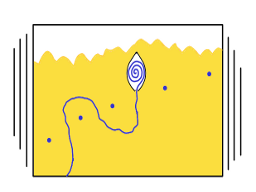
Today’s invention makes use of the Brazil Nut Effect in which a jar containing a range of different-sized nuts will, when agitated (in a gravitational field), end up with the biggest nuts on top

Instead of nuts, we use large beads with a specially streamlined shape, together with spherical small ones.

Each of the large beads contains a reel of thread or tape which unwinds as its bead is propelled upwards relative to the small ones. This results in a thread running vertically downwards beneath each of the large beads on the surface. Turn the container through an angle and repeat the agitation. A new set of parallel threads will form.

Manipulating the container in 3-D can drive the large nuts under and over existing threads, forming a warp and weft structure.

When this is sufficiently dense, the small beads can be allowed to flow out of the container -leaving a self-organised fabric behind.

#1390: JawJar

Today’s invention is a development of the standard, screw-threaded jar.

All sorts of these vessels exist, in a variety of materials. The idea is to engrave onto the helical surface of the container’s screw thread a groove like the surface of an old LP record.

This would be ‘played’ by a corresponding needle set or moulded into the threads of the lid, whenever the jar was being opened.

With the lid shaped to act as a loudspeaker, such a device might issue a brief warning about the misuse of medicine within or to those about to steal one’s milk from the communal fridge. It might simply say ‘Thanks from Pepsico.’

#1389: SupperSpray

We are told that too much salt in the diet is unhealthy.

Today’s invention is to provide salt pre-dissolved in vinegar for use on the dining table. A water spray, of the kind used on plant leaves, would be filled with vinegar and a small amount of salt added in the factory so as to form a solution of known concentration.

This would allow foods, such as fish and chips, to have only limited quantities of salt applied to them (and in a more uniform way than sprinkling separately).

#1388: Gapparent

Lots of sports have the scoring of goals, via some arrangement of posts, as an objective.

Today’s invention is to arrange for the posts in say, soccer, to change size (slowly) according to the distance between goals and posts. The apparent size of the goalmouth, from the perspective of the player currently on the ball, will thus stay constant.

This means that players will try shooting from farther out because a ball kicked from 50 yds away will will be presented with a much greater scoring area than one kicked from 5 yards.

#1387: Skinfriction

if it’s true that wiping one’s hands after washing provides the most effective approach to hygiene, then a lot of those air dryers could be improved upon. One obvious upgrade would be simply to introduce a barrier between the hands so they can’t be rubbed against each other when being dried.

Today’s invention is however an integral washing/drying machine made up of an airblade-like hand dryer suspended above a sink. This would have a single aperture big enough to accommodate the forearms, not just the hands.

People wanting to clean their hands thoroughly would insert them through the dryer’s aperture on the way to the sink below. The skin of the hands would be rubbed by the intense downwards airstream, forcing bacteria to the surface so that they could be washed off more effectively when they reached the sink. People could be encouraged to scrub one hand against the other within the airflow by having the fan activated by this specific movement. Waterflow from the taps could be arranged to occur only after a period of this dry scrubbing.

The hands could then be dried as they are withdrawn, in the usual way.