#2239: SkyStrings

Today’s invention is a massive musical instrument, based on a construction crane.

This would have several cables suspended from trolleys on the main boom.

harp

The cables would have different weights attached, each of which would also incorporate a loudspeaker chamber (red, yellow and blue).

Using a computer to control trolley movements, these could be made to bump into each other, creating some loud chords across the building site.

It would be a challenge to write some popular music for such an instrument.

Failing which, this might be used, when not actually building, as a modern equivalent of a clock tower’s bells, striking the hour.
#2222: WatchTime

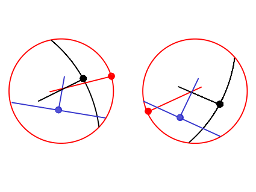
The idea here is to provide people with a digital display watchface on which all of the hands move at the same speed on circular scales with radii differing by factors of sixty.

The red circle and attached hand represent seconds, so that the hand completes one revolution per minute.

equalarcs

The black circle has only a segment visible and its hand moves at the same speed, but represents the passage of minutes.

Similarly, the blue circle and hand represent hours.

As time increases from the left to right hand diagram, so the hands all move clockwise at equal speed and the visible sections of the arcs on which they move are adjusted continuously.

Why would anyone want this? Well it makes the passage of even hours visible (imagine zooming in on the small-scale movement of a conventional hours hand).

#2214: Rotorgan

In a bygone innocent era, children used commonly to attach little flags to the spokes of their bike wheels so that they’d make a clicking noise by contact with the forks as the wheels rotated past them.

Today’s invention is an improvement on that system which could be hacked by anyone with an Arduino microcontroller and a redundant printer.

Spokeharp

This involves attaching a printer arm to one’s front fork (and/or rear frame).

The arm (grey) carries a metal reed (yellow) which plucks the spokes as they pass.

Driving the print head backwards and forwards radially allows a given spoke to impact the reed at a chosen position along its length so that the spoke emits a frequency corresponding to that position.

As the bike moves along, the printer moves the reed to a different position for each oncoming spoke and can thus be used to play a variety of tunes.

Having two such systems fitted to one bike would allow for the simulation of a harp duet.

Thus a cycling club outing becomes a string ensemble performance.

#2195: ChestVest

Body armour is heavy and inconvenient to wear, so that when someone shoots at you, it had better not be on a day when you decided to leave it at home.

Today’s invention is for anyone who has already suffered an injury requiring internal surgery.

ribcage

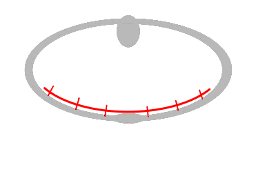
During that process, assuming an individual would be capable of returning to work or active duty, a mail or mesh made of kevlar and ceramic links can be inserted inside the body cavity so that major organs are protected (shown in red).

This would be attached to the inside surface of some ribs, leaving breathing minimally affected.

The mesh, made of biocompatible material, would be flexible enough to allow its folds to slip over one another so that mobility was also unimpaired.

#2182: MindMixers

There has been a lot of work done which indicates that researchers are more effective if they have more opportunities to bump each other serendipitously during the course of the day.

The Applied Maths facility at Cambridge has whiteboards in the toilets and today’s invention aims to promote that kind of always-on thinking.

Academic and research institute corridors tend to be a bit soulless and designed to allow ease of movement.

Imagine therefore a series of half-height barriers, each hinged to one wall and supported by castors. These hinges would be lightly sprung so that in an emergency (or when Prof Hawking is on the move) they would easily be pushed past.

Each of these baffles would offer an opportunity for academics, who may ordinarily avoid eye contact, to pause and say ‘after you’ or at least pause long enough to be reminded that the other person is that Latvian postdoc who wrote the thesis on Xian algebraic spaces.

These small, random social contacts are the kinds of events which seem to promote collaboration (and siting coffee and a pencil on a chain on a few of them would add to the effect).

#2173: ShotShots

Today’s invention is a system intended to make buying drinks in a bar more interesting and less time-consuming.

A group of people would sit at a table with an interactive surface.

When someone wants another drink they type in a pin code and select a drink from a menu which appears beside their glass.

The system knows the exact current position of the glass and authorises one of a number of tubes behind the (unmanned) bar to fire the drink through the air, over the heads of patrons, and into the glass. (Glasses might need to be more like brandy balloons to avoid spillage.)

Given reasonably still air in the room, this could be achieved over distances of perhaps 5m.

Yes, of course some people will move their glasses out of the way and attempt to interpose their mouths.

#2161: TunnelTrain

I just watched the movie entitled ‘Senna’ which left me feeling pretty uncharitable towards any French officialdom. This now extends to the FIA who seem to make all the rules in connection with land speed record setting.

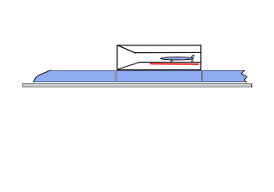
Instead of having to tour the world for a level, flat surface several miles long and so that drivers stand some chance of not being killed, today’s invention is a rolling road for such record attempts.

This would be mounted inside a supersonic wind tunnel, so that the vehicle would experience exactly the same aerodynamic effects as if it were hurtling along a salt flat.

One difference would be that if the car became unstable, and ran off the rollers, a hoist to which the vehicle would be attached using a number of fine carbon fibre cords would stop it crashing off the simulated road surface (red).

The other difference would be that to get an inlet air speed of Mach1+, the fan would be assisted by mounting the tunnel on the back of a bullet train.

These tend to have long, straight, smooth sections of track without too many railway tunnels.

#2150: TweeTV

Not having a TV is something I’d recommend that everyone should at least consider (especially if you live in the UK, where the licensing authorities make the gestapo seem friendly).

The only real downside (since you can always get David Attenborough on DVD) is the issue of being left out of conversations the next day.

Today’s invention attempts to make televison avoidance even better by helping address this remaining issue.

It takes the form of a Twitter feed, one per TV channel, which describes, 140 characters at a time, the highlights, or at least conversation-worthy aspects of, last night’s viewing.

This could be rapidly scanned by those who are free of the addiction on the way to the coffee machine, so that they would have just enough understanding to be included -without having to waste six hours on the required background research.

A better idea would be to have this information appear on the display of the coffee machine or water cooler itself.

#2145: Localaska

As one who prefers eating to making food, I rarely delve into the dark arts of culinary innovation.

Today’s invention represents an exception for those who like eating stuff which has spatially-varying temperature.

A microwave oven doesn’t heat the contents uniformly, which is why they tend to have integral turntables. In fact, the intensity of heating varies from point to point within the oven, so the temperature distribution resembles a patchwork quilt.

Today’s invention is a new, rapid version of Baked Alaska.

A base of eg biscuit crumb mix would have blocks of icecream placed on it where the microwave nodes occur. Then an additional layer of the crumble would be spread on top.

The whole thing would be microwaved on a grid standing above the turntable, so that only the antinodal regions would be heated.

This might also be used to insert other raw stuff inside baked goods…sushi pie anyone?

#2135: Adtomaton

Inspired by this, it occurred to me that a bit more advertising is what the world needs.

Today’s invention is a tower block with computer-controlled sliding window shutters. I’d also like to see the effects of coordinated colour-varying interior lighting when the shutters are open.

These allow low-res moving images of famous brands to be displayed across a huge canvas, in full view of traffic streams -and queues.

The images could be played wrapping around a building, not just on one face.

Residents would need to be paid a cut to tolerate the sharply varying interior light levels.