#1248: BioTick

Some cells divide in correspondence with a circadian rhythm.

Today’s invention is a wristwatch which makes use of this fact. A transparent duct containing suitable cell food substrate on the back face is formed into a spiral. This is lit from beneath to enable photosynthesis in eg cyanobacteria.

A small number of bacterial cells are located at the centre of the spiral. As the bacteria divide throughout the day, and feed on the substrate, they expand along the spiral in a deterministic way, passing gradations marked on the duct wall which indicate the time. The marks could even be spaced linearly by varying locally the width of the spiral track.

The spiral becomes filled over a 24 hour period…at which point, a small defined area of the bug population is scraped into the start section of a fresh spiral and the rest (carefully) discarded.

#1241: iPath

Today’s invention is a toy which works with one’s iPad (remember when everyone thought that was a stupid name?)

The toy is a bristlebot variant which carries an optical switch pointed down at the screen.

As the bot buzzes about and lands on a dark region, it presses the screen causing regions to change their lightness/darkness. If the screen is locally light, the bot buzzes off somewhere else. Thus, the whole thing behaves according to nonlinear feedback (with some visual noise added).

Should be fun to set going in a browser window (with the screen adjusted to high contrast).

#1240: Optomisation

I’ve been reading about how to save a fortune by changing my printer font so as to minimise ink usage.

In this spirit, today’s invention is a printer which presents a small optometrist’s chart on a touch screen control pad.

The user selects the line which contains the smallest readable characters, whilst standing over the machine, and the printer reformats all the pages in the current document to produce printed text which occupies the least space (saving on ink and paper).

For uberzealots, I’d also propose that the printed documents use a hybrid font (in which eg the ‘a’ is the one which uses the least ink from among all fonts, etc.) I suspect this might be a bit like an uneven version of Arial.

#1238: Blink-Ink

3-D is the new 2-D. If you are fed up though with having to wear those cardboard and cellophane specs to watch the latest movie, today’s invention can help.

It consists of a double-ended aerosol filled with organic dye. This is used to spray a small patch of semipermanent red dye on the inside of one eyelid and a small patch of greenish blue dye on the inside of the other.

When you close your eyes in front of a suitably coloured stereo pair of images on a screen which has the illumination ramped way up, you can not only see shapes on the screen through your lids but they will, in addition appear to be 3-dimensional.

This would allow you to watch 3-D movies whilst appearing for example to be asleep (should that ever be necessary).

#1236: WashScreen

Today’s invention is dedicated to Steven Hammer (by way of thanks for his many comments).

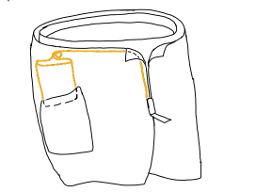
In response to his request for a way to screen trouser pockets for paper tissues, before placing them in the washing machine, it takes the form of inserts which are attached by cables to the trouser zip.

Before the trousers are removed, the zip must be pulled downwards -which in turn extracts the pocket liners.

These would be made of an open-weave mesh so that the trouser pocket contents would be exposed and the liners removed before the washing began.

#1235: FlightDeck

I read recently about how fighter planes are frequently scrambled in response to the use of certain words in transmissions from planes. Words like “bomb” and “hijack”.

The fighters are supposed to deflect an aerial attack by first making rude gestures at some incoming plane, followed after a decent interval, by shooting it down (presumably so that it crashes somewhere less publicity-worthy -ie anywhere that isn’t London).

Today’s invention attempts to avert this disaster. In the event that an airliner was suspected of being used in an attack, a special aircraft would be launched from the nearest airport.

This would be effectively a flying bombproof runway or deck. The deck plane would approach from underneath and behind (invisible from inside the captive aircraft).

It would activate the engine cutoff valves, causing the plane to settle onto the deck and be held in place by clamps on the wings. The captive plane could be boarded by special forces and the combined craft landed somewhere discreet very rapidly.

#1228: StainBrazen

It’s a major pain when a pen in my pocket leaks and ruins my favourite shirt or a glass of Medoc somehow misses my mouth and defaces a much-loved tie.

Today’s invention is a scanner/printer which examines any such stain and decides which shape it most closely resembles in a database of stored items. This would take into account the colour of the stain and the probability of overprinting with a darker colour.

The device then offers the user the chance to overprint the stain with either a one-off ‘logo’ or a repeating pattern based on the modified stain shape. Once a choice of disguise shape has been chosen, the printer applies this in order to obscure the stain and make the item of clothing usable again.

#1217: Turner

Abstract paintings can be fun, but let’s not pretend it’s art (ie ‘something designed to communicate an emotional state’). No, it’s decor.

Today’s invention is a picture frame which contains an old-style acoustic burglar alarm, wired to a small motor. The frame can accommodate any abstract work of your choice.

A few random times a day, if the sensor detects that no-one is in the room, the motor rotates the picture quickly through a random multiple of 90degrees, giving the owner more visual variety and an added talking point.

#1201: Slopetop

Today’s invention is a screen management program which causes software objects (such as folders and documents) placed on a laptop desktop to behave as if subject to physical forces (primarily gravity). This would cause items to slide to the bottom of the screen unless ‘pegged’ in place.

Similarly, ‘paint’ applied to a graphic would drip downscreen in a physically real way.

All of these simulated phenomena would be influenced by the angle of the screen to the horizontal (ie the farther from vertical, the slower the movement).

#1186: Onthefly

In future, when travelling between solar systems, astronauts will need spacestations and other equipment for colonisation and life support.

Rather than attempt to take this stuff with them, at huge cost, space travellers will need to take only a very large tube of adhesive.

Today’s invention is to skirt interstellar dustclouds, harvest this material (over a long time) and then use desktop manufacturing techniques to assemble structural components needed for repairs or landings, as needed, whilst in flight.

The dust might be bonded together into useful material (with locally optimised density and strength) via a combination of home-bought epoxy and pressure moulding processes (using the spacecraft internal pressure vs the vacuum of space).