#1804: SeCuring

If you want to stop someone copying your electromechanical product -and selling it as their own, you could try obtaining a patent in that someone’s country. If you don’t have the cash, consider today’s invention.

Sensors within the machine’s casing would detect any attempt to open internal enclosures that weren’t required for normal maintenance/access. These could be wired to a hidden mobile phone which would alert you as manufacturer.

Rather than generating a ‘cease and desist’ letter, however, these sensors would automatically release a fast-curing epoxy cement within the enclosures.

One component of the resin would be impregnated with metal fibres, so that the device would short itself out before being encased like a fly in amber.

This tactic is reasonably cheap, poses no danger to anyone, but results in a collection of nonfunctioning bricks which is no longer cost effective to reverse-engineer.

Personally, in advance of any of this, I like the idea of having the phone say “This device will self destruct in five seconds…”

#1803: iBrowse

I read an article about ‘whimsical’ texting icons which are now available on the iPhone to help express a greater range of emotions than the normal smileys.

I think these emoji are graphically ghastly. I can’t imagine Jobs letting Apple use them.

Today’s invention is therefore an emoticon upgrade.

Messages of up to 140 characters would have an emotional tone specified (the one in the image is ‘surprised’). This might be automatically extracted from the text itself.

This emotion is used to select an appropriate layout for the words themselves (so that ‘surprise’ will cause some of the words to be arranged in such a way as to indicate raised eyebrows.

#1800: Reflectowers

Corporations place great emphasis on having iconic buildings.

Today’s invention is a tower which, when built beside a body of water, looks like a rippled reflection in a pool.

This effect would be extended to other buildings and street furniture, so that the actual reflections would mirror those simulated by the buildings themselves.

#1795: FormaliTee

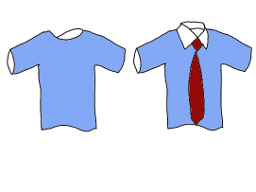
Geeks only ever wear a T shirt, but when some ‘suit’ arrives at their garage or lab, offering vast amounts of investment, they still may want to look briefly businesslike.

Today’s invention therefore is a clip-on collar-and-tie unit which disguises a plain-colour T as a short-sleeved business shirt (using a press-stud to join the collar halves at the back of the neck.

(This might easily be adopted by ironic boffins eager to mock any newly MBA’d managers).

#1791: TrimTime

Today’s invention is a novel beard trimmer.

A wristwatch has hands which have sharp edges. The watch glass has radial slots cut through it.

If you want to trim your beard, press the hair up against the glass, so that some hair pokes through.

Now, activate the separate watch motor, so that the hands race around at 100 times normal speed. The hands thus cut off protruding hair, which can be shaken back out through the gaps.

After use, the watch remembers what the time was and resets itself.

#1788: Glovendor

Today’s invention is a vending machine which will make you a pair of rubber gloves in the shape of the astronaut’s hands which most closely resemble your own.

It seems that NASA astronauts have all had their hands moulded in plaster in order to create their gloves. The range of hand shapes and sizes is surprisingly large.

A customer would approach the machine, insert their hands onto a plate and have them scanned in 2D. The resulting data would allow a pair of gloves to be quickly selected and moulded in latex, using one of the fifty or so pairs of moulds held in each machine.

The name of the astronaut and his or her image would appear on the machine’s screen at the same time as the gloves were dispensed, a few minutes later.

#1785: SweepStalks

Today’s invention is a way to get cylindrical haystacks to roll to one side of the field for collection.

I’d attach a motor and wheel unit by stabbing some prongs at the opposite end from the wheel into the stack.

This would drive the stack along the ground like one of those cottonreel tanks I so loved as a child.

Maybe school teams could be encouraged to develop elastic or solar powered motors and race their designs against each other.

#1782: Crustwich

There has been much talk in the press about the cheapest possible sandwich.

Today’s invention is an alternative to the toast sandwich.

It’s the crust-and-air sandwich.

Cut say two or three crusts off each slice of bread and place them as shown on one lower slice. Butter to taste and add the other slice.

As apparently thick as a regular sandwich but only 66.7% as many calories as the equivalent toast sandwich.

#1761: TimeSaver

All this turning backward and forwards of clocks is insane.

I’m reliably informed by my highly numerate wife that it takes 220 manual rotations to adjust our stove clock.

Today’s invention is a machine incorporating a camera which can look at the indicated time on all such old-world clocks.

Twice a year, it would be attached, using a clamp, to whatever knob is supplied and could thus rotate it, using a small motor, until the correct time is displayed.

#1742: RollingBowling

Today’s invention is inspired by my fellow train traveler, and ardent New Scientist reader, Pete.

In discussion with him today, I mentioned that certain commuter trains transport groups of people who form a book group with in-transit literary analysis.

Given my less erudite mindset, I therefore suggest a bowling alley in a train carriage.

Passengers could, with some allowance made for sudden accelerations, set up either a jack or skittles at one end and fling a ball from one end of the carriage to the other.

This relies of course on the availability of coaches where everyone gets a seat. It would also enable the kinds of conversations about relative velocity, so beloved of Physics textbook authors.