#2138: ChainChange

Today’s invention is a bike chain which acts as its own simple gearing mechanism.

Imagine two conventional, fixed-size sprockets, one attached to the pedals and one to the rear wheel hub.

The chain connecting these has links which are sprung so that they would naturally compress together into a shape like vvvvv rather than – – – – – – (Shown at the top in yellow).

As the pedal wheel rotates, two C-shaped diverters are moved in and out independently. Moving in flattens the vvvvv shape into – – – – – – around one or both of the sprockets.

This change in radius provides four gear ratios, as indicated, without needing any kind of derailleur mechanism (beyond the small, sprung tensioner wheel shown).
#2137: Minimirror

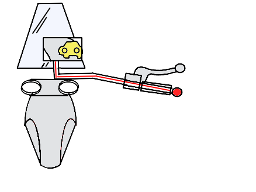
Today’s invention is a new mirror for motorcycles, or even bicycles.

It’s really essential that vulnerable road users are aware of what is bearing down on them from behind. I myself would be a stain on a Northern road had it not been for remembering to look over my right shoulder.

So, rather than use the standard drag-inducing mirror, located somewhere that requires you to take your eyes off the road, imagine a fish eye camera lens placed at the end of one’s handlebar (red).

The camera is connected, via an optical fibre bundle, running within the handlebar, to a small screen behind the windshield.

This makes any movement behind a two-wheeler immediately apparent -without the usual ‘messerschmitt-twitch’.

#2136: Ejectavator

The Otis Elevator Company…claims that its products carry the equivalent of the world’s population every five days.

This astonishing fact was gleaned here and sparked yet another idea about lifts (or elevators, if you must).

Buildings are being built to heights where cables can’t be used to support cars which travel from bottom to top: you have to swap lifts.

This has implications for safety in the event of a fire. People may find that a fire is below them and their escape is blocked…even when trying to use the stairs.

Today’s invention is therefore an ejector lift. If an inferno is raging at a lower level in a tower, a number of special reserve cars would descend from near the roof level.

These would collect people and also have many trailing harnesses to which occupants could secure themselves to a lift.

These emergency lifts would move upwards in the shaft each inflating a helium balloon above as they went.

At roof level, the drive gear would swivel out of the way, allowing a train of cars as well as the externally-harnessed passengers to ascend safely into the sky.

Each car could then drop an anchor at a safe distance and be winched to the ground.

#2133: Shelfbuilder

People often need tall buildings where cranes can be hard to find.

Today’s invention is a building which is built by its own lift.

The lift and structural steelwork would arrive in several containers.

Then the lift itself would be fitted with a powerful motor, so that it could raise balanced sections of framework. It would then secure these and be able to move out onto the cantilevered floors to winch up additional components.

The lift shaft would be extended upwards, so that more and more floors could be added.

Eventually the lift would remain, working within the finished building.

#2128: SofTank

Military tanks have traditionally been very heavily armoured and therefore limited to a maximum speed of about 35mph.

Today’s invention is a tank which is soft-skinned and thus light enough to move very fast and not require enormous tracks.

Instead of an overall coat of plating, the main gun carries a multi-layer composite shield.

Sensors on the vehicle detect incoming missiles (as currently happens with systems like this) and direct the gun turret to spin around so that the shield can be powered outwards along the barrel in time to act as an offset-detonation ‘skirt’.

This movement might best be generated by using railgun-type magnetic coils attached to the outside of the barrel.

The turret might accommodate two barrels and shields in order to provide better coverage for the entire vehicle.

#2127: HeelHound

I’ve always had a fondness for robotic dogs ever since Sony brought out Aibo.

On a larger scale, Boston Dynamics have created a cross-country pack robot called Big Dog

It manages to cross very rough terrain indeed, all by itself. Today’s invention would allow machines like this to move even more rapidly when following in the footsteps of a human being.

People can run across rough ground using their springy legs and a rapid reaction time (think fell running). Big Dog could achieve a similar performance by spending less time planning each step.

Instead, on very unstable surfaces, the robot would attempt to step on the footprints of someone it was following.

A particular ‘handler’ would attach a labeled, reflective badge to the rear of each boot. These would be detected by a dedicated camera on board the machine in order to indicate appropriate foot placement positions, milliseconds after the human had moved on.

#2126: Autower

Car parking is often hard to find.

Today’s invention is to change car design to help alleviate this problem.

Cars would be made in a semicircular shape with a ‘bite’ taken out as shown.

The bite would have funicular type drive wheels embedded which would engage with a rack on the back of another vehicle.

This would allow cars to form a tower which could then bend over (under computer control) to pick up others in the same way.

The effect would be to greatly reduce the amount of parking space needed.

The cars could also be constructed so that they allowed movement from one to the other when a tower had formed. In this way, instant, flexible office space could be made from commuter transport.

#2125: SkyStack

There is significant pressure both to create new airports and not to destroy huge acreages of land.

Today’s invention suggests an alternative approach.

A cylindrical tower acts as terminal building. Each section of the cylinder has a large runway platform cantilevered off it. The sections are powered and can rotate to optimise wind direction for landing etc.

This allows large numbers of planes to land and take off simultaneously in different directions, whilst passengers are transported by lifts up and down the inside of the tower.

It would reduce the amount of waiting enormously and thus lower the costs of air transport.

#2123: GustDusting

Today’s invention removes the need for crop spraying aircraft.

Instead, wind turbines placed on the edges of fields would each be fitted with a trough at the base.

When the wind is blowing in the right direction across the fields, the turbine turns in the usual way.

As each blade passes through the trough, it scrapes out a small amount of eg powdered insecticide and this is then dispersed, by the turbulent downstream flow, across the crops.

The particulate matter would be retained within the turbulent boundary layer, so that its distribution could be made reasonably uniform.

#2122: Aerofloats

Today’s invention is a seaplane with floats that can rotate (and detach).

The left image shows the normal flying configuration, seen from below.

The right hand image shows the floats rotated to act as extra wings and thus give added lift in mountainous regions.

The middle image shows one float rotated to support the plane, whilst parked on the water.

The other float can then be removed to act as a canoe…or even a minisub.