#2121: PlastiCalibre

There is a lot of rather overheated language being used in connection with a small group of nutters who claim to be able to make firearms using 3D, desktop printers.

First, I’d be surprised if even a very high-spec machine is capable of making a single-shot weapon that would work.

Even if that were possible, printing ammunition would be very difficult.

Why would anyone even bother, when you can buy a shotgun for a few dollars in many US states?

Today’s invention is for those who really think that home-printed guns are some kind of serious problem.

Since low-cost ammunition only comes in a very small number of diameters, each printer should contain, as embedded code, a routine which detects the design of a cylinder with one of these dimensions.

This would cause the machine not to accept any such design file for printing…or better yet, create the desired hardware using a slightly smaller diameter, making any kind of ballistic use impossible.

#2119: SheathBike

I’ve written before about bikes designed to break the land speed record.

Today’s invention is an alternative outer skin for one such machine.

Rather than worry about making a rigid monocoque, this surface consists of a translucent rubber sheath which is stretched over the bike and rider as shown.

It is held off the wheels by some guards shown in red, so that the best possible combination of small cross section, drag reducing tapering, minimised weight and rider movement is achieved.

The rider can also see enough to be able to steer without needing any windows.

#2117: FaceSafe

People buy guns primarily for home defence but they often end up being discharged accidentally and injuring the owner’s own family members.

There is also the danger that a burglar, confronted by a firearm, might get control of the weapon and shoot his way out.

Today’s invention is to fit domestic firearms with a small camera running face recognition software. This is now actually very reliable when asked to find the faces of only a small number of individuals.

It would therefore be trained to detect all one’s family members and used to control the safety catch on one’s home gun.

If this device was pointed at any of the designated people, then the safety would remain firmly on, avoiding some possible tragic consequences.

#2116: BladeBrake

I’m interested to read that even the best bicycle locks are all still vulnerable to attack by angle grinders or disc cutters.

Today’s invention aims to decrease that problem.

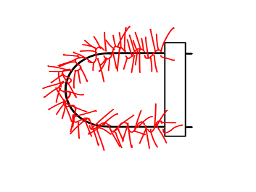
It takes the form of a steel spring which can be slipped over the U section of a bike lock, before it is closed around a bike.

The spring has a ‘beard’ consisting of numerous stainless steel wires and kevlar fibres. These are designed to obstruct access to the U section.

More importantly, they act as the fibres in chainsaw-proof clothing do, so that when a rotary cutter blade presses onto the lock, many fibres snag on the cutting edge and wrap themselves around its spindle (and also clog any safety guards). Fibre-loops would probably work best in terms of entangling with the disc.

This jamming makes cutting through the lock significantly more time-consuming.

When cycling, the ‘beard’ can be carried either in situ around the lock or pressed axially inside a tube (like the trunk of an artificial Christmas tree).

#2112: Cementrack

Over time, railway tracks that once had their sleepers firmly fixed to the ground flex, compress the underlying gravel and develop gaps underneath.

This causes damage to the tracks and increased noise and vibration for the passengers.

Today’s invention is a simple system which could be fitted to a large number of trains.

As a rail vehicle passes over a high-amplitude gap between sleeper and ground, the exact location is recorded.

This allows a later carriage of the same train or even a different one to squirt a pool of liquid cement beneath the sleeper in question.

When this solidifies within the gravel and under the sleeper, the vertical movement is reduced to zero.

#2110: StandSuit

Today’s invention is an alternative movement support system for people who might otherwise be in a wheelchair.

A carbon fibre vessel, shaped to closely fit the body contours of an individual, is mounted on a wheeled electric cart.

The vessel contains just enough water to cause the occupant to float.

This arrangement removes stress points from the person’s body, improving circulation whilst also allowing them to maintain eye contact with other people.

The small volume of water involved makes this system still highly mobile.

#2109: Animatime

Even the few people left in the world who can hand-make a watch tend to use some kind of a CAD system to design the works.

Today’s invention offers a new way to tell the time, based on this fact.

Consider watches with reasonably large processors and nice screens on board (such as those based on the iPod nano).

Each of these could run a cut down CAD model of a particular classic mechanical watch movement (see the drawing here).

This might not include the dynamics but would just show all the components articulating in the correct ways and driving simulated hands to indicate the time (with electronic, rather than mechanical precision).

The various parts in the model could also be made to display with varying translucency, so that the interactions within the watch would all be visible.

#2106: EverEdge

Today’s invention is a sharpening steel for penknives.

As you put your main knife blade away, you engage a boss on the fold-out steel with a slot in the blade itself.

On opening the blade next time, the blade drags the steel along the length of its cutting edge and then releases the boss.

(The steel would need to have its sharpening facets manufactured so that their direction varied along the length and were thus always at the optimal angle to the blade’s edge).

#2105: Powerachute

I’ve seen plenty of videos which seem to show ordinary quadricopters comfortably transporting a mass of 1kg.

That set me thinking about a new kind of parachute.

Let’s assume that battery weight takes up say 90% of that 1kg.

Wire together 1000 or so individual quad rotors into a dome shape, like a parachute.

As a jumper falls, each of these spins, acts as a dynamo and stores energy in a central battery.

Near the ground, the dynamos switch to being motors and the battery drives them so as to break the parachutist’s fall.

#2100: BlowBlink

Today’s invention is a small fan which can be fired up to ensure that raindrops or dust particles can never land on a camera lens whilst it is being used under environmentally challenging circumstances.

The fan speed would be set up so that the biggest, fastest everyday particle would be deflected away from the glassware.

This would probably require the airflow to be directed outwards along an annular tube centred on the camera lens axis.

Normally, such a flow would cause horrible vibrations and result in image blurring, but the fan motor would be controlled so as to blast out a burst of air and then stop when the shutter was actually open.

A cleverer variant on this would use the flash to illuminate oncoming particles and apply real-tme image processing to allow the air stream to change strength according to their size, direction and speed. The lens cover could be deployed automatically if the system sensed imminent damage.

Another development might involve actively heating the fan output in order to create artistic, heat-haze effects in the image.