#2423: GazeGlaze

Cars should ideally have wraparound windows that provide a complete 360-degrees of visibility for the driver.

Unfortunately, vehicles tend to need extra strength to protect the occupants -hence the glass windows will be interrupted by steel (or carbon fibre) pillars.

visipillar

Even the narrowest structural members can occlude or disguise significant moving objects, such as farm animals, cyclists or motorbikes.

Today’s invention is roof pillars for cars which take a leaf out of the civil engineers’ handbook.

Pillars with circular apertures and external glazing could not only look good and retain strength but provide enough extra peripheral visual information to allow a driver to spot an approaching cyclist in time to brake and thus avoid a collision.
#2422: Carmour

Racing drivers wear helmets and fire resistant overalls, but it’s all a bit 1950s (Stirling Moss used to wear a cork polo helmet, with only limited success).

Today’s invention is a suit of armour for racing drivers made of carbon fibre and fitted with a cooling system, just as spacesuits are.

canon-senna-mansell-1710630-h bigtallguy

Every driver in eg F1 would have a custom-fitted suit, so that no team would have an advantage.

The main benefit would be that in a collision, legs and internal organs would be much less likely to be crushed.

The armour might come equipped with lugs to which a winch could be clipped to extract a driver from eg a burning vehicle much more rapidly. It could also have monitors embedded within it so that a driver’s in-race health could be more closely assessed via telemetry.

#2420: PinPrints

I reckon I can touch a flat surface with about three different, reproducable levels of pressure (‘resting on’, ‘positive contact’ and ‘pressing hard’, say).

Touchscreens are usually not directly sensitive to pressure level, but almost all of them should be capable of differentiating between these three conditions (even if only by virtue of their different optical effects).

pinpress

Today’s invention is a way to identify yourself via a touchscreen.

Your new, ten-digit pin code consists of a pattern of different levels of pressure when in contact simultaneously with a screen. This gives a total number of ~59k different codes (ie >>10^4, as commonly used with keypads).

It might take a bit of practice, but once burned into motor memory, this would be super quick and impossible to shoulder-surf.

#2417: Spiraluggage

Today’s invention is a suitcase on wheels which packs clothing more tightly than normal, yet with fewer creases.

Once the top is opened, the handle on this case can be pulled upwards, bringing with it several coathangers.

rollercase

Items of clothing, eg suits, can be hung on each hanger and then a thumbwheel twisted to pull the clothes down into a snailshell compartment, of which there are several.

This rolls the clothes up tightly, minimising their volume but without crumpling them.

#2414: DataMaze

A conventional optical disk always spins in one direction, whilst the laser read head moves radially across its surface -following the spiral path on which the recorded micro-depressions have been laid.

This movement is essentially the same for all disks.

file0001110988167

Today’s invention is a way to make piracy of digital content much more difficult (albeit with a small increase in production time/cost).

My DVD player would come with the facility to generate a unique, 2-D read head motion program embedded securely within it -a new one for every disk. The spinning would continue as normal.

My machine is networked to the manufacturer and sends them a code from which they derive the required read pattern and use that to imprint my movie’s bits (together with an identifier which allows my machine to use the right internal movement pattern when reading it).

I can thus buy a DVD online which will be printed with exactly the same bit stream as yours…except that my bits will be laid out in a pattern which only my machine can read.

I can make you a copy of my disk, but it won’t play in your machine.

#2413: HelterShelter

I’m told that fire appliance ladders can’t reach higher than the sixth floor of a burning building.

For people caught in a skyscraper or towerblock at higher altitudes than this, today’s invention could be a lifesaver.

skeltershelter

The ladder is fitted, whilst at ground level, with a giant steel loop supporting a ‘stocking’ made of stretchable fabric.

People can jump into this, as they would a conventional ‘trampoline’ supported by firefighters. The difference is that they have less distance over which to build up speed and when hitting the stocking surface, the deceleration is much more gradual.

Many people can jump into this device at once without much danger of hitting each other. Each of them then slides down a narrow central tube of the same material, at an approximately constant speed, to emerge safely at ground level.

#2410: Barnacladding

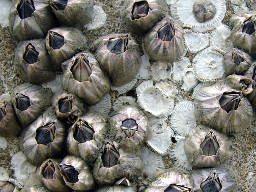
Everyone knows that barnacles are bad for boats…they increase drag and may actually damage the underlying hull surface itself.

The shells of these creatures are incredibly tough and impact resistant. Today’s invention is a way to make use of barnacles as a natural protective coating.

barnacladding

Imagine a diving suit for people who have to work in shark-infested waters. This could have barnacle shells epoxied to its outer surface, away from the inner sides of elbow and knee joints.

If attacked, these relatively light shells would act as effectve armour…allowing a diver enough time to retreat to a cage.

#2408: PistolPicker

Today’s invention is a magazine for firearms which allows the user to choose the kind of round to fire next (ie blank, high-charge,tracer, rubber etc).

The magazine would be filled with a number of different types of round, in order.

PistolPicker

It would have a spring at either end, so that as rounds were extracted and fired, as usual, the remaining ones would be available to choose, by moving the magazine up or down. This movement could be controlled manually or motorised in response to a switcahable safety catch indicating which type to select.

This offers the possibility that eg a police officer could, without stopping to swap ammunition clips, choose to fire a warning shot or a rubber bullet, rather than have only lethal projectiles to fire.

#2407: Pillowheel

I’ve always admired this invention: the exhaust-inflated tyre change balloon -but you don’t see many of them in use at the side of the road.

Maybe it’s not that great an idea to run your engine with a restricted exhaust?

pillowheel

Anyway, today’s invention is an adaptation of the above idea but which doesn’t actually require the car owner to do any tyre changing.

The balloon device would be smaller than is normally required to remove wheels.

It would be inflated under the vehicle as usual but only raise it enough to lift the flat tyre off the ground -and then be sealed.

The balloon would have a set of small, ultra-tough castors on the underside. These would be able to turn under radio control, so that as you turn the steering wheel, the castors would help steer.

This system would allow a car to be driven home at low speed, so that anyone who was unable to change a wheel could still get back to base without waiting two hours for roadside assistance.

#2405: Asturnaut

I watched a video today about donning a hard-shell spacesuit and realised that there are some upgrades that might be possible.

Today’s invention is the first of these.

everystockphoto-nasa-space-239201-l

Since an astronaut has to move his or her whole torso to look to the side, why not equip the helmet seal with the ability to rotate?

This turns the helmet into a kind of tank cupola which would be driven by a small motor to the left or right.

An arrangement like this might best be effected by having an optical sensor detect and respond to movements of dye spots applied to the wearer’s face.