#2263: Stressearch

When I’m trying to recall a name or fill in a crossword clue, I often find myself knowing the correct stress pattern without being able to remember the exact word(s).

For example, I spent a week last year trying to recall the name of the actor who played ‘The Joker’ most recently. His name was ‘blah blah-blah’, with his first name beginning with H…maybe.

marcin_krawczyk_invention

Today’s invention is a dictionary plug-in which helps with this kind of tip of the tongue memory recall.

Since online dictionaries usually contain both phoneme and stress pattern information (eg ‘Definition’ ?def-?-?nish-?n ), a user would be able to narrow his search for a word or phrase by specifying the pattern of stresses in such a nebulous memory trace eg blah-blah, blah-blah-blah.

This would be particularly useful to poets who often search for a particular sound pattern with an appropriate meaning, I’m told. It would also have helped when I was trying recently to remember the names of the early North American explorers, blah-blah and Clark.

I find it interesting that we seem to store such a rhythmic representation, but that the link to the specific sounds is harder to make.

#2261: Poutrageous

Today’s invention is a double-ended lipstick.

Each end would have a different shade, so that wearers could experiment with various combinations of colour on the top and bottom lips.

Jenny_Rollo_lips

Not only would this be visually striking, but for a more subtle effect, you could wear a lighter version of the lower-lip colour on the upper lip (to compensate for the natural shading there).

#2260: Wastepanes

Public spaces contain fewer rubbish bins than ever before (partly because of the perceived need to deny terrorists receptacles in which to hide bombs).

This has led to a phenomenon called Litterplugs, in which people without access to bins find a convenient crevice and shove their litter there.

trashslice

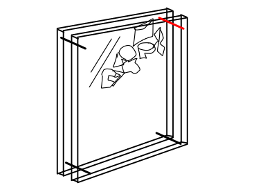
Today’s invention exploits this tendency by providing locations into which people can cram their refuse legitimately. They would shove eg crisp packets, crushed drinks cans, etc into the top of a gap between two plexiglass screens mounted on a wall.

This would allow inspection of the contents and when full, could be easily cleaned out by allowing one sheet to rotate about one corner fixing (red), dumping the contents into a larger, mobile waste bin.

#2259: Globeglass

It’s cool that Google have mapped the night sky.

This set me thinking that it might be really nice to create a cellphone app which allows the user to point his mobile device at the ground and see a simulation of whatever part of the world is beneath him (In the same way that fighter pilots can see through the floor of their planes, when wearing the latest helmets).

Evan_Earwicker_paperweight

Scanning this backwards and forwards would show a number of spatially-arrayed labels, located on the outer, transparent surface of a simulated sphere (The onboard cellphone gyro could be used to calculate the required angles).

The labels could be set to show famous landmarks or the hometowns of emigrant relatives etc.

#2257: Serialabel

I’m told that ‘bingewatching’ of eg an entire TV series over a single weekend is a growing social phenomenon.

For those of us who are slightly less media obsessive, viewing an episode every now and then, via the now ancient DVD technology, can be deeply frustrating.

episodes

Consider, for example, the infamous boxed set. Although most players will have a ‘last time played’ memory function, this isn’t much help if you can’t remember which disc you are on.

Today’s invention is a simple labelling for discs which allows anyone to record where they stopped last time.

Discs would have episode numbers printed on them in the form of a clock face. When you put the disc away, simply leave it rotated to the ‘last episode watched’ marker, inscribed on the case.

If you live in a household with several independent viewers, one way to avoid who-watched-what-last? warfare would be to have cases come with a number of thin, disc-shaped sheets. These could be made in different diameters, centred on the hub, so that several people could record their separate histories (which might require a notch in the disc itself to ensure that it was always replaced at the same rotational position, relative to the box).

(Who am I kidding? I really want a boxed set which loads directly into a reader, box and all, and which gives no acccess to any of the disks, so that they can’t be lost, scratched etc.)

#2253: SpaceSheet

Astronauts, I’m told, have real difficulty in adapting to sleeping in space.

Microgravity means that they need to strap themselves in and often find their arms floating freely when they wake up.

fluxbed

Today’s invention is a blanket for astronauts which has a matrix of small but strong magnets embedded in its outer surface.

These are attracted to a steel bedboard so that the astronaut can feel some simulated blanket weight and thus fall asleep more easily.

Weaker magnets embedded in velcro straps would provide similar restraints for the hands.

#2249: Y-knot

Tangled earbud cords are a pain and I’ve suggested several remedies before.

Today’s invention is another. It takes the form of a very thin, Y-shaped balloon to which the cables would be bonded.

blowbuds

When you extract your tangled cables from your pocket, to greatly lessen the untangling problem, simply blow in the open end of the Y balloon and the internal pressure will fix everything except tight knots.

#2248: Oscillasign

It is rather amazing that the human visual system is hyper-sensitive to motion and yet can still read text which is moving about randomly.

As urban areas become a forest of roadsigns, today’s invention makes use of our motion detectors to help drivers pay attention to high priority signs.

buzzsign

Roadsigns which were deemed particularly important would be mounted on stiff springs.

As traffic passed and breezes blew, these signs would oscillate enough to boost attendance to them but not so much as to impair recognition of their content.

It’s only a matter of time before the advertising industry takes advantage of this idea.

#2246: Burstoroid

A burst tyre is something to be avoided. In particular a tyre which shreds when an aircraft lands or a lorry passes over some sharp ironwork can have catastrophic consequences.

Today’s invention is therefore a simple backup.

backupwheel

A vehicle with many wheels would have some subset of its tyres constructed in the following way.

These tyres would have a solid inner tyre moulded into them during manufacture.

When the outer rubber surface is damaged and deflation occurs, this inner tyre would contact the ground as the outer fragments were torn away.

This would allow control to be maintained until the vehicle could be brought to a stop.

Although this would add a small weight penalty, the improvement in safety would be significant.

#2243: SledHeads

Athletes in the various bobsled events go to enormous lengths to achieve greater speed.

Today’s invention is a new form of helmet attachment.

sledheads

The pilot would have a (yellow) biconcave spacer attached to his helmet.

Similar fitments would be applied to the pushers in eg a four-man bob.

The brakeman would have a tapering helmet attachment as shown (blue).

This would allow a crew to press their heads together during a run and thus greatly smooth their combined aerodynamic profile.